
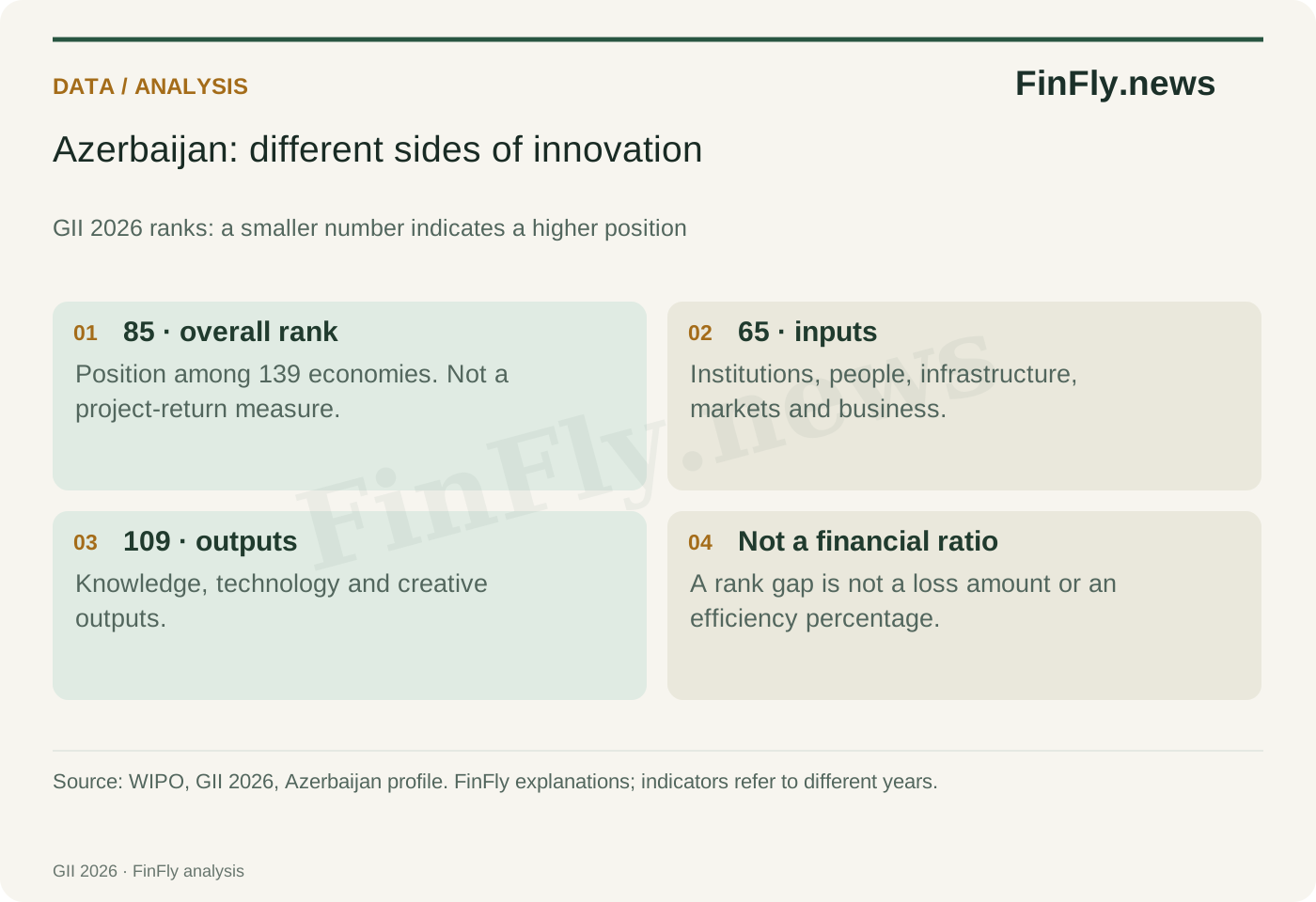
Azerbaijan occupies two different positions within the same innovation economy. It ranks 65th for the resources and conditions intended to support new products, but 109th for measured innovation outputs. That difference, rather than its overall position of 85th alone, makes the Global Innovation Index 2026 country profile useful to businesses.
The World Intellectual Property Organization’s index covers 139 economies. It does not measure the profitability of an individual startup or the quality of a particular research project. It does, however, reveal an uneven national system: relatively favourable conditions in selected areas coexist with weaker outcomes in knowledge diffusion and technology exports.
Resources are not revenue
The GII input sub-index combines institutions, human capital and research, infrastructure, market sophistication and business sophistication. The output sub-index covers knowledge and technology outputs and creative outputs. These are composite measures, not accounts of money invested and money earned.
The difference between 65th and 109th therefore cannot be described as a 44% efficiency loss or a quantified revenue shortfall. Rankings locate an economy relative to others. They establish neither the size of a loss nor a causal relationship. Their practical implication is more modest: improvements in enabling conditions should be tested against the emergence of products that customers actually want.
Strengths and weaknesses coexist
Azerbaijan ranks 36th for institutions and 63rd for market sophistication. It places 89th for human capital and research, 87th for infrastructure and 91st for business sophistication. Knowledge and technology outputs rank 100th, while creative outputs rank 110th.
Even the relatively strong institutions pillar is not uniform. Its business-environment sub-pillar ranks fourth, while the rule-of-law indicator ranks 91st. Some measures rely on surveys. For an entrepreneur, that variation matters more than an undifferentiated positive or negative verdict: access to support and confidence in contractual enforcement are different business conditions.
On the output side, the profile places Azerbaijan 121st for high-tech exports relative to total trade and 113th for ICT services exports. These ratios are influenced by their denominator: substantial commodity trade can reduce the relative weight of technology flows. Absolute values and consistent time series are also needed to assess an industry’s development.
Several transitions separate research from a market
The report’s thematic chapter examines barriers facing science-based ventures: proof of performance, access to testing facilities, certification, rights to the technology and the first customer. Having a laboratory does not replace an industrial pilot. Funding a pilot does not guarantee a repeat order.
For Azerbaijan, this offers a diagnostic framework rather than an established explanation for every weak indicator. A project that stalls before testing may need technical infrastructure. A project that passes its tests but cannot secure purchases may receive another research grant without resolving its demand problem.
FinFly’s interpretation is that support should be evaluated through transitions between stages. How many technologies pass independent validation? How many secure a paid pilot? How many buyers place another order? These are different events, and combining them into a single count of supported projects conceals commercial risk.
Which outcomes should count?
For a research team, a key milestone may be a working prototype with clear rights. For a company, it may be a deployment that the customer pays for without continuing subsidy. For the state, it may be durable local operations, skilled employment and export earnings. Success on one measure does not establish success on all the others.
Not every research project should generate immediate profit. Basic science produces knowledge whose value can emerge much later. Imposing a short revenue deadline on every laboratory could undermine that foundation. The appropriate distinction is between a research mission and a commercialization programme, rather than between immediate sales and failure.
The GII methodology also warns that the 2026 edition uses observations from different years, and that changes in rank reflect indicator coverage and data availability as well as performance. A new centre or support measure will not necessarily appear immediately in the index. A more substantive benchmark is sustained improvement in verified project outcomes. That is what will show whether enabling conditions are becoming a functioning innovation economy.