
A startup can receive a grant, assemble a working prototype and impress investors while still lacking a business. Between technical success and durable revenue sits a buyer willing to adopt the solution and pay for it. For science-based ventures, that transition can be harder than the demonstration itself.
In Global Innovation Index 2026, WIPO identifies demand uncertainty as a distinct commercialization barrier. A functioning technology does not guarantee a first customer, and interest in a pilot does not guarantee repeat orders. For Azerbaijan, this offers a useful way to evaluate startup support: count not only developments created, but also what happens after testing.
A grant finances the opportunity to test an idea
Research funding allows work whose outcome is not known in advance. It can be justified even when no commercial product emerges. Grants and revenue have different functions: the former reduce the cost of exploration and experimentation; the latter establish that a buyer receives value on specified terms.
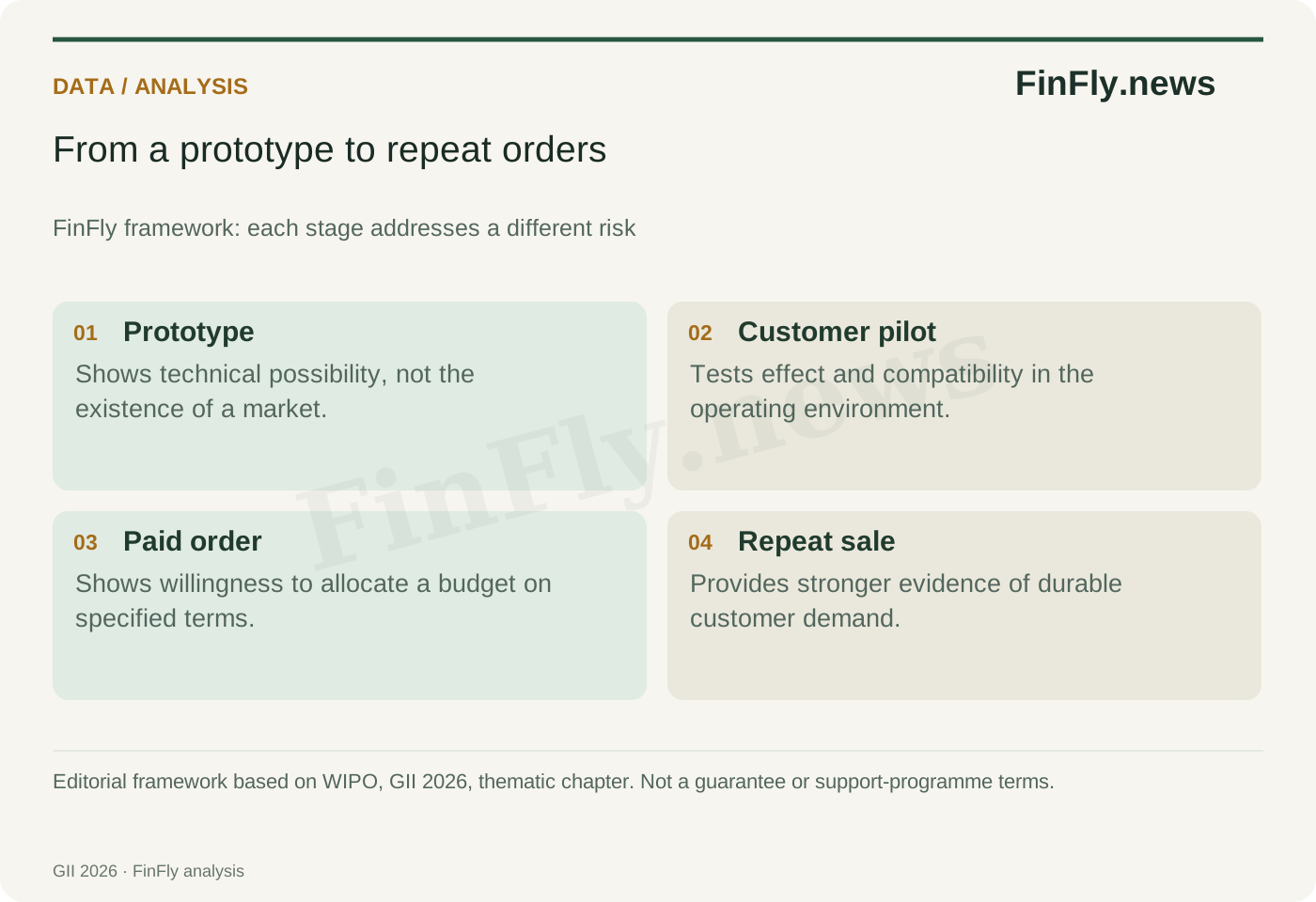
The mistake is to equate completion of a funded project with market entry. A prototype demonstrates technical possibility. A free pilot produces evidence about use. A paid pilot adds willingness to allocate a budget, but does not yet establish repeatable sales. A repeat order indicates a further, stronger level of adoption.
The buyer assesses more than the technology
For an established company, a new solution brings risks: compatibility with existing systems, staff training, supplier reliability and responsibility for failures. Even potential savings may not justify immediate adoption if measurement has not been agreed or the transition could interrupt core operations.
Consider an illustrative case, not a reported Azerbaijani project: a company offers an industrial customer a sensor intended to reduce energy consumption. Laboratory accuracy matters, but purchase decisions require evidence from the factory. The device’s contribution needs to be separated from changes in production load, weather and equipment settings. Otherwise the promised saving remains an untested explanation.
FinFly’s practical conclusion is that a useful pilot starts with the decision it is meant to inform. The parties establish a baseline, measurable effect, testing period, acceptable risks and full cost of use. This is an editorial evaluation framework, not a universal contract template.
The first customer can reduce investment risk
A customer supplies more than money. It specifies requirements, offers a testing environment and demonstrates which problem it will pay to solve. For an investor, this can reduce market uncertainty. A letter of intent, a paid experiment and a commitment to repeated deliveries nevertheless carry different economic weight.
Even a signed contract must be assessed through its volume, timing, acceptance criteria and termination provisions. Preliminary interest is not a guaranteed cash flow. Incorporating the entire stated value of a potential order into a revenue forecast without examining obligations would therefore be risky.
Demand support needs competitive safeguards
WIPO’s recommendations discuss procurement based on functional outcomes and first-buyer mechanisms. The principle is to define the problem while leaving room for different technical approaches. This is an international policy direction, not a claim that a particular procedure is available to every Azerbaijani startup.
The approach carries risks of its own. Supporting one supplier can create customer lock-in, and a paid pilot can become an indefinite demonstration. Transparent criteria, verifiable outcomes and opportunities to compare solutions are needed. Applying such a model to public procurement would require a separate examination of local law; the report does not replace that work.
What to measure after a programme ends
A useful ecosystem scorecard follows a sequence: projects reaching customer tests, projects receiving payment, projects obtaining repeat orders, and firms selling to independent buyers. Support costs and time between milestones matter too. One large contract can be valuable without establishing a scalable sales model.
Neither a government purchase nor a corporate pilot guarantees commercial success. Their value lies in reducing a particular uncertainty. The main question for innovation support in Azerbaijan is therefore not simply how many startups received money, but which risks the money helped resolve. When a grant is followed by a returning customer rather than merely another grant application, a technical development gains a better chance of becoming a durable business.