
The State Statistics Committee of Azerbaijan reports that the average accrued monthly wage for January–July 2026 was 1,176.7 manats, up 7.2% compared with the same period of 2025. In August 2026, prices for food, alcoholic beverages and tobacco rose by 7.2% compared with August 2025. The two identical figures describe different periods and different bases, so their coincidence is not proof that real growth has been wiped out, but a reason to look more closely at the structure of spending.
What exactly the matching 7.2% shows
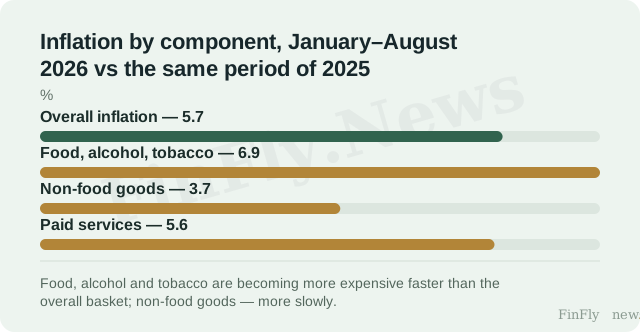
The average nominal wage is an accrued amount, not a median and not a take-home sum; taxes and deductions are not reflected in it. The 7.2% growth refers to the cumulative period January–July 2026 versus January–July 2025. Food inflation of 7.2% is August 2026 versus August 2025, that is, a single month, not a cumulative figure. Overall inflation for January–August 2026 was 5.7%, non-food goods — 3.7%, paid services — 5.6%.
The gap within inflation itself matters more than the coincidence of the two figures. Food, alcohol and tobacco are becoming more expensive faster than the overall basket, while non-food goods are rising noticeably more slowly. For a worker whose spending is skewed toward food products, the 7.2% nominal growth benchmark is closer to the boundary than for someone whose basket is closer to the average. But the average wage does not describe the distribution: it may conceal a gap between industries and sectors.
Where this becomes a business decision
As of 1 August 2026, the country had 1,781.1 thousand employed workers: 836.9 thousand in the public sector and 944.2 thousand in the non-public sector. This is a point-in-time snapshot, not an average for the period, and it is not broken down by pay levels. If a company is planning indexation or hiring in a segment oriented toward food spending, it is useful for it to compare its payroll not with the average wage in the country, but with the price dynamics of precisely those categories that shape its workers' spending.
The practical conclusion is not a recommendation to change the budget, but a decision boundary. Nominal wage growth by itself does not say anything about purchasing power: that requires inflation, taxes and sectoral differences. If food inflation steadily holds near the nominal growth of pay, pressure on real incomes in the relevant segment persists; if it slows, the picture will change without any change in nominal rates. This can only be checked on comparable periods.
The coincidence of 7.2% is not a conclusion that real growth has disappeared, but a signal about structure. Nominal wages are growing by 7.2% in cumulative terms, food prices — by 7.2% in annual monthly comparison, overall inflation — by 5.7%. As long as the periods and bases do not coincide, it is correct to say only that the food segment is moving faster than the overall basket. For business, this means the need to look at one's own spending basket, not at the national average.