
The average nominal monthly salary of paid employees in Azerbaijan for January–July 2026 was 1,176.7 manats, up 7.2% compared with the same period last year. This figure describes neither a typical worker nor the pay for a specific vacancy, but the average remuneration of paid labour over the period under review. Who exactly this aggregate covers can be seen from State Statistics Committee data on employment as of 1 August 2026.
On that date, the country had 1,781.1 thousand paid employees: 836.9 thousand in the public sector and 944.2 thousand in the non-public sector. According to FinFly calculations, the non-public sector accounts for 53.01% of paid employment. That is slightly more than half, but not all private workers: the self-employed and informally employed are not included in the count of paid employees, so the average salary does not describe the labour market as a whole.
Where workers are concentrated
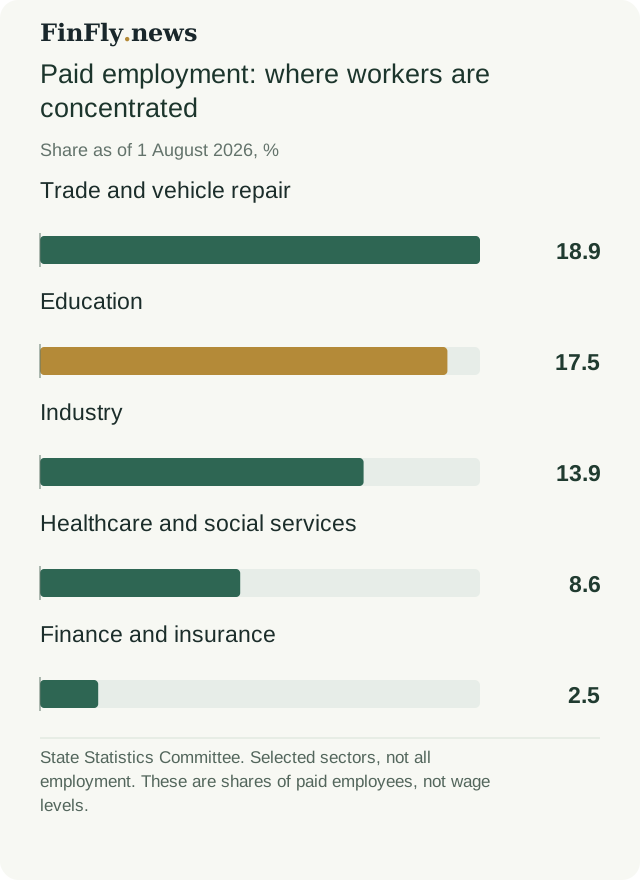
The structure of paid employment is heterogeneous. According to the State Statistics Committee, 18.9% of paid employees work in trade and vehicle repair, 17.5% in education, 13.9% in industry, 8.6% in healthcare and social services, 6.8% in construction, 6.1% in public administration and defence, 4.4% in transport and warehousing, 3.9% in professional, scientific and technical activities, 2.5% in finance and insurance, 2.3% in agriculture, forestry and fishing, and 15.1% in other sectors.
Trade and education together account for 36.4% of paid employees — a FinFly calculation based on State Statistics Committee shares. This means that two sectors form more than a third of all paid employment. Finance and insurance account for 2.5%, and professional, scientific and technical activities for 3.9%. The release under review does not contain sectoral salary rates, so it cannot be said that workers in these sectors earn more or less than the average. But the concentration of employment itself shows that the overall average is made up of groups that differ greatly in size and composition.
Why the aggregate can move without pay rises
The average salary is a ratio, and it can change because of the composition of employment, not only because of changes in rates. If the share of high-paid or low-paid groups in the total number shifts, the average changes even when pay within groups remains unchanged. This is a general mechanism, not a proven cause of the specific 7.2% growth in January–July 2026: we do not have data on how the structure of employment changed within the period. The average is also not the median, which divides workers into two equal-sized groups by pay level. A single average value cannot establish how many people earn more or less than 1,176.7 manats.
Comparisons with GDP require caution. According to the State Statistics Committee, in January–August 2026 trade and vehicle repair accounted for 10.8% of GDP, whereas in paid employment as of 1 August this sector accounted for 18.9%. The periods and coverage differ: GDP covers January–August, employment is a point-in-time estimate as of 1 August, and employment covers only paid employees. It is therefore incorrect to derive labour productivity from this ratio.
What this means for hiring
For an employer, the overall average is a poor sole benchmark. It shows neither the median, nor the modal rate, nor the pay for a specific position, nor the sectoral level. The presence of large sectors — trade, education, industry — means they carry weight in the overall average, but this does not imply wage dynamics within them. A decision on a rate is more logically based on the specifics of the position, the sector and the local labour market, rather than on a single aggregate figure.
To assess the causes of average growth, changes in pay within sectors and changes in the composition of employment are needed simultaneously. A shift in shares alone will not yet allow the contribution of the structural factor to be called significant: that would require a separate calculation. For now, the published statistics provide a useful picture of the scale of paid employment, but they do not turn the national average into a universal price of labour.