
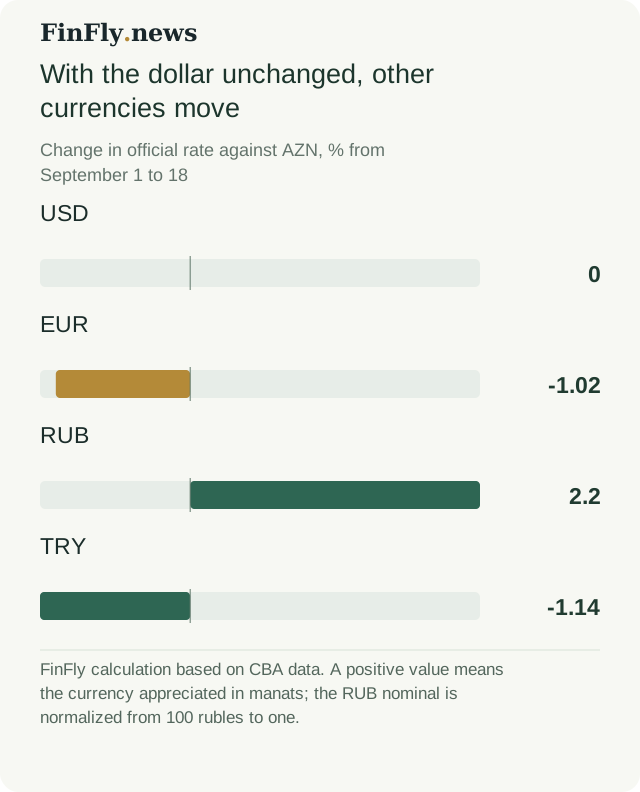
The dollar-to-manat rate in CBA bulletins on September 1, 10, 16, 17 and 18, 2026 stands at 1.7 AZN per 1 USD. This equality applies to only one pair. According to FinFly calculations on the same data, over the same period the euro fell 1.02% against the manat, the Turkish lira fell 1.14%, and the ruble rose 2.20%. A motionless dollar and moving other currencies are not a contradiction but different objects of observation.
Arithmetically, the quotation of any currency in manats can be divided by USD/AZN to obtain its calculated ratio to the dollar. If the denominator does not change, a change in that ratio corresponds to a change in the quotation against the manat. This identity does not establish the cause of market movement and does not turn a calculation based on official bulletins into an exchange price. It merely shows why the immobility of one pair does not mean the immobility of the others.
What the five dates show
Within the period, movements were non-monotonic. The euro went from 1.973 AZN on September 1 to 1.9784 AZN on September 10, then to 1.9493 AZN on September 17 and 1.9528 AZN on September 18. The ruble, by contrast, rose from 1.9699 AZN per 100 rubles to 2.0178 AZN on September 16–17 and stood at 2.0132 AZN by September 18. The lira fell against the manat from 0.0352 to 0.0348 AZN. These are five selected observations, not a check of every day in the period and not a long history: they cannot be used to judge a trend for a month or a year.
The unit of measurement also matters. The CBA publishes the ruble per nominal of 100, so 1.9699 AZN is the price of one hundred rubles, not one. For comparability, FinFly normalized the ruble to one unit: 0.019699 AZN on September 1 and 0.020132 AZN on September 18. The percentage change does not depend on normalization, but absolute values without this caveat are read incorrectly. It is equally incorrect to interpret these percentages as the real effective exchange rate of the manat: these are changes in nominal official quotations against individual currencies, not a trade-weighted basket.
What this means for calculations
For a company whose revenue or payment is denominated in a currency other than the dollar, a USD anchor does not eliminate currency risk. If an invoice is in rubles, then with an equal nominal invoice its manat equivalent rose over September 1–18; if in euros or lira, it fell. This is FinFly's comparison based on official quotations, not an assessment of a specific transaction: the bank's exchange price may differ. How important this is for an individual enterprise depends on the currency in which contracts are concluded and how settlements are structured; the weights of actual payments by currency are not defined in this comparison, so these percentages cannot be extrapolated to the entire economy.
Dollar stability helps primarily where the settlement currency coincides with the dollar. It does not cancel out the rise in the price of imported raw materials from a supplier, changes in logistics costs, or domestic inflation — these factors lie outside the exchange-rate pair. And it does not mean that 1.7 AZN per dollar will always hold: such a conclusion does not follow from five dates, and there is no forecast here.
How to test the thesis
The test is simple and specific. One needs to take a longer series of official CBA rates — not five dates, but, for example, all working days of a quarter — and see how changes in USD/AZN relate to changes in EUR, RUB and TRY against the manat. If the dollar stays put while other currencies diverge in different directions, the thesis is confirmed. A longer series will allow an assessment of the scale of fluctuations that five separate dates do not reveal. And separately — to check in which currencies the contracts of the business in question are actually denominated, because that is what determines which of the three percentages matters for it.