
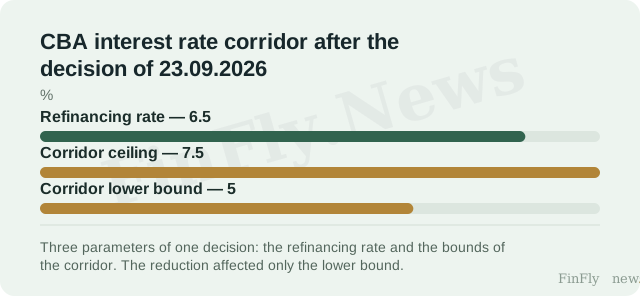
Azerbaijan's strategic foreign exchange reserves as of 30.09.2026 amounted to 89,380.7 million dollars, and the Central Bank on 23.09.2026 left the refinancing rate at 6.5% and the ceiling of the interest rate corridor at 7.5%, lowering only the lower bound — by 0.5 percentage points, to 5%. The main point here is not the size of the buffer itself, but the divergence within a single decision: the easing affected the lower edge of the corridor, while the key rates remained unchanged. The reserve stock is a value on a date, not a flow and not an indicator of the availability of funds; therefore, the link between the volume of reserves and the direction of monetary policy cannot be directly inferred from these documents.
What exactly the two documents recorded
The State Statistics Committee reports strategic foreign exchange reserves as a stock of assets as of 30.09.2026 — 89,380.7 million dollars. This is not income for the month and not the result of operations for the period: the definition of the indicator explicitly states that it refers to a stock on a date, and the change may reflect both inflows and outflows and the revaluation of assets. This leads to a practical conclusion: the figure itself says neither whether reserves grew or shrank, nor how liquid they are and in which instruments they are placed.
The CBA's decision of 23.09.2026 is structured differently. The refinancing rate was kept at 6.5%, the ceiling of the corridor — at 7.5%, and the lower bound was lowered by 0.5 percentage points, to 5%. That is, the movement occurred in one segment of the corridor, not across its entire scale. The Bank justifies the decision by the dynamics of actual and projected inflation, the situation in the foreign exchange market, changes in banking sector liquidity and global monetary conditions. This is a description of motives, not proof that reserves and rates are linked to each other.
Why the gap in the corridor matters more than the size of reserves
For a business assessing the cost of short-term funding in manats, what matters is precisely the gap: with the rate kept at 6.5% and the ceiling at 7.5%, the upper part of the scale does not move, while the easing concerns the lower bound — 5%. If a company's funding is tied to the upper part of the corridor, the CBA's decision by itself does not change that bound. If, however, it concerns the segment oriented to the lower bound, conditions have formally eased. This is a conditional discussion of the mechanics of the corridor, not a statement about what happened to specific rates on loans and deposits.
Hence the limitation: the size of reserves is not a decision on borrowing, pricing or procurement. A stock of assets is not payment turnover, not nominal demand and not the volatility of contract prices; it does not show how much funds are available to business and on what terms. To move from these data to a decision, what is missing is an observation specific to the decision itself: the actual rates on the instruments the company uses, and the structure of reserves. Without this, changing the borrowing budget or the currency position on the basis of a single stock figure and a single decision on rates would be premature.
The only stable conclusion from the two documents is the divergence within the CBA's decision: the key rates remained at 6.5% and 7.5%, while the lower bound of the corridor fell to 5%. Reserves of 89,380.7 million dollars as of 30.09.2026 are a separate stock on a date, which confirms neither the dynamics, nor the availability of funds, nor a causal link with policy. The next comparable observation is the next CBA decision on rates and the next release with a new date on reserves: it is worth checking whether the refinancing rate, the bounds of the corridor and the stock itself have changed relative to 6.5%, 7.5%, 5% and 89,380.7 million dollars.