
Azerbaijan's strategic foreign exchange reserves as of September 1, 2026 amounted to 90,769.7 million dollars. On the Central Bank's website, another figure was published close in time — 15,301.3 million dollars of official foreign exchange reserves as of August 31. For reading these data, what matters more is not the difference in magnitude, but the difference in coverage: the national strategic indicator cannot, without qualifications, be called the reserves of the CBA itself.
Two indicators instead of one common wallet
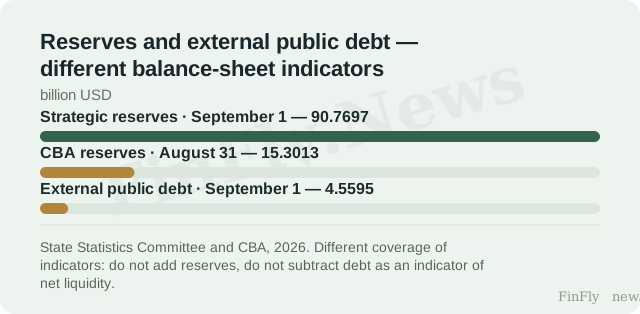
The first sum is given in the macroeconomic summary of the State Statistics Committee, the second — in the regulator's monetary indicators. These are not alternative estimates of the same line. The national aggregate and the indicator of an individual institution answer different questions. Neither of these two publications by itself gives grounds to consider all 90.8 billion dollars directly available to the CBA for operations on the foreign exchange market.
Therefore, the sums cannot simply be added together and the result called the country's reserves. Without reconciling the composition of the aggregate and the consolidation rules, such an action risks producing double counting. Subtracting one sum from the other also will not automatically establish the size of any fund's assets or the budget's free resource. For such conclusions, a breakdown by owners and components is needed, not just an arithmetic difference.
In the chart, the dates are kept separate: August 31 for the CBA and September 1 for strategic reserves. They are close and make it possible to show the scale of different indicators, but they do not substitute for a single reconciled balance. The composition of assets, the valuation currency and changes in value may be no less significant than the difference in reporting dates.
Reserve replenishment and foreign exchange operations
In its decision of July 31, the CBA estimated its foreign exchange reserves at 13.8 billion dollars. The later figure as of August 31 is about 15.3 billion. These observations point to an increase in the published level, but do not allow the entire difference to be declared the volume of the regulator's currency purchases: the first value is rounded, and the change in the value of reserves may include not only operations but also revaluation.
The CBA itself, in its July explanation, reported absorbing the excess supply of foreign currency on the domestic market. This provides information about the operations conducted, but not a complete quantitative breakdown of the increase in reserves. The trade balance surplus, the inflow of foreign currency into the economy and the change in reserve assets are not the same magnitude; equating them to one another conceals intermediate financial flows.
A large stock does not remove the question of availability
The State Statistics Committee also reports external public debt as of September 1 — 4,559.5 million dollars. Strategic reserves are larger than it by approximately 19.91 times, according to FinFly's calculation. This is a ratio of two specific balance-sheet indicators, not a coverage ratio for all external obligations of the economy. Public debt is not equal to the country's total external debt, and the volume of assets by itself does not disclose the terms and conditions of their use.
For a company planning foreign currency payments, the reserve stock is part of the overall assessment of stability, but not a promise of a specific exchange rate or exchange conditions. Even a large national sum does not answer questions about the price of bank conversion, the currency of the contract and the settlement date. Substituting these data for a check of one's own obligations would be just as wrong as considering the entire national aggregate a single operating account of the regulator.
In further updates, it is useful to track each series separately, preserve its reporting date and compare the change in the stock with available explanations of operations and revaluation. Only such reconciliation makes it possible to distinguish an increase in assets from a specific source of their replenishment. At present, the main conclusion is that the reserve buffer is large by the published sum, but its economic meaning is also determined by the composition, ownership and availability of assets.