
In Azerbaijan's retail trade, the fastest product groups are at the same time the narrowest. According to State Statistics Committee data for January–August 2026, sales of computers, telecommunications equipment and printed products grew in real terms by 33.4%, pharmaceutical goods and medical products by 21.6%, while these groups accounted for only 1.6% and 2.7% of consumer spending. Food products, by contrast, accounted for 50.1% of spending but added only 1.5%. This is the main gap: the rate of growth is not equal to scale.
Half of spending is growing the slowest of all
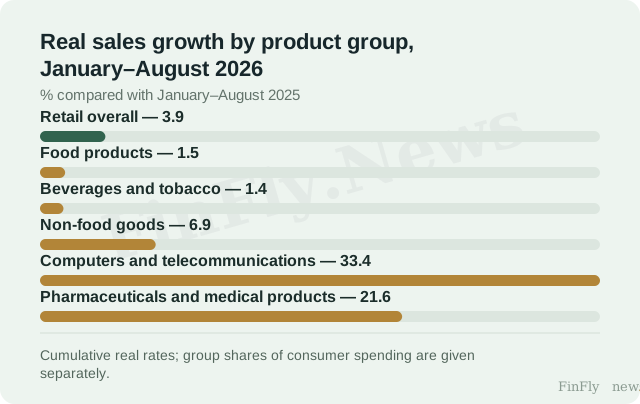
Food remains the core of the consumer basket: 50.1% of all consumer spending in the retail network in January–August 2026. But real sales growth specifically for food products was 1.5% compared with the same period of 2025 — below the overall retail figure, which reached 3.9% in January–August. Beverages and tobacco products, a separate series with a 4.3% share, added 1.4%. That is, the most mass part of demand is growing more slowly than average, rather than pulling retail along with it.
The non-food segment as a whole grew by 6.9% — noticeably faster than food. Within it, the spread is enormous: clothing and footwear contributed 4.3%, automotive fuel 4.3%, electrical goods and furniture 8.9%. Computers, telecommunications equipment and printed products grew by 33.4%, pharmaceuticals and medical products by 21.6%. These two groups are the most dynamic, but their shares of spending are 1.6% and 2.7%, respectively.
What this means for an assortment decision
For a business planning an assortment or a marketing budget, the gap between rate and share is a decision boundary, not a signal to act. If a company is choosing between expanding a fast-growing narrow category and working with mass food, rate alone is not enough: 33.4% growth on a base of 1.6% of spending and 1.5% on a base of half of all spending are different in absolute contribution, and they cannot be directly compared using this data.
The practical conclusion is conditional: a bet on the fastest niche is justified only after checking its absolute capacity in money terms and the sustainability of demand. This requires a breakdown of turnover by product group in a single breakdown — for January–September 2026, the State Statistics Committee gives total turnover of 50,774.7 million manats, but without a breakdown by group. As long as there is no such breakdown, a decision on assortment or purchases remains incomplete.
The gap between rate and scale is not an anomaly but an ordinary property of retail statistics: narrow categories can grow faster without determining overall demand. Food with half of spending and 1.5% growth and computers with 1.6% of spending and 33.4% growth are two different types of opportunity, and they should not be confused. The next comparable observation is the State Statistics Committee's publication for January–September 2026 by product group: whether the gap between computers and food persists and whether pharmaceuticals begin to slow after 23.8% in January–July and 21.6% in January–August.