
The fastest-growing categories in Azerbaijani retail remain small in sales volume. In January–August 2026, the group of computers, telecommunications equipment and printed products grew by 33.4% in real terms, while medicines and medical goods grew by 21.6%. However, they accounted for 1.6% and 2.7% of retail turnover, respectively. According to the State Statistics Committee, the entire market grew by 3.9%. For a seller, there are two different signals here: where sales are growing faster and where the bulk of purchases is concentrated.
The large basket is growing more slowly
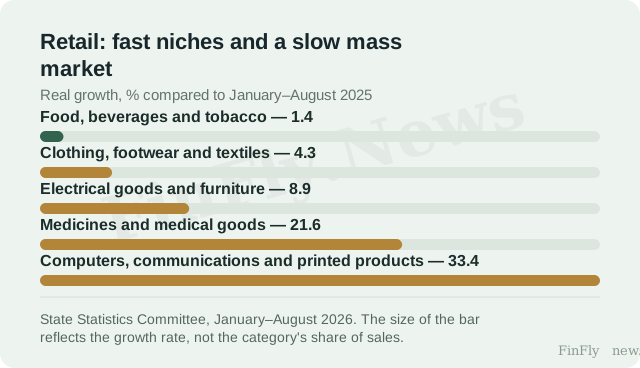
Of the 44.3 billion manats in retail turnover, 24.1 billion came from food, beverages and tobacco, and 20.2 billion from non-food products. The first group grew by 1.4% in real terms, the second by 6.9%. Together, food, beverages and tobacco account for 54.4% of sales — the sum of the published shares calculated by FinFly. Fast small categories do not describe the behavior of this much larger part of the market.
There are other segments between the extremes. Electrical goods and furniture added 8.9%, clothing, footwear and textiles — 4.3%. At the same time, clothing accounts for 12.7% of turnover, while electrical goods and furniture account for 4.9%. Therefore, an equal focus on the highest percentages can distort the picture of the available market. A small fast-growing niche may be interesting for a specialized company, but its size cannot be automatically transferred to the plans of a large retail chain.
This is not a calculation of the contribution of individual goods to overall growth: that would require comparable weights, not just shares of turnover in current prices. But the difference in scale already allows separating niche dynamics from the mass market. A high growth percentage by itself also says nothing about markups, customer acquisition costs or store profit.
Prices are not equal to additional purchases
During the same eight months, prices for food, alcohol and tobacco rose by 6.9%, and for non-food products by 3.7%. Real retail growth rates already take price changes into account. Therefore, the growth of cash receipts and the expansion of sales volume cannot be considered the same result: price increases can raise the average check without a corresponding increase in purchases. The given indices do not allow calculating the nominal revenue growth of a specific chain.
For a grocery store, this makes inventory turnover and the costs of servicing sales no less important than the total amount of receipts. For an electronics seller, rapid industry growth may be an argument for checking demand for new items, but not for purchasing any product within a broad category. The statistics combine computers with telecommunications equipment and printed products: it does not prove that each of these markets grew by 33.4%.
Market size is not a family budget
The food share describes purchases in the retail network, not all household expenses: there is no complete picture of housing payments, services and other spending here. For the same reason, average monthly purchases per person — 538.6 manats — cannot be taken as disposable income or the budget of a typical buyer. For retail, this is a characteristic of recorded turnover, not a ready-made portrait of the customer.
The next substantive question is whether growth is expanding beyond the small leading categories. Comparing the growth rates of large product groups in future statistical releases will help distinguish a broader market recovery from the persistence of individual fast niches. So far, the published data support a selective approach: there is overall retail growth, but equal opportunity for all store formats is not visible behind it.