
The State Customs Committee of Azerbaijan records for January–August 2026 14.6779516 million tonnes of exported crude oil and 9281.89355 million dollars of its value. This is a cumulative total for eight months, not a monthly figure, and it contains no comparison base: neither a comparable period nor a monthly breakdown. Therefore, the correct conclusion is limited to the level, not the direction of movement. The value of oil (9281.89355 million dollars) is comparable to the value of natural gas (5710.86927 million dollars), but the volumes of these two items are measured in different units — million tonnes and billion cubic metres — and a direct comparison of physical quantities here is incorrect. For business, this means: the figure can be used as an absolute benchmark of accumulated exports, but not as confirmation of growth or decline.
What exactly the figures show
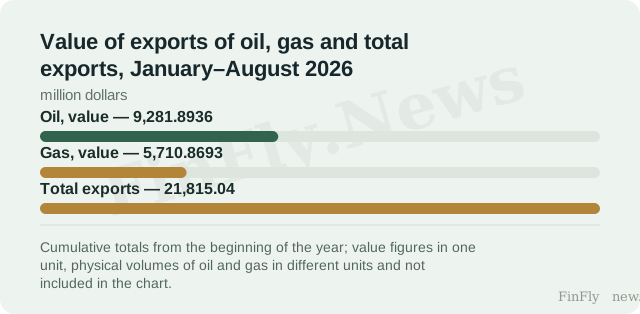
Customs statistics for January–August 2026 provide two separate values for crude oil: physical volume — 14.6779516 million tonnes — and value — 9281.89355 million dollars. Both values are accumulated from the beginning of the year, that is, they describe eight months, not one month. Volume and value are accounted for separately, and the price per tonne was not calculated from these data. Alongside are total exports of goods (21815.04 million dollars), total imports (11423.35 million dollars) and the foreign trade balance (10391.69 million dollars) — also on a cumulative basis for the same period.
Natural gas in the same publication is represented by 16.37757925 billion cubic metres and 5710.86927 million dollars. The value figures for oil and gas are expressed in the same unit — million dollars — and are therefore comparable as monetary totals. The physical quantities — million tonnes and billion cubic metres — are in different units, and they cannot be added or directly compared. This is not a limitation of the publication, but a property of the units of measurement themselves: a tonne and a cubic metre describe different physical substances.
Where the boundary of applicability lies
If a company forms a revenue or procurement budget tied to oil exports, these figures give only the absolute level of the accumulated total for the eight months of 2026. They do not show whether the physical volume grew relative to the previous period or whether the price changed: for that, a comparable period and a monthly breakdown are needed, which are not available. The condition is simple: as long as there is no comparison base, any statement about the direction of movement is an assumption, not an observation. The value total by itself also does not prove either a price shift or a change in physical supplies.
The limitation here is one and specific: the absence of a comparison base and monthly detail does not allow separating physical volume from the price effect. The next comparable observation is the State Customs Committee's publication for January–September 2026: to compare the accumulated volume and value of oil with a comparable period. Such a test will show whether physical exports are moving differently from their value — and only then will there be grounds to speak of a trend rather than a level.
The key fact of January–August 2026 is neither growth nor decline, but a recorded level: 14.6779516 million tonnes of oil and 9281.89355 million dollars of its value according to the State Customs Committee of Azerbaijan. The value totals of oil and gas are comparable to each other as monetary amounts, while the physical ones are not, since they are measured in different units. For business, this means that the figure is suitable as an absolute benchmark, but not as confirmation of dynamics. The direction of movement remains an open question until a comparable period appears.