
Roughly two-thirds of the annual growth in the manat money supply came from something other than cash. That is the result of comparing the CBA's monetary aggregates at the end of July 2026 and 2025. Separately, the regulator reported excess banking liquidity at the end of June. These are different indicators and different periods, but both raise a practical question: is the presence of money in the system sufficient for affordable credit to an enterprise? The sources reviewed contain no data on rates on new corporate loans that would confirm a general decline in their cost.
As of 31 July 2026, the M2 aggregate stood at 43.84 billion manats, up 19.6% year-on-year, according to FinFly's calculation. Cash outside banks, i.e. M0, grew more slowly — by 15.1%, to 19.17 billion manats. As a result, the share of cash in M2 declined from 45.4% to 43.7%. Arithmetically, about 65% of the annual increase in M2 was provided by growth in its non-cash component, calculated as M2 minus M0. This is a share in the increase, not the share of non-cash money in the total supply.
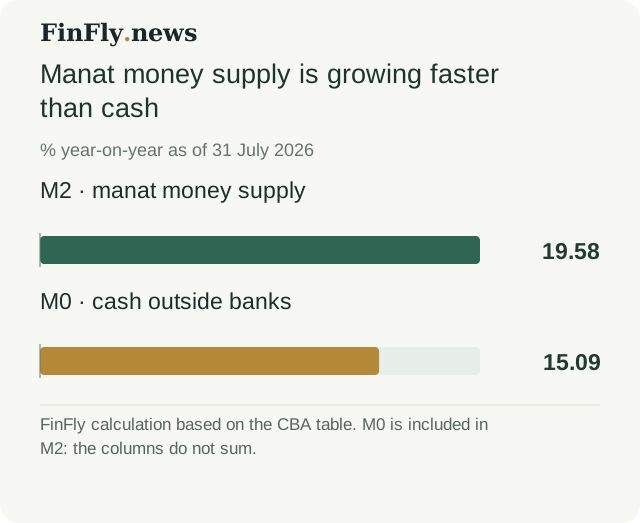
This is a change in the composition of the money supply, not proof that the population has begun to save more or to use non-cash payments more actively. M0 is included in M2; the two indicators cannot be added together. Nor can the difference between them be called citizens' deposits: the aggregate is not limited to the population. In a methodological footnote, the CBA specifically states that deposits of non-residents and the central government are excluded. The comparison shows which part of the money stock grew faster, but does not explain the motives of its holders.
Money at banks is not yet a loan to a borrower
A more direct answer about the position of banks is contained in the CBA's July decision. According to the regulator's estimate, the structural surplus of their liquidity excluding required reserves reached 6 billion manats by the end of the first half of the year — 2.1 times more than in December of the previous year. The CBA called this evidence of significant lending potential. This refers to the capacity to lend, not to a confirmed reduction in rates for enterprises.
At the same time, excess liquidity does not mean that all funds automatically turn into new loans. The regulator uses deposit operations and notes to manage liquidity. According to the same decision, at the end of June seven-day deposit operations accounted for 84.3% of the sterilisation portfolio through open market operations. This is a share within the CBA's instruments, not the share of all bank money. For lending, separate issues remain: borrower risk, collateral, bank capital and demand for new loans.
AZIR must be read together with the footnote
September data provide a different snapshot in time. As of 17 September, AZIR — the benchmark for the unsecured interbank money market — stood at about 5.81% with a policy rate of 6.5% and corridor bounds of 5.5–7.5%. The difference from the policy rate is about 0.69 percentage points. But next to the AZIR value there is an asterisk: the CBA indicates that it was calculated using a reserve methodology. The table for that day reflects a single transaction worth 50 million manats.
For 16 September, the table shows no transactions and zero volume; the published index is also marked with an asterisk, meaning it was calculated using the reserve methodology rather than from that day's transactions. For 14 September, six transactions worth 142 million manats are shown, without such a mark. This means that when reading the series, one must distinguish market observations from a reserve calculation. Neither is the price of a bank loan for a company: such a loan differs in both term and risk from an interbank instrument.
What separates potential from result
The July aggregates and the September AZIR cannot be combined into a claim that M2 growth caused a decline in rates. But together with the CBA's assessment, they help frame a fork in the road: the banking system may have resources for lending without offering equally favourable terms to all borrowers. For an enterprise, the test of this possibility will be the bank's offer for a new loan — its rate, fees, term and collateral — rather than a single liquidity indicator. Growth in the money supply does not replace such a test.
There is also a constraint on the monetary policy side. Keeping the corridor on 31 July, the CBA pointed to opposing pressures: a higher inflation forecast supports a tighter policy, while a significant excess of foreign currency supply over demand supports a looser one. The next decision is scheduled for 23 September; its outcome is not known in advance. Even a change in the corridor would not by itself establish whether new loans to companies have become cheaper. So far, growth in M2 and excess liquidity are confirmed, but not a general decline in the cost of business loans.