
Better underwriting does not guarantee higher total earnings. Insurance premiums arrive before many claims are paid, leaving an investment portfolio between collection and settlement. Financial-market movements can outweigh improvements in the insurance operation without a sudden surge in claims.
Page 8 of Lloyd’s half-year report records pre-tax profit falling from £4.249 billion to £3.536 billion. Underwriting profit rose from £1.505 billion to £1.919 billion, while investment returns fell from £3.168 billion to £1.795 billion. The comparison is between the first halves of 2025 and 2026; the results were released on 3 September 2026.
Investment weakness outweighed underwriting gains
Our calculation from the unrounded figures shows a £414 million underwriting improvement against a £1.373 billion reduction in investment returns. A favourable change in foreign-exchange results and a modest increase in other expenses bring the overall decline to £713 million. Stronger underwriting offset only about 30% of the investment decline.
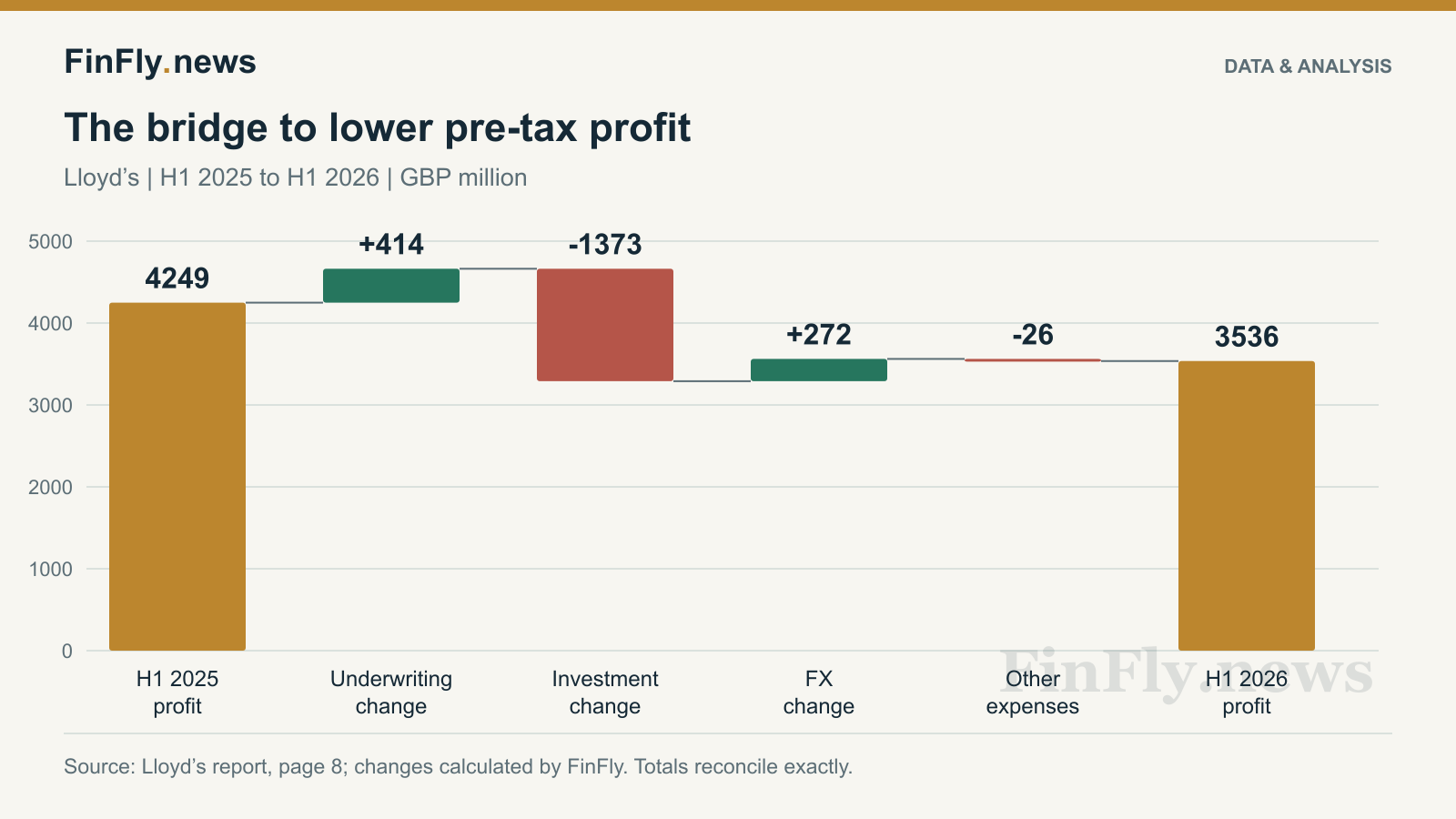
This decomposition matters when judging the durability of earnings. Falling total profit can coexist with improving underwriting. The reverse is also possible: asset income can temporarily conceal weak pricing of insurance contracts. A single bottom-line number cannot distinguish between the two.
Bond valuations and cash flows are different
The US National Association of Insurance Commissioners explains interest-rate risk through the falling market value of existing bonds when rates rise, and the need to match asset and liability cash flows. Its discussion focuses primarily on life insurance. Its accounting observations should not be applied mechanically to the entire Lloyd’s market.
A simple illustration shows the valuation mechanism. A zero-coupon bond paying 100 in one year is worth 95.24 at a required yield of 5%. At 6%, its calculated price falls to 94.34. The promised payment has not changed, but the sale price has. This example ignores default, taxes and trading costs; it is an explanation, not an investment recommendation.
| Question for the accounts | Distinction it reveals |
|---|---|
| What makes up investment returns? | Recurring income versus asset sales and revaluation |
| When are claims expected to be paid? | An accounting loss versus pressure to sell investments |
| Are currencies and maturities matched? | Portfolio yield versus mismatch risk |
| How much capital and liquidity are available? | Falling earnings versus the ability to pay on time |
A policyholder needs more than an earnings figure
A business buying property or liability cover needs dependable contract performance rather than maximum insurer profit at any cost. Asset quality, capital adequacy, liquidity and claims development are more useful when considered together. Lower profit alone does not establish a claims-paying problem. Equally, a profitable reporting period is not a substitute for checking these measures.
For Azerbaijan, this international example provides an analytical method rather than a diagnosis of local insurers. Conclusions require the accounts of the individual company and its asset and liability mix. The central distinction is between the quality of the insurance operation and the share of earnings supplied by financial markets.