
Expansion and quality do not necessarily move together in insurance. Premiums can rise as an insurer adds contracts, covers more valuable assets or increases limits, even while the price of a comparable risk falls. For an underwriter this tests pricing discipline. For a policyholder it makes the details of renewal more important.
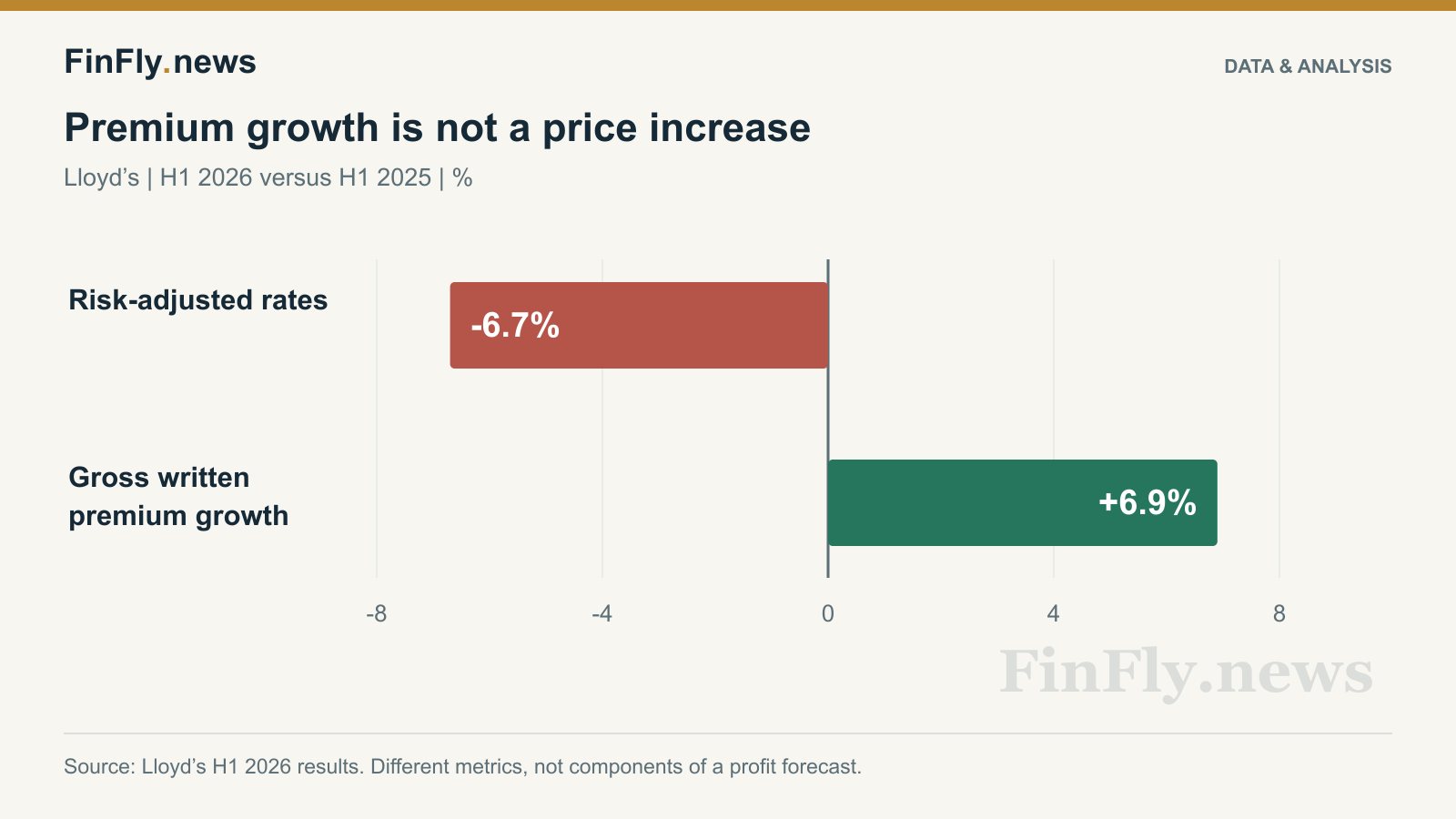
Lloyd’s first-half 2026 results illustrate the distinction: gross written premiums increased 6.9%, while risk-adjusted rates fell 6.7%. The results were published on 3 September and cover January to June, not current November quotations.
Business volume is not the price of risk
Premium income measures the scale of accepted business, not its profitability on its own. New sales can offset discounts in a revenue total without removing pressure on the return from individual contracts. A useful assessment therefore looks at price, portfolio composition and servicing costs alongside growth.
Marine insurance also requires a currency adjustment. IUMI’s report released on 23 October put global marine premiums for 2025 at $42.6 billion, up 5.5%, while highlighting dollar weakness and competition. Those figures cover a different market and period. They do not establish an equivalent change in marine pricing in the first half of 2026.
A discount may leave more risk with the buyer
Consider a company whose annual premium falls from AZN 100,000 to AZN 90,000, but whose deductible rises from AZN 20,000 to AZN 100,000 per event. It saves AZN 10,000. On one covered loss of AZN 150,000, ignoring other terms, its own share increases by AZN 80,000. This is a hypothetical FinFly calculation, not an insurance quotation or an estimate of loss frequency.
| Compare | Why it matters |
|---|---|
| Premium for the same asset schedule | Rules out apparent savings created by covering less property |
| Per-event and aggregate deductibles | Shows how much loss the business retains |
| Limits and sublimits | A large headline limit can conceal a smaller allowance for a particular risk |
| Exclusions and interruption indemnity period | Determines which losses could qualify for compensation |
The implications for Azerbaijan’s businesses
International price competition is a reason to seek comparable quotations, not a basis for assuming the same discount locally. The final price depends on the asset, claims history, route, currency and reinsurance arrangements. Without quotations for an identical exposure, a claim that Azerbaijani premiums have fallen by the Lloyd’s average would be unsupported.
Renewal negotiations should be assessed against two outcomes: the cost of the policy and the loss the company still has to finance itself. If the first falls while the second rises sharply, a cheaper policy may weaken rather than improve resilience. That balance says more about the quality of the purchase than the insurer’s premium-income ranking.