
An economy can produce more while output per resident falls. The reason is straightforward: the size of the total matters, but so does the number of people used to calculate the average.
The World Bank's 18 November release forecasts Afghanistan's GDP growth at 3% in 2026 and population growth at 6.6%. The bank expects GDP per capita to decline by 3.3%.
The arithmetic behind the result
Set last year's GDP and population to 100. Output then becomes 103 and population becomes 106.6. Dividing 103 by 106.6 and multiplying by 100 gives roughly 96.6. Output per person is therefore below its initial level.
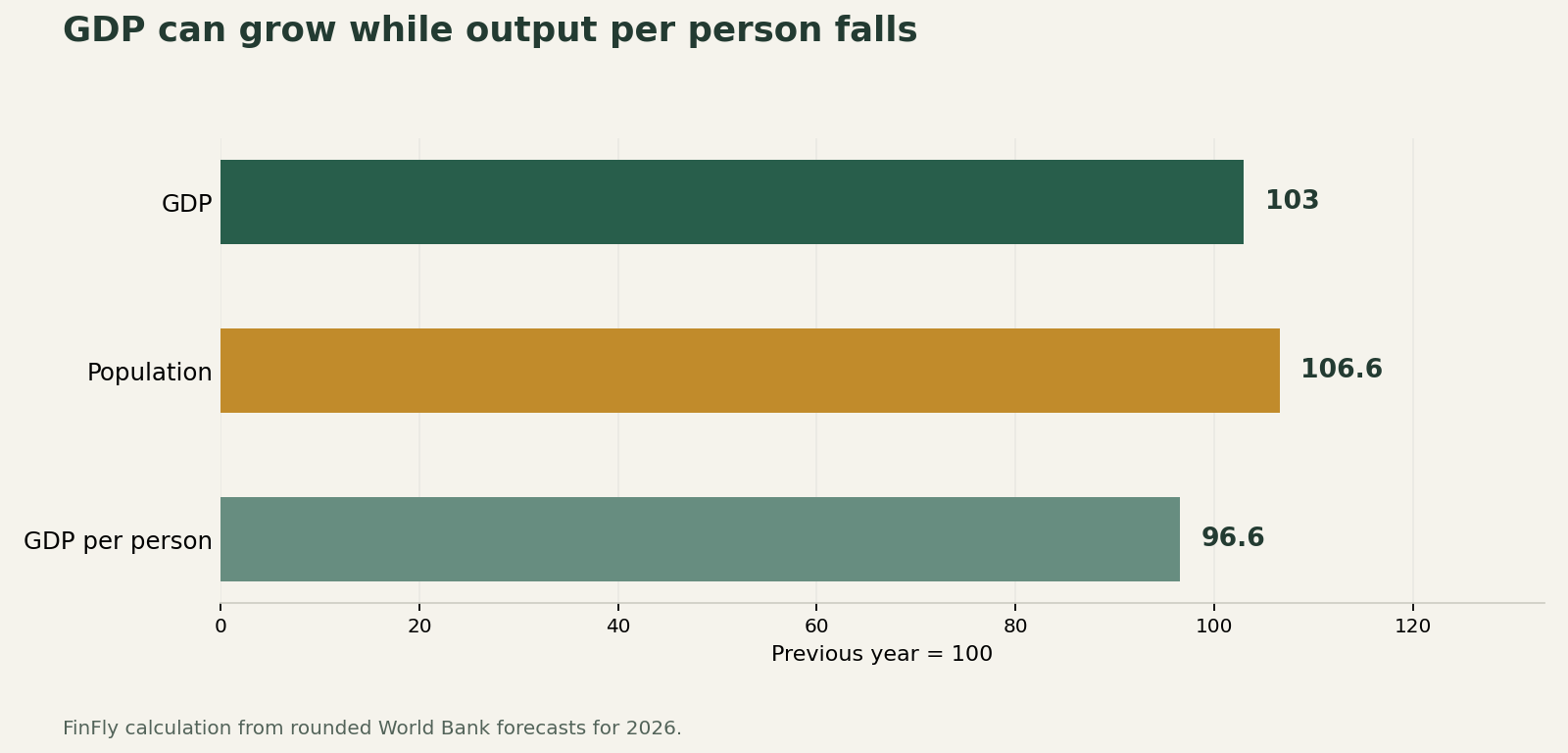
Our calculation uses rounded growth rates. Its approximately 3.4% decline differs slightly from the bank's published 3.3% because the exact result cannot be reproduced without unrounded inputs.
| Measure | Question it answers |
|---|---|
| Total GDP | Is aggregate output increasing? |
| GDP per capita | Is output keeping pace with population? |
| Household income | How much money does a family receive? |
| Purchasing power | What can that money buy? |
An average is not every family's experience
Average output is not the same as wages or disposable income. Some of it corresponds to company profits and other income. Different groups may benefit unevenly, while their spending needs differ too.
For a hypothetical household, an additional income source helps. But if the number of dependants also increases, the amount available per person can fall. This illustrates the division involved rather than replacing national statistics with a household budget.
How to read a recovery headline
Check three distinctions: forecast versus recorded outcome, aggregate versus per-person figures, and whether price changes have been accounted for. Without them, the same word, growth, can describe very different developments.
Employment and household incomes are also needed to assess lasting improvements. More output matters, but by itself does not establish whether people find everyday expenses easier to afford.