The foreign-currency share of Georgian bank deposits has fallen markedly. That changes the funding mix, but it does not eliminate currency risk or automatically reduce the cost of lari lending.
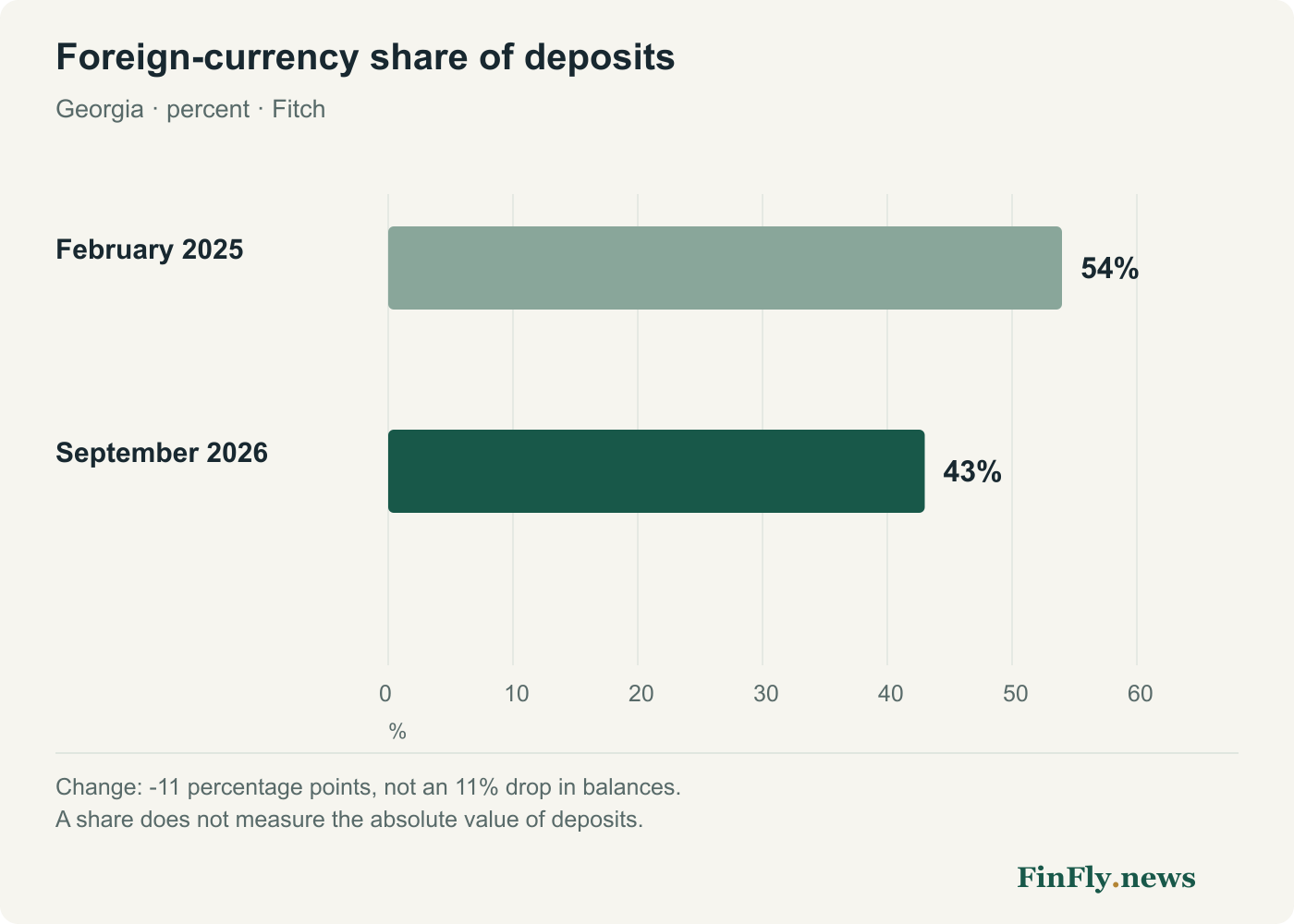
According to Fitch’s October assessment, deposit dollarization fell from 54% in February 2025 to 43% in September 2026. The decline is 11 percentage points, or about 20.4% relative to the initial share. It is not a measure of the change in the monetary value of foreign-currency deposits.
A falling share does not measure the entire stock
The foreign-currency share can decline when lari deposits grow faster than foreign-currency balances. Exchange-rate valuation and changes in the depositor mix can also affect the calculation. Without comparable absolute balances, it is not possible to conclude that households withdrew one fifth of their foreign-currency savings.
A bank’s funding quality also depends on maturity, concentration and stability. One large corporate account is not equivalent to a diversified retail deposit base with different withdrawal behavior. The aggregate currency share is a starting point for analysis, not a complete liquidity assessment.
Currency matching reduces one risk, not every risk
Fitch puts loan dollarization at 41.5%. Its proximity to the 43% deposit figure looks more balanced at sector level than widely divergent shares would. However, the percentages refer to different totals. Subtracting them does not reveal an open foreign-exchange position.
Banks may use external funding, derivatives and foreign-currency assets outside the loan book. Assessing an individual institution requires its balance sheet and currency-specific liquidity metrics. Sector averages cannot establish that every bank has eliminated funding mismatches.
| Observation | Supported conclusion | Unsupported conclusion |
|---|---|---|
| Deposits: 54% → 43% | A lower foreign-currency share | Foreign-currency balances fell 20.4% |
| Loans: 41.5% | Currency lending remains substantial | Every borrower is hedged |
| Similar loan and deposit shares | A useful starting signal | Every bank has a zero open FX position |
Fitch figures; FinFly interpretation. Loan and deposit shares have different denominators.
Revenue currency remains decisive for borrowers
A company earning lari while servicing dollar debt has a currency mismatch regardless of the banking sector’s average dollarization. A weaker lari raises the local revenue required to meet an unchanged dollar payment. A lower foreign-currency interest rate does not, on its own, compensate for that exposure.
A dollar-earning exporter may have a better natural match for dollar borrowing. Yet matching currencies does not protect it against lower sales, late customer payments or a mismatch between receipt and repayment dates. The test is whether cash is available when an obligation falls due, not merely whether two contracts name the same currency.
The next test is funding cost and resilience
Dedollarization can broaden the domestic funding base. Connecting it to cheaper credit requires evidence on rates for new deposits and loans, their maturities and credit quality. Two aggregate currency shares cannot establish that transmission.
For Azerbaijani businesses dealing with Georgian partners, the practical question is who bears exchange-rate risk and how quickly it feeds into prices. The banking system is less dollarized, but a sound transaction assessment still begins with the transaction’s own cash flows and payment schedule.