
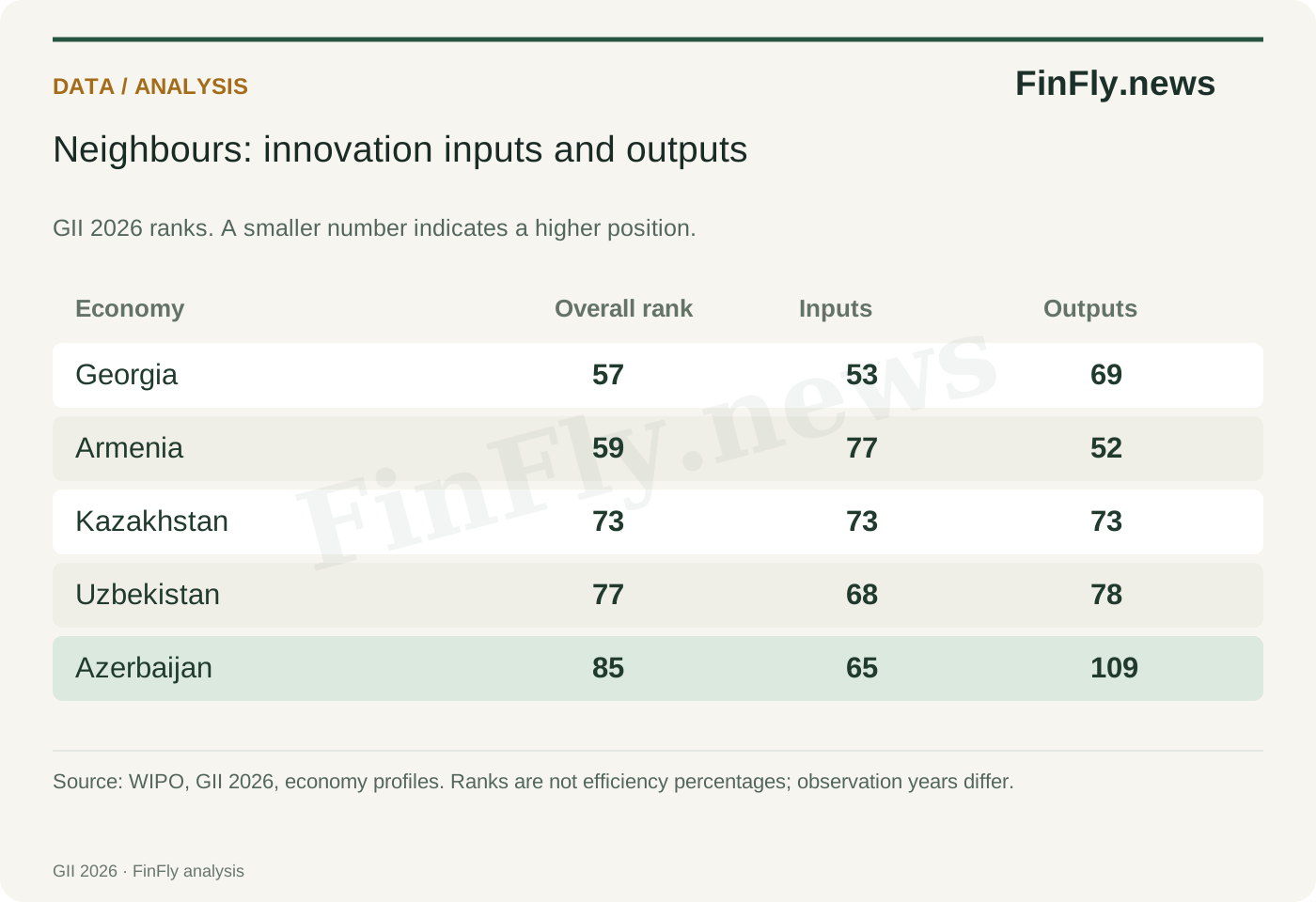
Georgia ranks 57th in the Global Innovation Index 2026, Armenia 59th and Azerbaijan 85th. Switch from the overall ranking to innovation outputs and the first two countries change places: Armenia ranks 52nd and Georgia 69th. Azerbaijan places 109th. That reversal alone shows why neighbouring economies cannot be compared through one league-table row.
WIPO’s index evaluates national innovation systems, not just startups. It covers 139 economies and incorporates education, institutions, infrastructure, markets, business and outputs. It is not a ranking of company valuations, founders’ quality of life or the attractiveness of a particular investment.
Georgia: a stronger input position
Georgia’s profile places its input sub-index 53rd and its output sub-index 69th. Institutions rank 37th, human capital and research 62nd, and market sophistication 57th. The overall position combines several pillars rather than reflecting a single standout measure.
This supports a description of relatively stronger enabling conditions than outputs. It does not establish that every company will obtain financing or sell a product quickly. Establishing operations still requires checking customers, skills, banking arrangements and specific contractual obligations.
Armenia: outputs rank above inputs
Armenia has the opposite configuration: 77th for inputs and 52nd for outputs. Knowledge and technology outputs rank 60th, and creative outputs 45th. Armenia and Georgia’s nearly adjacent overall positions consequently describe different systems.
This cannot be converted into a claim that Armenia uses every invested dollar a certain percentage more efficiently. Ranks are not monetary ratios. Nor can all outputs be attributed to one sector: the output sub-index combines different forms of knowledge, production and intangible assets.
The practical implication for a regional business is to identify the capabilities behind the result. A company seeking a research partner needs a specific laboratory and clarity about technology rights. An export team needs sales and customer-support capabilities. The headline position helps frame questions; it does not answer them.
Azerbaijan: variation within the system
Azerbaijan sits between its two neighbours on inputs, at 65th, but below both on outputs, at 109th. Institutions rank 36th, slightly above Georgia’s corresponding position and substantially above Armenia’s. A single institutional pillar therefore cannot explain the entire overall difference.
Azerbaijan’s weaker positions include knowledge and technology outputs, at 100th, and creative outputs, at 110th. That justifies closer examination of commercialization, knowledge diffusion and export composition. It does not independently establish the cause of each difference with neighbouring countries.
Two additional Central Asian benchmarks
Kazakhstan ranks 73rd overall and in both sub-indices. Uzbekistan places 77th overall, 68th for inputs and 78th for outputs. These provide useful additional profiles: a shared ambition to develop innovation can coexist with different relationships between resources and outcomes.
Kazakhstan’s three identical ranks do not mean that every underlying indicator is balanced or that the system has no weaknesses. A higher overall position also does not make an economy the best location for every industry. Fintech, biotechnology and industrial equipment require different customers, rules and infrastructure.
Avoiding false precision
The GII methodology explains that observations refer to different years, some data are missing, and changes in measurement complicate comparisons across editions. The 2026 index cannot directly identify the effect of one recent reform. Differences in rank certainly cannot be translated into percentages of technological superiority.
For FinFly, the useful outcome is a map of differences rather than the selection of a single winner. Georgia has the higher input position, Armenia the higher output position, and Azerbaijan has particular reason to examine the transition between the two sides of its system. An entrepreneur’s next step is to compare that map with the actual stages of developing and selling a product. That is where a regional advantage either becomes a contract or remains an abstract ranking.