
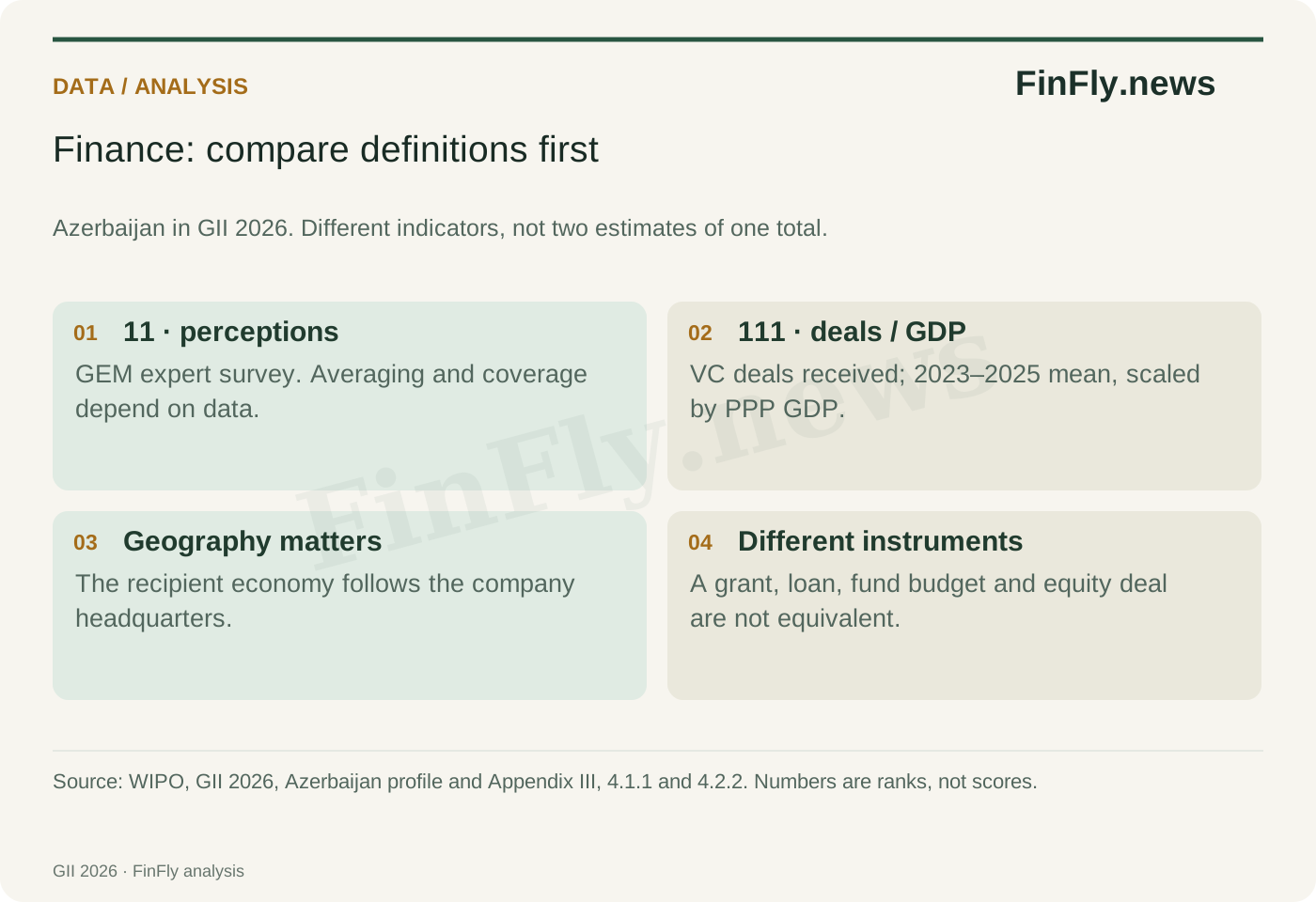
At first glance, Azerbaijan’s GII 2026 profile offers two incompatible answers about startup funding. The country ranks 11th for finance for startups and scaleups, but 111th for venture capital deals received relative to economic size. The hundred-place difference is not, in itself, a statistical error.
The first measure reflects expert perceptions of the financing environment. The second captures a defined set of recorded transactions. They differ in subject, source, period and scale. Neither establishes that funding is sufficient for every founder, nor that the country has no venture market.
What the favourable assessment measures
According to WIPO’s definitions, Finance for startups and scaleups draws on experts surveyed by the Global Entrepreneurship Monitor. It uses five-year average perceptions, with actual coverage depending on a country’s participation. Azerbaijan’s profile also marks this observation as older than the indicator’s base year.
This is an assessment of financing conditions, not a record of investment payments. An expert may consider several support instruments, while a founder needs a particular instrument at a particular stage. A favourable overall assessment does not establish that a given team can raise capital tomorrow for manufacturing or international sales.
What counts as a venture deal
The second measure uses PitchBook transactions from 2023–2025. The three-year average is expressed per billion purchasing-power-parity dollars of GDP. The recipient economy is assigned according to the company’s headquarters; investors can come from anywhere.
Equity and mixed debt-and-equity transactions are included, while pure debt is excluded. Accelerator deals are excluded unless the accelerator participates in subsequent financing rounds. A grant, a bank loan, a programme budget and an equity round therefore cannot automatically be combined into the same statistic.
Geography matters too. An investment in a company with Azerbaijani founders but an overseas headquarters may not count as a transaction received by Azerbaijan. This explains the accounting rule; it does not establish that such cases determined the country’s position. Assessing their importance would require checking the recipients of individual rounds.
A fund announcement is not a local investment total
On September 29, 2025, IDDA announced an agreement with White Hill Capital to establish a new venture financing company in Azerbaijan. This is a concrete example of financing infrastructure being developed. The formation announcement does not, however, establish how much money has already reached local startups.
Three quantities should be kept separate: capital available to a fund, capital actually invested, and capital allocated to companies in the relevant geography and stage. A regional fund can invest in several countries. Its entire capital cannot be treated as an investment in Azerbaijan merely because it has a presence in Baku.
Deal counts are also different from deal values. One large round and ten small rounds answer different questions about capital and breadth of access. For a founder, the initial cheque size, follow-on reserves and the investor’s ability to support entry into another market matter as well.
A more useful financing map
FinFly’s proposed framework separates four layers. The first finances early development through grants, competitions and prototype support. The second provides equity investment in a company. The third supplies growth capital after initial sales. The fourth is money from customers, which validates demand and reduces dependence on another financing round.
These instruments are not interchangeable. Debt needs servicing; equity changes ownership; grants normally carry conditions on use; revenue entails obligations to a buyer. Ignoring these differences can make the funding environment appear more optimistic or more pessimistic than the position of a particular business.
The rankings justify neither an allegation that the data are false nor a conclusion that sufficient capital is available. They demonstrate the need for more precise measurement. Disclosed investments, follow-on rounds and company sales would provide more substantive evidence of market development. Until comparable evidence supports a broader conclusion, 11th and 111th should be read alongside their definitions—not selected individually as a ready-made verdict.