
The official euro-to-manat exchange rate published by the Central Bank of Azerbaijan (CBA) declined from 1.973 AZN on September 1 to 1.9528 AZN on September 18. According to FinFly's calculation based on these official figures, that is a drop of 1.02% over the period. However, the decline was not continuous: on September 10, the rate stood at 1.9784 AZN, above the starting level, and on September 17 it fell to 1.9493 AZN, before rebounding to 1.9528 AZN on September 18. The dollar rate remained 1.7 AZN across all five observations. With USD/AZN unchanged, the movement in EUR/AZN arithmetically corresponds to the movement in the EUR/USD ratio; that ratio itself, derived by dividing the official rates, is a FinFly calculation, not a market quotation.
What this changes for an importer
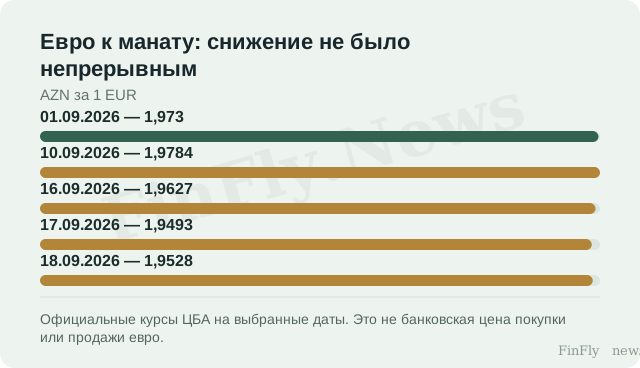
For a company whose contracts are denominated in euros, a lower exchange rate means a lower manat valuation of its liabilities. A hypothetical invoice of 10,000 EUR would have cost 19,730 AZN at the September 1 rate and 19,528 AZN at the September 18 rate; the difference is 202 AZN before costs. This is a hypothetical FinFly calculation based on official CBA data, not a description of an actual transaction. Savings arise only where payment has not yet been made and where the contract currency is indeed the euro. If the contract is denominated in dollars and the purchase is only indirectly linked to a European supplier, the effect will be different and would require a separate calculation.
The mechanism here is hypothetical rather than observable: all else being equal, a lower exchange rate reduces the manat cost of a future euro payment. But "all else being equal" is a strong assumption. The rate may reverse before the payment date, and the payment itself may be tied to a different fixing date. It is therefore more accurate to speak of the sensitivity of cost to the exchange rate on a specific date, rather than a guaranteed benefit.
What the decline does not guarantee
It does not guarantee the price at the bank. The official CBA rate is not the buy or sell price of euros for a customer; the bank spread and commissions can significantly alter the actual cost of conversion. Nor does it guarantee lower prices in stores. Retail prices depend on the contract currency, the purchase date, already-paid inventory balances and the trade markup. Goods purchased at the previous rate will not automatically become cheaper just because the official rate has fallen by 1.02%.
Even two companies with identical purchases may see different effects. One earns revenue in manats and buys euros for payment, while the other has euro receipts and pays the supplier from them. In the second case, part of the currency need is already covered by foreign-currency revenue. This is a general mechanism for matching receipts and liabilities, not a statement about any particular company's operations.
What this means for business
For an importer with euro liabilities, it makes sense to break down contracts by currency and payment date and assess what share of liabilities remains unpaid. The hypothetical saving of 202 AZN on 10,000 EUR is an order of magnitude, not a promise: it scales with larger volumes, but sensitivity to a reversal in the exchange rate grows proportionally. For a company that has already paid for a shipment, a lower exchange rate creates no cash effect—it only changes the valuation of future purchases. If the liability amount is fixed in manats, its size does not change with the euro quotation by itself.
How to test the thesis
The test is simple and requires no forecast. Take a specific unpaid euro contract, fix the payment date and compare the manat amount at the official rate on that date with the amount at the September 1 rate. Then add the actual bank spread and commission. This separates the change in the reference valuation from the actual cash result. Neither the positive difference between the two dates nor its size guarantees that the benefit will hold until the future payment. Published rates allow you to measure a change that has already occurred, but not to choose the best date to buy currency without risk.