
Uninsured damage does not disappear from the economy. A damaged warehouse still needs rebuilding, lost inventory needs replacement and an idle business continues to incur some expenses. Without insurance compensation, the burden falls on owners, lenders, workers, customers and, where specific support is approved, the state.
For the first half of 2026, Munich Re estimated natural-catastrophe economic losses at nearly $112 billion and insured losses at $44 billion. Swiss Re Institute estimated $100 billion and $42 billion respectively. The publications appeared on 30 July and in August. They are different organisations’ estimates of the same period, not consecutive updates to a single series.
Different estimates, a substantial gap in both
Subtracting the insured portion gives approximately $68 billion outside insurance in the Munich Re estimate and $58 billion in Swiss Re’s. FinFly’s calculations imply uninsured shares of about 61% and 58%. The slight difference from Munich Re’s rounded description of a 60% gap reflects calculation from already rounded totals.
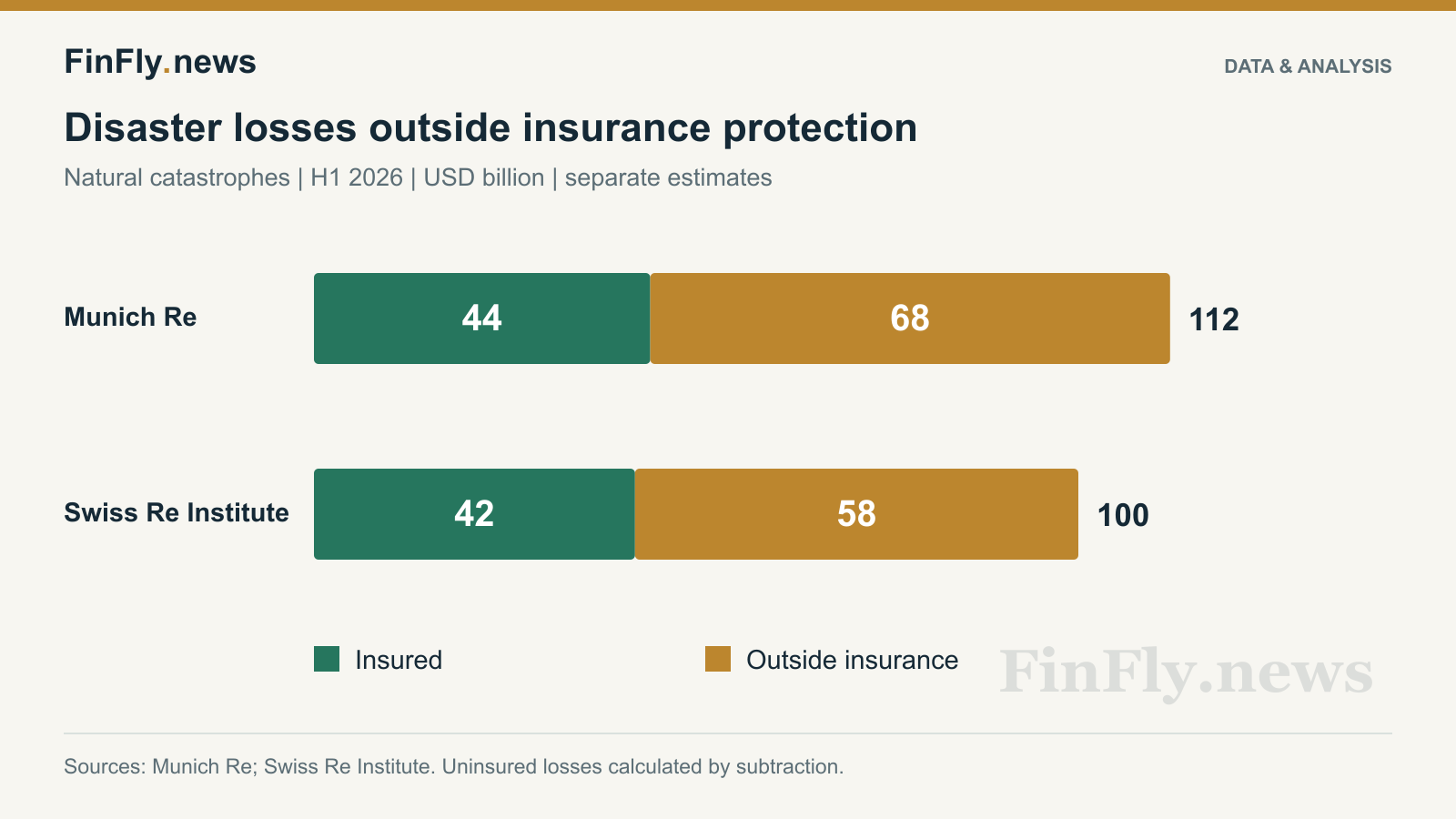
Using one organisation’s economic-loss estimate with the other’s insured-loss figure would produce a share consistent with neither methodology. Estimated insured losses are also not equivalent to cash already paid by the publication date. They describe the anticipated insured portion of damage, not a cash-flow statement.
A policy does not necessarily close the gap
A business can hold insurance and still retain significant exposure. The reasons differ: a deductible, an insufficient limit, an excluded event, an undeclared asset or a lack of business-interruption protection. Financial planning needs the loss left after all terms have been applied, not simply confirmation that a policy exists.
| Mechanism | Potential consequence |
|---|---|
| No relevant coverage | Restoration must be funded with own resources or borrowing |
| A limit below the financing need | An insurance payment funds only part of the recovery |
| Interruption is not covered | Restoring property does not necessarily restore revenue |
| Recovery follows expenditure | Even an insured loss can require bridging liquidity |
Public support is not an automatic recovery
The expectation of government assistance becomes especially important when a company treats it as guaranteed. That is a weak assumption in a working financial plan: the amount, timing and eligible recipients depend on specific decisions. Possible support is not a cash equivalent to an established insurance claim.
A hypothetical business may have enough resources to restore its premises but insufficient cash for payroll and debt service during closure. A contingency plan therefore needs a calendar of expenditure and available inflows, not just a final total. Liquidity during the first weeks and the eventual rebuilding bill are different problems.
What Azerbaijani businesses can assess
Global percentages cannot be assigned to a country without comparable local estimates of total and insured losses. An individual business can nevertheless examine its replacement costs, site vulnerability, coverage terms and the timing of funds.
The economic purpose of insurance is not a promise to repay every loss. It is an agreed allocation of specified costs after an event. Where the contract does not solve the problem, prevention, liquidity reserves and a continuity plan are needed rather than an assumption that missing funds will necessarily arrive later.