
The Central Bank of Azerbaijan lowered the lower bound of the interest rate corridor from 5.5% to 5% — the new value is effective from 24 September 2026. This is the only confirmed change within the corridor: the policy rate (6.5%) and the upper bound (7.5%) in the provided observations are still dated 5 February 2026. The corridor is not changing as a whole, but on the floor side. At the same time, the AZIR interbank rate on 29 September 2026 was 5.8316%, that is, it remains above the new floor, rather than at its level.
What exactly changed in the corridor
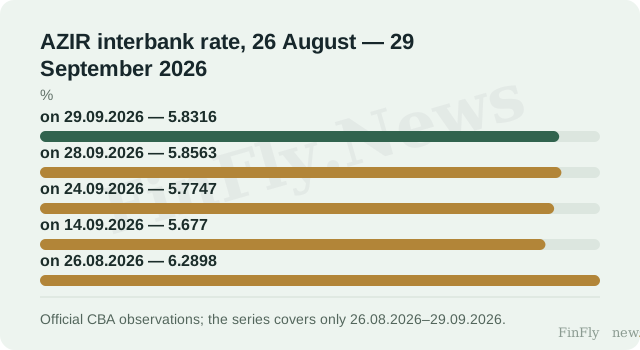
The lowering of the lower bound from 5.5% to 5% is recorded as a new effective value from 24 September 2026. The date in the entry means the start of effect, not the date of publication or of a new decision, so it is correct to speak specifically of the value entering into force. The policy rate of 6.5% and the upper bound of 7.5% in the provided data have a single date — 5 February 2026. This does not prove that they were not revised: there are simply no other observations for them, and the dynamics of these two rates cannot be confirmed.
The asymmetry matters in itself: with the policy rate and the upper bound unchanged, lowering the floor from 5.5% to 5% widens the corridor from below. But it does not follow from this that the lowering of the floor was the result of a separate decision on rates or that it reflects a change in the course of monetary policy. The observed fact is narrow: one value of the lower bound has been replaced by another, while the other two parameters in the data remain at their previous level.
Why the corridor floor is not equal to the cost of money for business
The lower bound of the corridor is not the rate on loans or deposits for the population, nor the funding price for a specific company. The AZIR interbank rate shows the level at which banks actually trade short-term liquidity among themselves. On 29 September 2026, AZIR was 5.8316% versus 5.8563% the day before. On the date the new lower bound took effect, 24 September, AZIR was 5.7747%, and the local minimum of the available history — 5.677% — falls on 14 September.
This leads to a practical conclusion for a company with floating rates: lowering the corridor floor by itself does not guarantee cheaper short-term funding until the interbank rate approaches the new floor. If AZIR holds around 5.8% with a floor of 5%, the cost of short-term money for banks remains above the lower bound. A decision to revise the borrowing budget, prices or procurement requires separate observation — the actual terms on a specific instrument, not just the level of the corridor floor.
The main point in this entry is not the size of the reduction, but its one-sidedness: the corridor floor has been lowered to 5%, while the policy rate and the upper bound in the data remain at the level of 5 February 2026. The interbank rate, meanwhile, holds above the new floor, around 5.8%. For business, this means that relying only on the lower bound when assessing the cost of short-term funding is insufficient. The limitation is simple: for the policy rate and the upper bound only one observation is available, so their dynamics cannot be judged.