
An interbank benchmark near 6% can look like a signal that business loans will soon become cheaper. Several steps separate an overnight rate from a company’s loan agreement, however. There is also a more immediate qualification in November’s series: most observations carry a fallback-calculation marker.
The latest value available at our check in the Central Bank’s table was 6.0191% for November 26, compared with 6.2672% on October 30. We calculate a fall of 0.2481 percentage points, or 24.81 basis points. That is a movement in the index, not a separate policy-rate decision.
The asterisk matters
FinFly checked all 17 published November observations from November 2 through 26. Sixteen carry the fallback marker, or 94.1%. This is a share of observations in our selected interval, not a share of banks or transactions. Calendar dates absent from the table were not filled in or treated as zero interest rates.
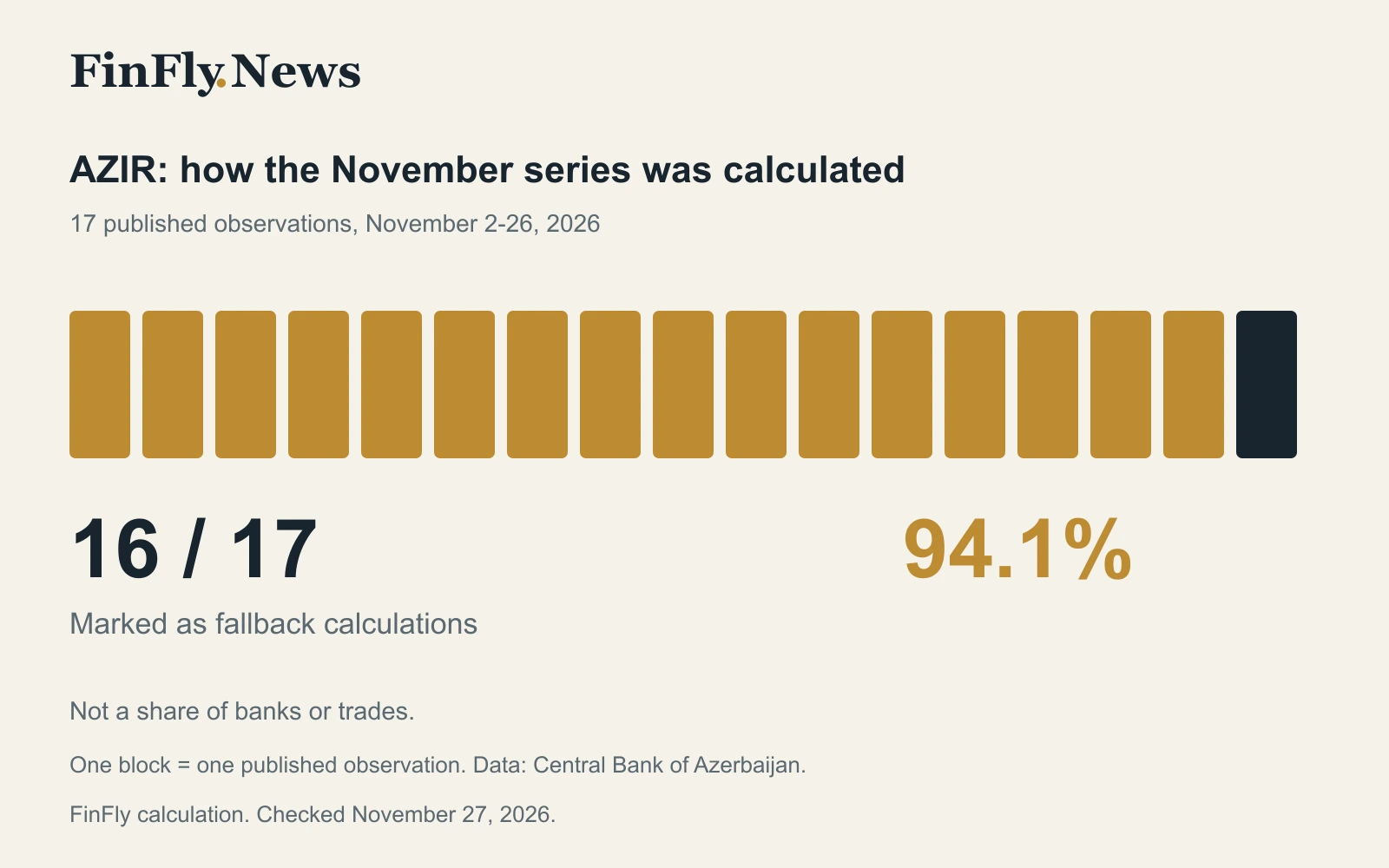
Under the AZIR methodology, fallback procedures apply when there are fewer than three eligible trades or their total value is below AZN 30 million. Crossing the monetary threshold alone is therefore insufficient: one large trade still fails the transaction-count requirement.
The fallback mechanism maintains index continuity when the transaction base is insufficient. That does not make the published value erroneous. It does mean the value should not necessarily be described as the product of a broad set of independent market trades. The asterisk also does not identify which fallback stage was used on an individual date.
Why a borrower does not automatically receive this rate
AZIR concerns unsecured overnight interbank lending in manat. A company normally borrows for a different term and presents a different credit risk. Its price may include the bank’s funding cost, expected credit losses, operating costs and collateral conditions. One benchmark cannot replace those components.
| Contract type | Meaning of a lower benchmark |
|---|---|
| Fixed rate | Does not rewrite the agreement automatically |
| Floating rate | The specified index and reset date matter |
| Contractual rate floor | The floor can limit a reduction |
| New loan | Borrower assessment and the bank’s margin also matter |
Putting a quarter-point change into money
For scale, consider a hypothetical AZN 100,000 loan with an unchanged balance for a full year. If its rate actually fell by the entire 0.2481 percentage points, the simple annual saving would be AZN 248.10: 100,000 × 0.2481 / 100. Fees and other charges are excluded.
This is a sensitivity illustration, not a bank promise. Amortisation would change the result. A contract tied to a different index, resetting later or containing a floor would not mechanically follow the example. A fixed-rate agreement would not generate this recalculation without a contractual change.
The signal worth following
When assessing the money market, examine the rate alongside the value and number of eligible trades. A broader trading base conveys different information from a stable series maintained through fallback procedures. Low reported trading volume alone, however, proves neither a system-wide liquidity shortage nor a surplus.
For a company, the next step is more concrete: compare bank offers for the same amount, term and repayment schedule, including fees. For an existing loan, check the repricing formula. A lower interbank benchmark deserves attention, but becomes a financial saving only after those conditions have been met.