
Income growth close to 10% sounds substantial, but higher prices have already absorbed part of the gain. Azerbaijan’s aggregate household income rose 9.6% to AZN 72.7117 billion in January–September 2026. Consumer prices averaged 5.7% above the corresponding period of 2025. A simple adjustment leaves purchasing-power growth of approximately 3.7% for the aggregate income amount.
Both inputs come from the State Statistical Committee’s macroeconomic summary. Our calculation deflates aggregate income using the consumer price index. It is an illustration, not a separate official measure of real disposable income, not a per-capita figure and certainly not the outcome for every household.
Why subtraction is only an approximation
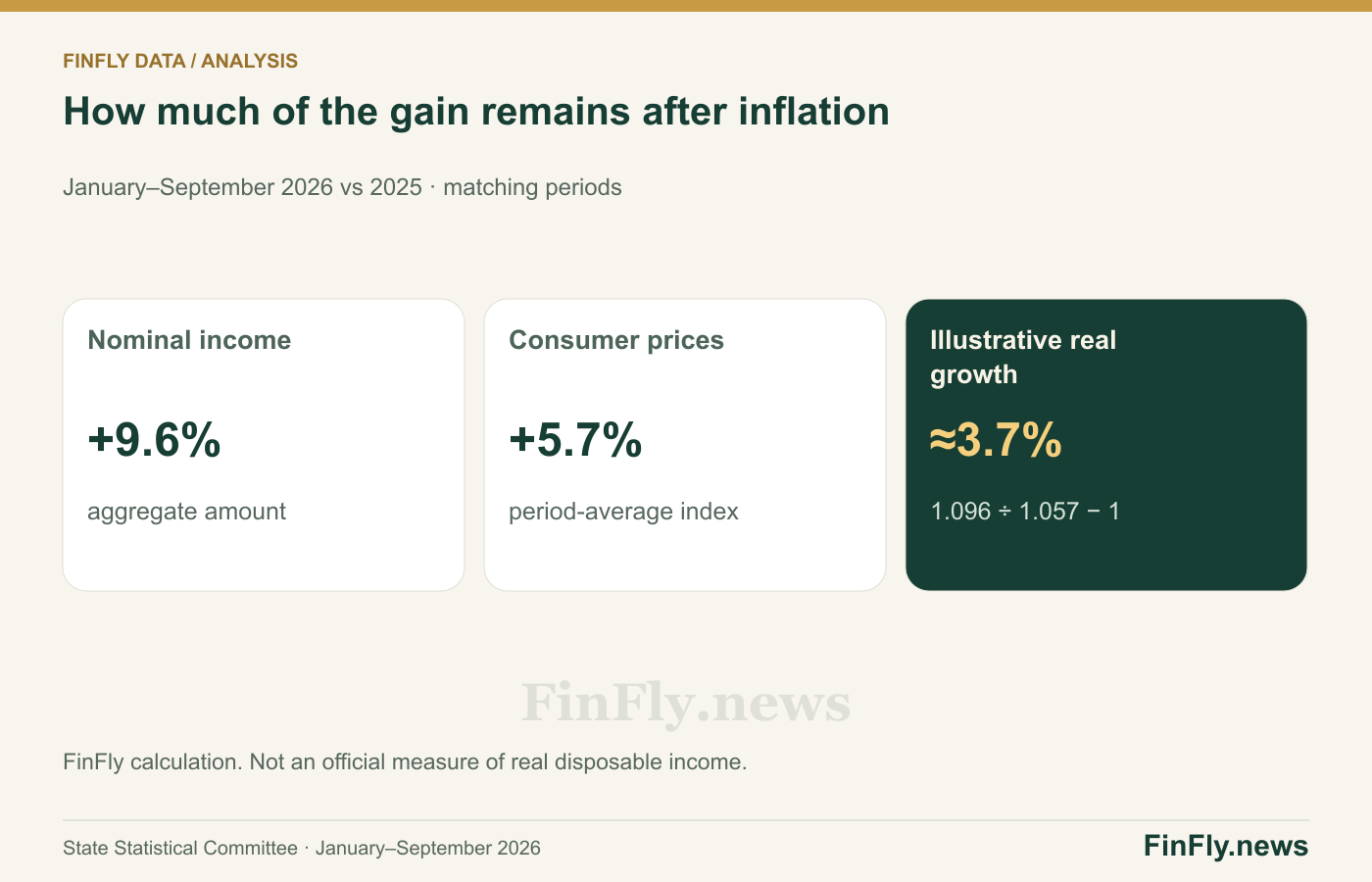
The calculation is 1.096 / 1.057 − 1 = 3.69%. We divide the income index by the price index rather than subtracting 5.7 from 9.6. Simple subtraction gives 3.9 percentage points, a convenient approximation but not the exact change in the ratio.
Imagine a fixed basket that cost AZN 100 a year ago. With 5.7% inflation, it now costs AZN 105.70. If the corresponding income amount rises from AZN 100 to AZN 109.60, it buys about 3.7% more of that basket. This is an illustration with an unchanged spending mix, not a measured household budget.
Why the national gain may not feel personal
Aggregate income combines different sources and population groups. Its increase need not be evenly shared. Someone whose income is unchanged does not gain spending power because the national total rose.
Spending baskets also differ. A household devoting more of its budget to food and rent can experience a different cost change from a homeowner with a different mix of expenses. The headline price index is not a personalised cost-of-living measure.
Income and money available for new purchases are different too. Receipts may be used to repay debt, build savings or meet mandatory payments. Without detailed income and expenditure distributions, we cannot establish how much of the increase became additional discretionary demand.
What retailers should watch
Real retail trade grew 3.8% over the nine months, with current-price turnover of AZN 50.7747 billion. That growth rate is close to our illustrative income adjustment. Similar numbers do not prove causation, however: the measures have different coverage and methods.
For a retailer, the useful distinction is between revenue growth caused by prices and growth in quantities sold. A rising average receipt can conceal fewer purchases or fewer items per basket. Businesses need their own sales mix to assess that possibility.
A nominal gain is the beginning of the calculation, not the conclusion. Households should compare their income with their own essential spending basket. Businesses should examine volumes and receipt composition. For the economy as a whole, a larger aggregate income amount is not evidence that everyone is 9.6% better off.