
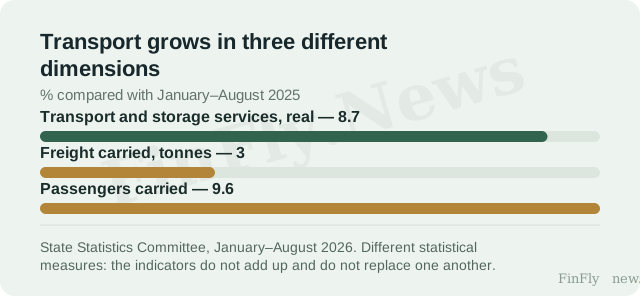
Azerbaijan's transport statistics give different answers depending on what is being measured. In January–August 2026, transport and storage services grew by 8.7% in real terms, freight carried in tonnes rose by 3.0%, and the number of passengers carried increased by 9.6%. This is not a contradiction but three different indicators. For businesses, the error begins where overall growth in services is mistaken for an equivalent increase in the need to move freight.
Not only freight transport
According to the State Statistics Committee, the value of services provided amounted to 10,931.9 million manats. Of this total, 59.4% came from freight transport, 28.1% from passenger transport, and 12.5% from storage and postal services. Consequently, the overall figure describes far more than the loading of trucks, trains or ships. The shares show the structure of the value of services in the current period, but they do not allow a precise distribution of the contribution to real growth between segments.
Over the eight months, 162.7 million tonnes of freight were carried. The bulk was by road — 63.4%, with pipelines accounting for another 25.3%. Rail accounted for 7.5%, maritime transport for 3.6%, and aviation for 0.2%. This composition does not allow national tonnage to be interpreted as an indicator of a single international route. It would be incorrect to attribute the entire increase to the Middle Corridor or to transit through the country without a separate breakdown.
A tonne has no distance
The same weight of cargo over different distances means different transport work. Therefore, tonnage does not replace freight turnover in tonne-kilometres. The structure of transport and the set of related services can also influence the difference between physical weight and the volume of services. These are possible mechanisms, not established causes of the January–August result: the data published here are insufficient to separate them quantitatively.
At the same time, 8.7% is a real rate calculated taking price changes into account. It cannot be explained simply by higher tariffs. But this indicator also cannot be transferred to the monetary revenue of a specific carrier: its dynamics will depend on its own tariffs, the set of operations and orders. Industry growth is not a measure of the profit or utilisation of each market participant.
Passengers add different dynamics
The number of passengers carried amounted to 1,491.1 million. This is a count of journeys, not the number of unique people: regular trips by one passenger are counted many times in the total. Road transport served 89.8% of recorded passenger journeys, and the metro 9.5%. The dynamics of this part of the sector, which grew by 9.6%, are closer to the overall rate of services than the dynamics of tonnage. However, such proximity of numbers does not prove that passenger transport provided the main contribution to growth.
The practical conclusion for an operator is to separate planning for freight and passenger operations. Expanding a fleet on the basis of an overall industry percentage could prove a mistake if a specific route does not replicate the national dynamics. For a warehouse, handling and storage duration matter; for a carrier, the route and the nature of the load. These parameters help translate a general signal of activity into verifiable demand for one's own service.
In the next comparison, tonnage, transport work and the value of services should be monitored separately rather than seeking a single universal number. If the available data on tonne-kilometres and tonnage diverge, this will make it possible to test the role of average transport distance. Until such a check, the main conclusion is already sufficiently clear: the sector is growing, but the figure of 8.7% does not mean that there is 8.7% more freight in Azerbaijan.