
Azerbaijan's State Statistics Committee records real growth in transport and storage services of 10.0% for January–September 2026 compared with the same period last year. Within the year, the cumulative rate increased: 7.1% for January–July, 8.7% for January–August. But the physical volume of freight transported for January–August 2026 amounted to 162.7 million tonnes — only 3.0% more than a year earlier. The value volume of services and physical tonnage are different quantities, and their divergence over a comparable period deserves attention.
What the figures show
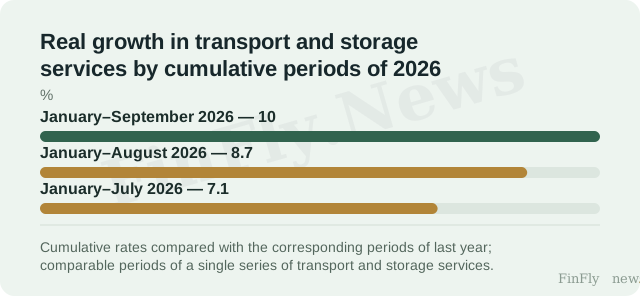
The State Statistics Committee publishes transport and storage services as a value volume, not as a quantity of tonnes or passengers. For January–September 2026, real growth was 10.0%; for January–August — 8.7%; for January–July — 7.1%. The cumulative rate rose consistently, and this acceleration relates to comparable year-on-year periods, not to a single month. The difference between 10.0% and 8.7% is 1.3 percentage points, a change in the cumulative rate, not growth for a single month.
The physical indicators for January–August 2026 give a different picture. The volume of freight transported amounted to 162.7 million tonnes, growth — 3.0%; the number of passengers — 1,491.1 million people, growth — 9.6%. In the freight structure, 63.4% is accounted for by road transport and 25.3% by pipelines; in the passenger structure, 89.8% is accounted for by road transport and 9.5% by the metro. For the comparable period — January–August 2026 — real growth in the volume of services was 8.7% versus freight growth of 3.0%.
Why these are different benchmarks for the freight business
If a company is planning purchases, rates or a transport budget, the aggregate real growth in the volume of services of 10.0% does not replace monitoring its own freight flow. Real growth in the volume of services and physical tonnage are different quantities: the first is measured in comparable prices and reflects the volume of services, the second measures the mass of freight. With a freight base of +3.0% for January–August 2026, the volume of services in the sector may grow faster than tonnes, but this does not prove that the cause is specifically tariffs, transit or a particular mode of transport.
The practical conclusion is a conditional decision boundary. As long as there is no breakdown of services by freight, passenger and warehouse-postal segments for January–September 2026 and no physical volumes for the same period, it is premature to change contractual rates or a procurement budget based only on 10.0%. Such a decision requires one's own data on utilisation, routes and tariffs, not an industry aggregate. This is a limitation, not a verdict on the indicator: it remains a useful benchmark of logistics activity.
The main point is not the double-digit growth itself, but the divergence between real growth in the volume of services and physical tonnage over a comparable period. For January–August 2026, transport and storage services added 8.7% in real terms, while freight grew by only 3.0%. This proves neither tariff pressure nor a structural shift: the breakdown of services by segment and the physical volumes for January–September have not yet been published. The proposed test is to wait for the next comparable publication from the State Statistics Committee with a segment breakdown of services and tonnage for the same period.