
Zero growth in maritime trade sounds favourable to a freight buyer: less pressure on ships and more room to negotiate. Yet a tonne of cargo does not tell us how long a vessel is occupied carrying it. That distinction prevents a weak volume market from becoming a promise of cheap imports.
In its November 26 update, UNCTAD forecasts flat maritime trade volume in 2026 but a 1.5% increase in tonne-miles. These are forecasts, not final annual results. The difference between the two measures is more informative about shipping work than the volume headline alone.
The same cargo can occupy a ship for longer
Moving an unchanged shipment over a longer route does not increase physical trade volume. It does, however, delay the vessel’s and container’s return to circulation. Additional transit days absorb some available carrying capacity. Demand for transport work can therefore rise even when the number of tonnes does not.
That is not proof that rates must increase. Vessel deliveries, sailing schedules, competition and individual port conditions also matter. But the argument that flat trade necessarily requires falling freight rates leaves out part of the mechanism. Nor does a global measure automatically describe a particular route serving Azerbaijan.
The less visible bill for waiting
For an importer, delay means more than a late container. The supplier may already have been paid while the goods remain unavailable for sale. A financed purchase incurs interest; a cash-funded purchase still ties up capital that could be used elsewhere.
Consider a hypothetical $100,000 shipment financed at 12% a year. With simple interest on an unchanged balance and a 365-day basis, ten additional transit days cost about $329. This is a FinFly scenario, not an observed average loan rate or a carrier tariff.
| Additional time | Financing cost |
|---|---|
| 10 days | $329 |
| 20 days | $658 |
| 30 days | $986 |
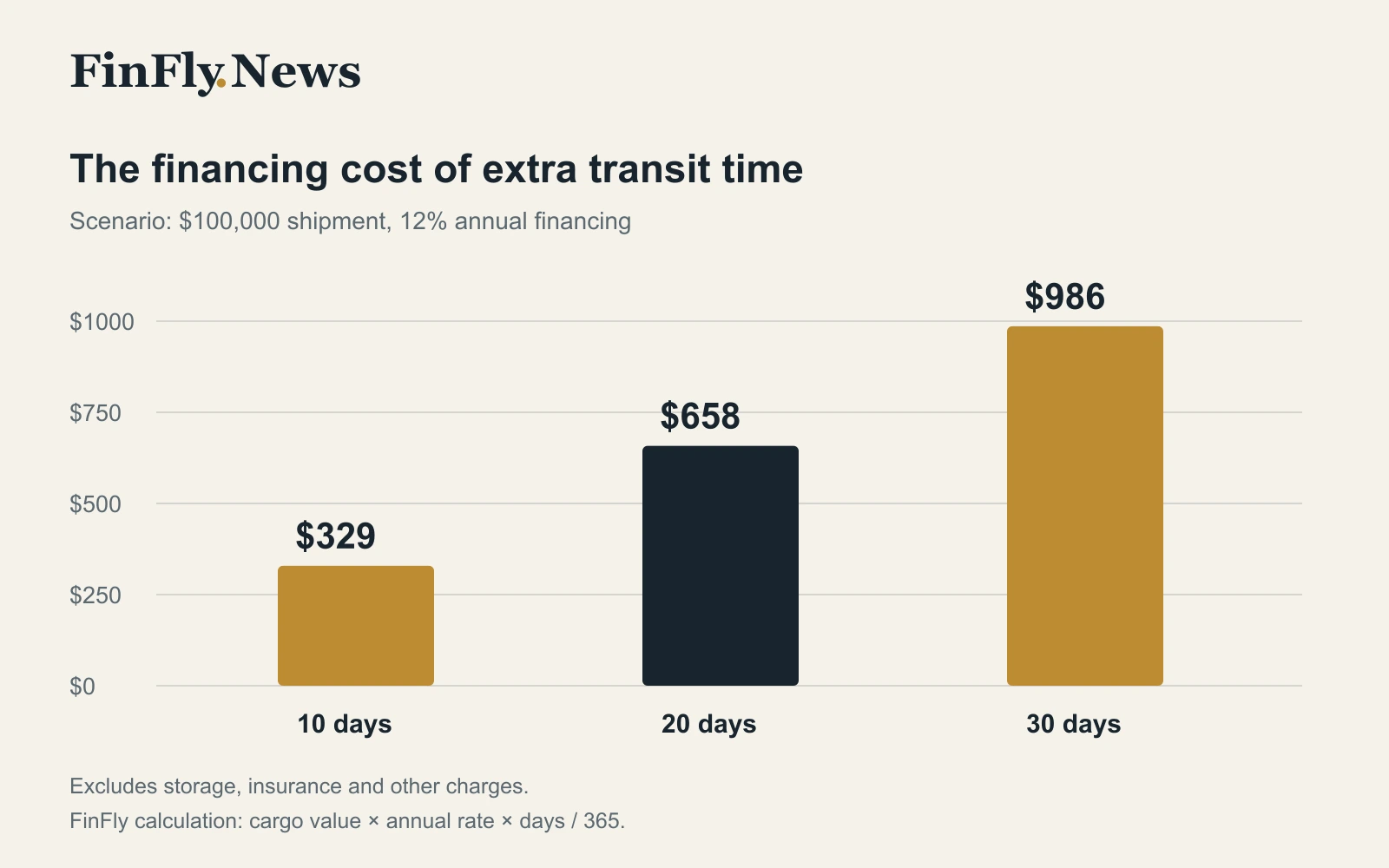
In this example, a faster route priced $250 higher could pay for itself through ten days of financing savings alone. A $600 premium would not be covered by that benefit in isolation. A final comparison must also include insurance, handling and the consequences of missed sales. One attractive ocean freight quote cannot stand in for all those costs.
Put two carrier offers on the same basis
| Question | What must be comparable |
|---|---|
| Price | Identical origin and destination, with the same charges included |
| Time | Waiting and transfers, not just sailing time |
| Capital | The amount of money tied up and for how long |
| Risk | Liability limits, insurance and the consequences of delay |
For the Middle Corridor, the full chain matters more than its most attractive individual segment. A shorter sea leg may help, but extra transfers or waiting for the next transport mode can absorb the saving. The reverse is possible too. Without comparable routes and commercial offers, there is no defensible universal winner.
A global forecast cannot do the procurement work
The practical response is not necessarily to change carrier immediately, but to change the comparison. Request an all-in delivery price and a realistic range of arrival times. Internally, agree what another day of inventory costs and which delays actually interrupt production or sales.
Flat trade can ease one component of cost while leaving another elevated. The importer does not always win with the cheapest freight quote. The more useful negotiating target is a predictable total cost for goods delivered and available to sell.