In the StartupBlink 2026 edition, Tbilisi ranks 298th with a score of 1.907; Baku ranks 308th with 1.832. The difference is 0.075 points, or about 4.1% relative to Baku's score, according to FinFly calculations. This is a ratio of index scores, not an assessment of one city's superiority in investment returns, cost of living, or funding volume.
Baku and Tbilisi's trajectories have swapped places
Global ranking position; further left is higher
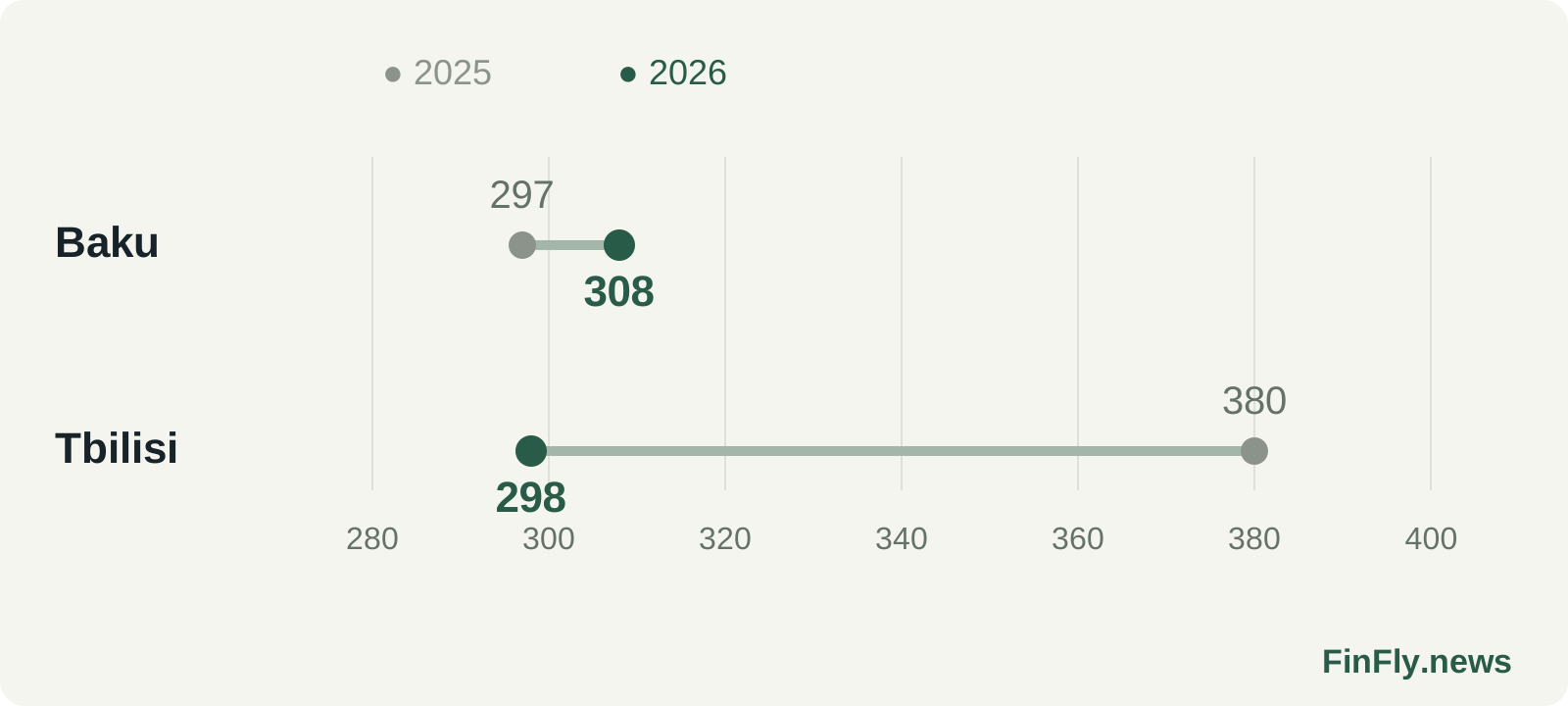
2025 → 2026. 2025 positions are calculated from 2026 places and annual changes.
Close results, different trajectories
The Georgia profile states that Tbilisi climbed 82 positions, with its score rising by 85.2%. Baku, according to the Azerbaijan profile, lost 11 places while its score increased by 19.2%. The previous edition's positions, reconstructed from these changes, are 380th and 297th respectively. Consequently, the order changed not because Baku's calculated result necessarily declined, but against the backdrop of Tbilisi's faster advancement.
The round "top 300" mark is convenient for headlines but is not an economic barrier. There is no automatic difference in investment rights or market access between 298th and 308th places. The 4.1% should not be read as a statistically significant advantage: the report does not provide confidence intervals for these two scores. The table shows an order based on the accepted model, not the accuracy of predicting an individual project's success.
How to compare support without advertising promises
A practical example of the Georgian approach is the annual GITA acceleration program, launched in January 2026. It includes Plug and Play, Startupbootcamp, 500 Global, and Founder Institute. The cycle is divided into training, product refinement, and sales development. The terms provide grants of 50,000 lari in the second phase and 150,000 in the third for startups at the relevant stages. This is the program's design, not confirmation that every applicant receives both amounts.
For a founder, the value of such a sequence lies in the ability to match support to their stage. However, the name of an international operator does not replace checking the specific package: who is eligible, what obligations arise, and whether there is access to buyers in the relevant industry. The number of applications and the number of teams that complete the program are also not equivalent to the number of sustainable companies.
In Azerbaijan, work with corporate demand is visible in the Industry Challenge by IDDA and Plug and Play, announced on September 28: technology teams are offered tasks from Baku Metro and ADY. Comparing this mechanism with the Georgian program is useful by the tasks it solves, not by the prominence of the brand. Testing with an industrial customer and universal acceleration are different tools; neither replaces all others.
These programs help understand current support directions but do not prove the cause of the ranking change. This is especially true for autumn initiatives that appeared after the annual positions were calculated. To establish their impact, one must observe participants' results after the program, account for teams' starting stages, and separate the effect of selecting strong projects from the effect of the assistance itself.
Choosing a Business Location Takes More Than a Ranking
For a team selling software to banks, meetings with banking customers, procurement timelines, and the ability to test the product are important. For a mass-market app developer, user acquisition channels and international payments may matter more. The same position in a composite index does not guarantee the same conditions for these two business models.
There is also the boundary between national and city levels. StartupBlink accounts for population when calculating country indicators but not city ones. Therefore, comparing Baku and Tbilisi cannot be replaced by comparing Azerbaijan and Georgia's places and then calling it a result solely of capital-city programs. These are related but differently constructed series.
The change in places makes Tbilisi a useful comparison point for Baku: it is worth studying which companies drive advancement and which mechanisms help them grow. But the ranking alone does not justify relocation or moving a business. Substantive verification begins where an entrepreneur has confirmed funding terms, an accessible customer, and a clear opportunity to repeat sales in the chosen market.