
According to the StartupBlink 2026 table, Azerbaijan ranks 81st with an overall score of 1.134. A year earlier, the country was in 74th place. The phrasing "startups fell seven places" is too broad: what changed was the national ecosystem's position in a comparative index, not measured revenue or the number of active companies.
The ranking measures movement relative to others
Rank depends not only on a country's own performance but also on the scores of other participants. If the score rose while the position fell, other ecosystems collectively pushed it lower. One cannot automatically conclude that exactly seven specific countries overtook Azerbaijan: the net shift may include counter-movements and the emergence of new entrants.
Neighboring markets show how much growth rates vary. In the same edition, Georgia's score increased by 78%, Uzbekistan's by 227.3%, and Kazakhstan's by 26.5%. Kazakhstan also lost one place. Consequently, even notable score growth does not guarantee an improved position. One must compare both one's own dynamics and changes among a comparable group of countries.
Azerbaijan: Growth Until 2025 and a Change of Direction
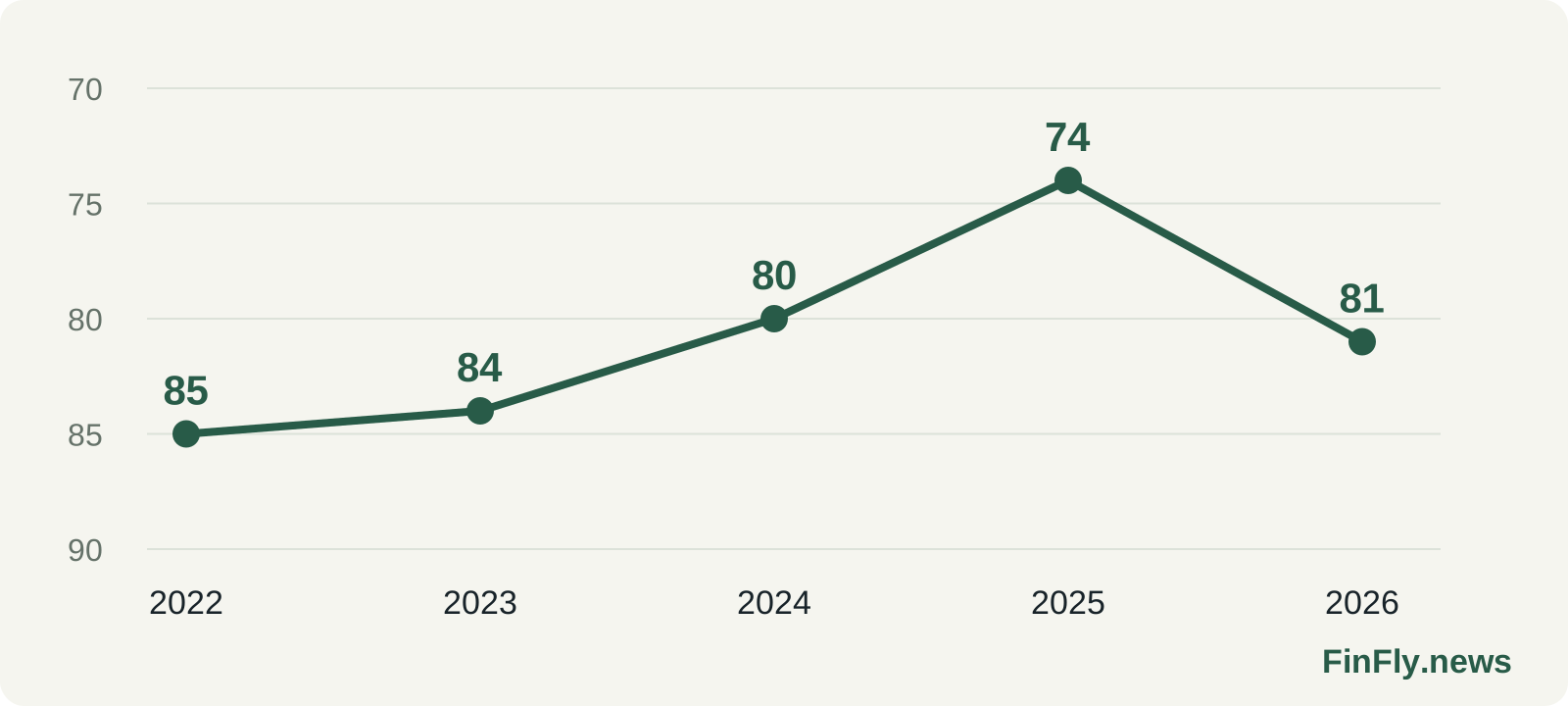
Global ranking position; lower is better
One Weak Year Does Not Erase Previous Growth
The historical chart for Azerbaijan shows a sequence: 85th in 2022, 84th in 2023, 80th in 2024, and 74th in 2025. Then comes a decline to 81st. According to FinFly's calculation, the 2026 position is still four places above the 2022 level but seven worse than the previous year. Both comparisons are valid; they answer different questions.
For assessing long-term direction, the entire series is useful; for analyzing the latest change, the most recent year is relevant. Choosing only a convenient starting point creates a false picture: comparing solely with 2022 hides the recent loss of positions, while comparing only with 2025 hides the earlier advance. Moreover, the series of ranks cannot be turned into an estimate of accumulated business growth: a position is an ordinal number, not market volume.
What Actually Grew by 7.3%
StartupBlink defines ecosystem growth as the change in the overall score between editions. The score is composed of the number of participants, the quality of results, and the business environment; at the country level, population size is taken into account. This is a composite assessment. Statements like "investment grew by 7.3%" or "there are 7.3% more startups" do not follow from it.
The composition of the index also changes. The 2026 methodology describes updates affecting universities, corporate innovation activity, and business environment assessment. The authors also warn about the impact of new data sets on results. Therefore, the score difference reflects not only changes at companies but also measurement features; it cannot be entirely attributed to economic events over the year.
Within the composite score, various combinations are possible: one component strengthens, another weakens, and the overall score remains positive. To prove which factor determined Azerbaijan's result, a comparable breakdown of its components for both years is needed. Proximity in the ranking does not substitute for such decomposition and does not show a causal link between a specific support measure and the final position.
Where the Index's Usefulness Ends
For an investor, a national position may serve as a reason to study a market, but it does not replace checking the product, customers, and terms of a specific deal. For a founder, it does not answer whether their particular team will receive funding. And for government programs, a proper evaluation of results requires company metrics: revenue, employment, overseas sales, and further development after support.
The 2026 outcome is more accurately described as a loss of relative positions amid growth in the calculated score. This is a signal about the pace of advancement compared with other ecosystems, but not a ready diagnosis for the entire technology sector. It is worth monitoring the sustainability of changes and their composition: an improved rank becomes more convincing when it can be linked to verifiable company results, not just to a change in the final table row.