
Industrial AI should be evaluated by changes in production costs and outcomes, not the number of models connected. Lower defects, shorter downtime and faster operations create value only after the full cost of deployment is included.
A Chinese departmental action plan published in January sets 2027 targets for applying three to five general-purpose large models in manufacturing, building 100 high-quality industrial datasets and promoting 500 typical applications. These are targets, not evidence of completed deployments.
From deployment counts to operating results
The same tool may improve quality control on a well-prepared line while performing poorly where data are incomplete. Outcomes depend on sensors, process organization, staff training and integration as well as the model itself.
Results should be compared with the original process at comparable utilization and product mix. Otherwise, seasonal output changes or a different assortment can be mistakenly credited to AI. Phased implementation with a control unit and a measurement method agreed in advance provides a stronger test.
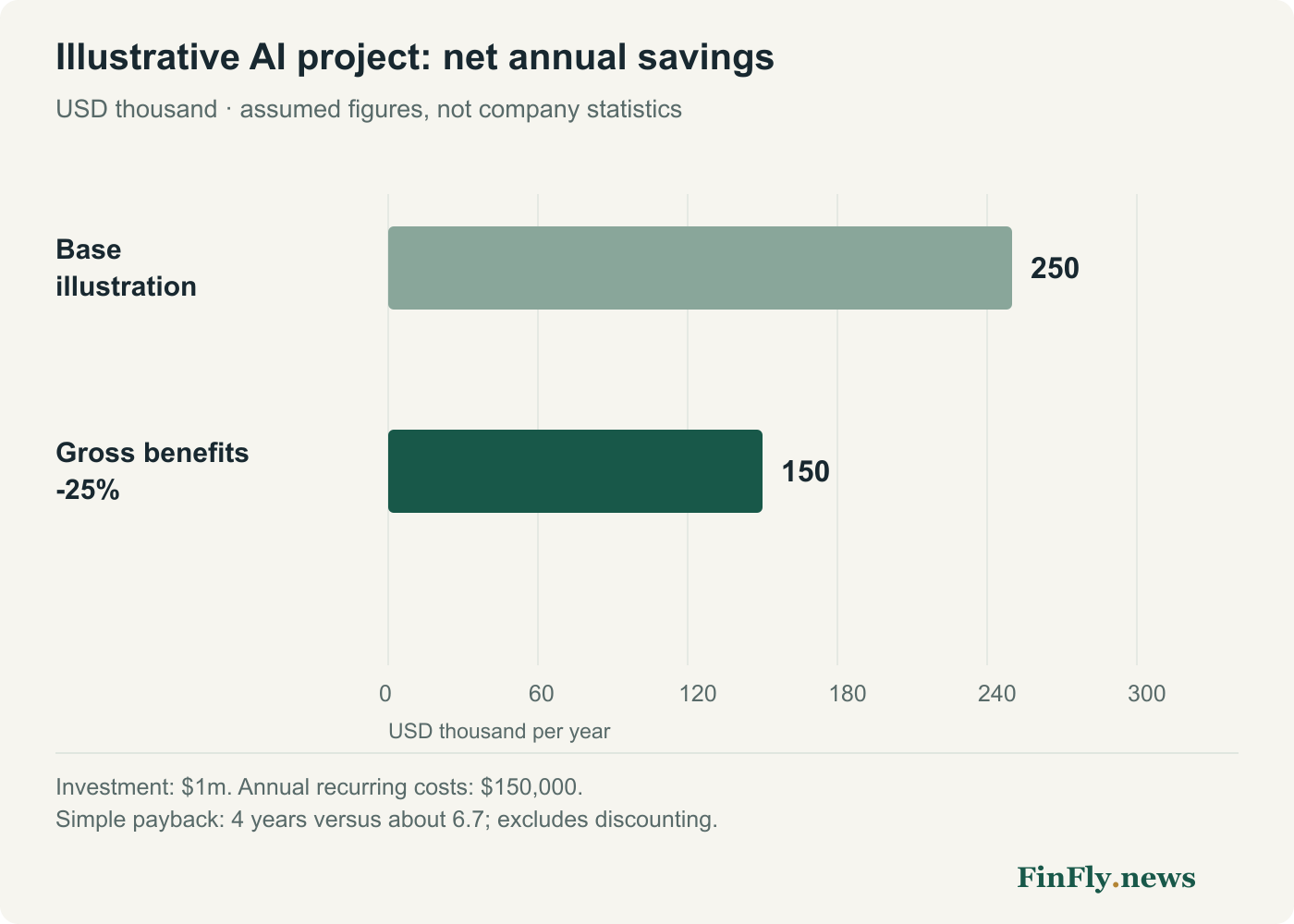
An illustrative calculation: savings must cover support
Suppose a company invests $1 million. Reduced defects and downtime deliver $400,000 in annual gross savings, while operation, computing, updates and support cost $150,000. Net annual savings are then $250,000, giving a simple payback of four years.
If gross benefits are 25% lower, they fall to $300,000. With unchanged recurring costs, net savings decline to $150,000 and simple payback lengthens to approximately 6.7 years. This is a FinFly illustration using assumed figures, not Chinese company statistics or an investment forecast.
| Measure | Base illustration | Benefits 25% lower |
|---|---|---|
| Initial investment | $1m | $1m |
| Annual gross savings | $400,000 | $300,000 |
| Annual recurring costs | $150,000 | $150,000 |
| Annual net savings | $250,000 | $150,000 |
| Simple payback | 4 years | About 6.7 years |
FinFly illustration. Excludes discounting, tax, financing costs and residual value.
Solution quality includes security and control
Chinese authorities’ May AI-agent guidelines emphasize safety, controllability and standardization. In manufacturing these have direct economic implications: an erroneous automated action can interrupt production or require products to be inspected again.
Evaluation should include access permissions, logging, rollback and manual operation. Omitting these costs to present a shorter payback distorts the decision. Saving on controls while increasing the probability of an expensive failure does not constitute a durable efficiency gain.
Scale measured results, not demonstrations
Moving from a pilot to multiple factories requires testing whether gains transfer across equipment, personnel and datasets. Costs do not all scale proportionally: some development is reusable, while integration and support may be needed at each site.
Azerbaijani businesses can apply the same approach regardless of supplier nationality. Specifications should define baseline metrics, measurement methods, full costs and acceptance criteria before deployment. Scaling can then be based on production economics rather than the persuasiveness of a demonstration.