
Expanding industrial AI changes the questions lenders should ask Chinese technology and manufacturing companies. Participation in a priority program cannot replace evidence of who will pay for a product and when investment will begin generating cash.
Fitch identifies AI as a broader Chinese credit theme. For practical borrower assessment, we distinguish equipment suppliers, software providers and companies applying AI within their own production processes.
Policy priority and funded demand are different signals
The official AI Plus initiative promotes integration across industry, research, consumption, public administration and other areas. It sets policy direction; it does not guarantee income for every project carrying an AI label.
A lending decision needs an identifiable repayment source. Policy can encourage demand, but a particular order still depends on the buyer’s budget, procurement, technical acceptance and product quality. Broad policy support alone is an inadequate basis for financing prospective revenue.
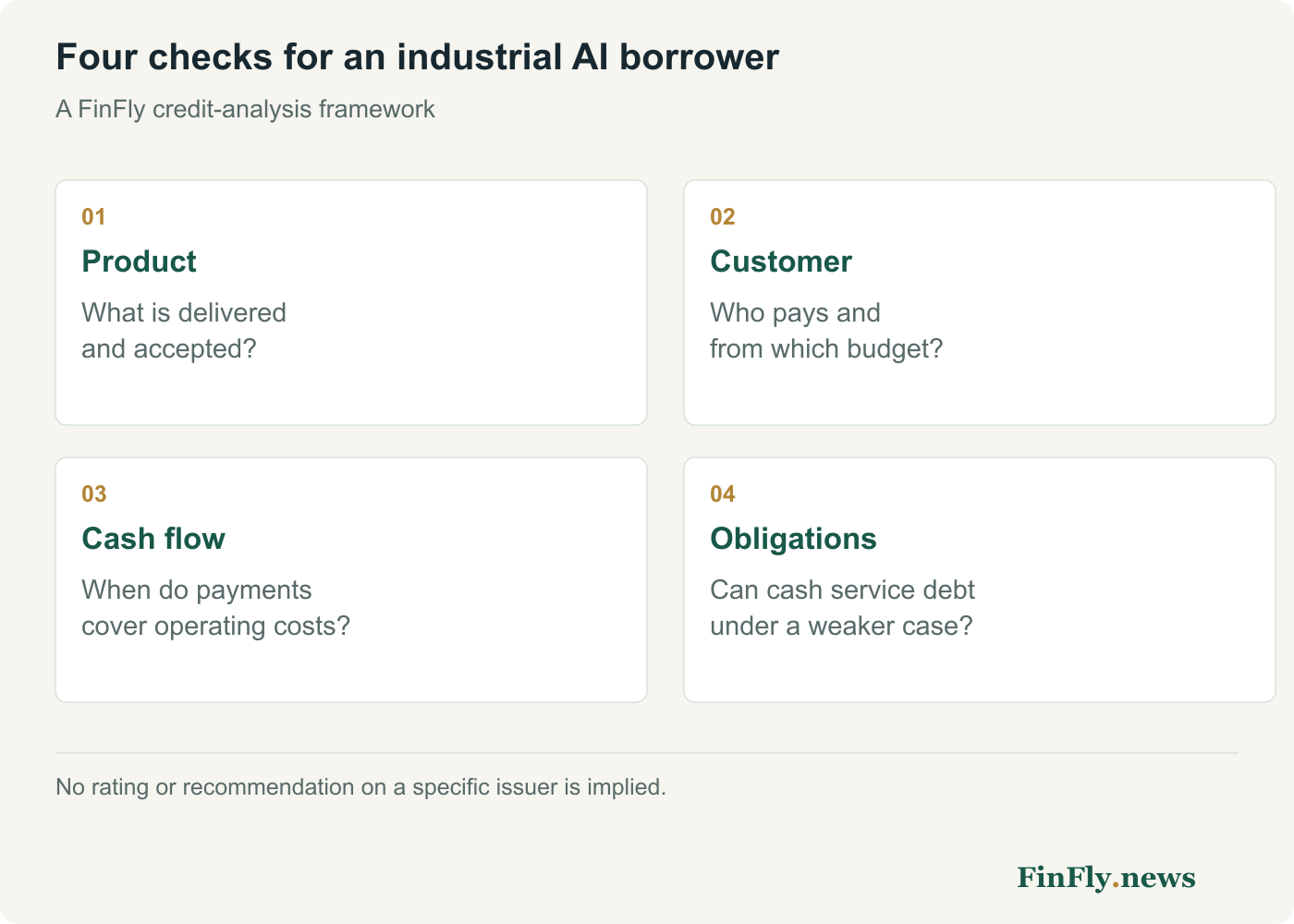
Different business models require different funding
An equipment supplier may secure large orders while financing components and inventory ahead of final payment. A software developer may incur substantial costs before repeat sales scale up. A manufacturer using AI obtains benefits through costs, quality or productivity rather than necessarily earning a separate AI revenue stream.
Identical sales growth does not therefore imply identical debt-service capacity. Analysis needs advances, payment terms, inventories, repeat orders and support costs. A signed contract must be distinguished from a delivered, accepted and paid result.
| Model | Repayment source | Main test |
|---|---|---|
| Equipment | Customer payments | Inventory, advances and receivables |
| Software | Licenses and services | Renewals and support costs |
| Industrial user | Savings and extra output | Verified benefit after all costs |
FinFly analytical framework, not an assessment of specific issuers or a bond recommendation.
Investment can precede customer payments
A business may add capacity before customers are ready to use it. Interest obligations then arise ahead of operating cash generation. Sound technology does not eliminate this timing mismatch, and reported revenue may not resolve it if payment terms lengthen.
Stress analysis should separately test delayed orders, lower prices and higher implementation costs. Maximum shocks should not automatically be added together, but it is useful to establish which risks could coincide and how much liquidity would remain.
Implications for regional customers
Azerbaijani companies purchasing equipment or digital systems need to assess supplier resilience as well as the product demonstration. Updates, spare parts, maintenance and access to data over the contract term all influence total ownership costs.
The strongest evidence is not the number of AI references in a presentation, but recurring customer payments and verified operating results. Credit assessment remains business assessment: the product, customer, cash flows and obligations must form a sustainable model.