
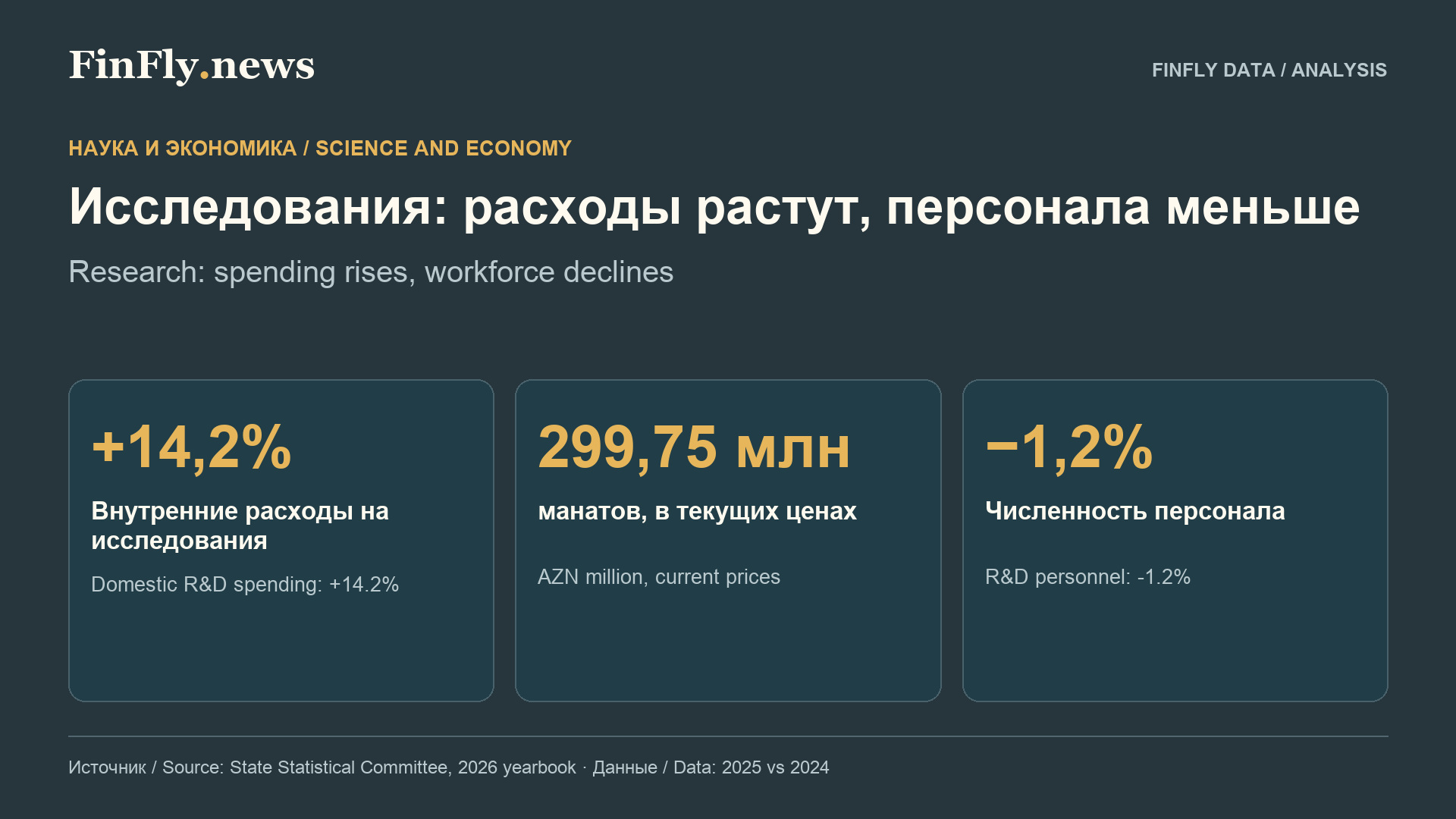
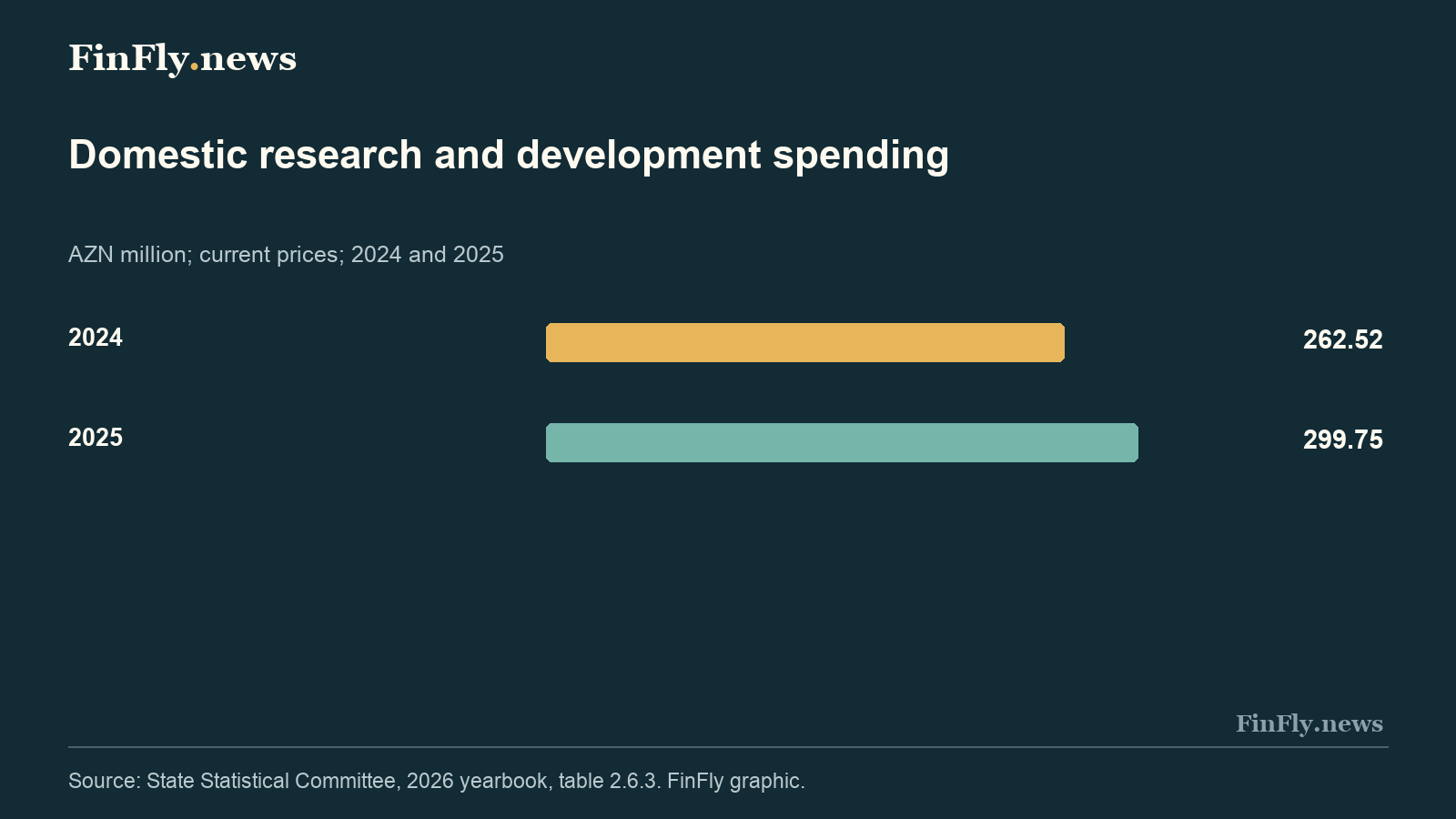
Azerbaijan's domestic research and development expenditure rose to AZN 299.75 million in 2025 from AZN 262.52 million a year earlier. Personnel engaged in R&D declined from 19,405 to 19,165. FinFly calculates spending growth of 14.2% alongside a 1.2% reduction in personnel.
The figures appear in the State Statistical Committee's Education, Science and Culture in Azerbaijan yearbook, whose release was announced on November 19. The edition is dated 2026, but the results examined here concern 2025, not the current November.
Higher spending is not proof of greater research output
Rising expenditure combined with fewer personnel implies more spending per recorded worker, but does not prove higher productivity. Spending includes more than staff compensation: other current costs and capital expenditure also contribute. Price changes matter as well, since the increase reported here is nominal.
The headcount decline alone cannot establish its cause. Staff departures, organisational restructuring and redistribution of functions require separate evidence. Total R&D personnel should not simply be described as the number of scientists: the measure includes different staff categories.
The science budget and R&D spending are not additive
| Indicator | 2024 | 2025 |
|---|---|---|
| Domestic R&D expenditure, AZN million | 262.52 | 299.75 |
| R&D personnel, people | 19,405 | 19,165 |
| State budget expenditure on science, AZN million | 197.2 | 199.4 |
The science budget line and domestic R&D expenditure represent different statistical measures. Adding them would not produce a valid total for research funding. Analysing funding sources requires the separate financing breakdown, rather than simply combining these two amounts.
Technology businesses need a connection to customers
Greater expenditure may support research infrastructure, but commercial impact is reflected in a different set of outcomes: functioning technologies, business orders, licences and deployment. Spending and personnel statistics provide an essential starting point, not a complete evaluation of innovation policy.
The central finding is that financial resources and the personnel base moved in different directions. Understanding whether this is sustainable requires comparable information on disciplines, age, compensation and applied-project outcomes. Without it, higher spending cannot be labelled either a technological breakthrough or proof of inefficiency.