Countries discussing artificial intelligence are often cast as either model developers or buyers of foreign services. There is a third role: supplying the computing capacity on which other companies run their models. For Azerbaijan, this offers a connection between energy resources and digital exports. The product being sold, however, is not electricity alone. It is a reliably completed computing task.
The World Bank’s October Europe and Central Asia Economic Update places Azerbaijan among countries with potentially favourable computing costs under an electricity-pricing assumption that covers costs. This is a model result, not a ranking of operational data centres. The report does not establish the size of Azerbaijan’s compute exports or the returns on a particular local project.
Why inexpensive electricity is not enough
In the cost structure discussed by the Bank, hardware accounts for roughly 90% of unit costs. Graphics processors are globally priced, making electricity one margin on which locations can compete. That does not make the tariff the sole determinant of success. More expensive financing or underused servers can absorb the advantage from cheaper power.
A data centre pays for equipment and infrastructure whether its capacity is fully occupied or not. The relevant variables therefore include both the price of a computing hour and the share of available hours a customer actually buys. A signed contract and sustained demand matter more commercially than a proposed facility’s headline capacity.
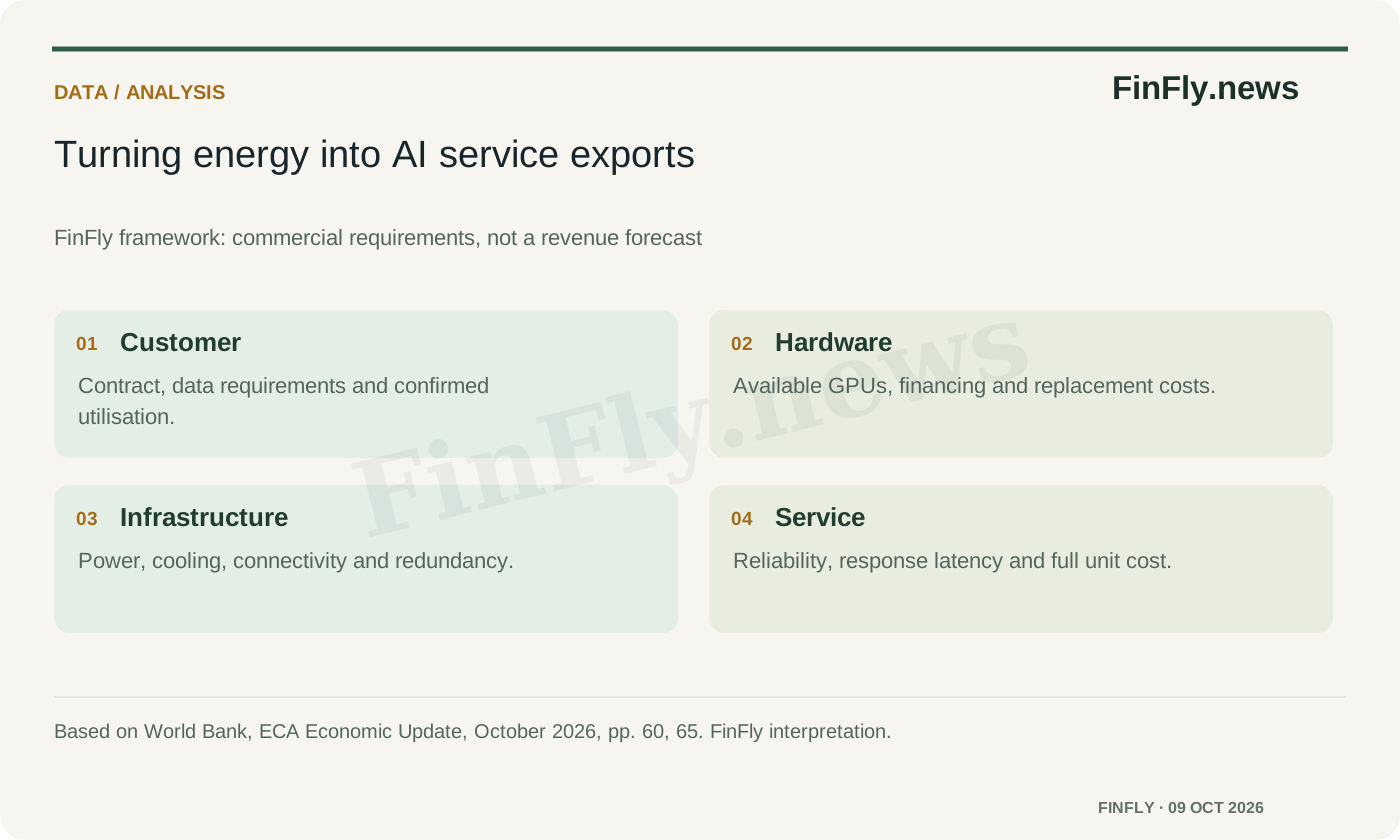
Independent FinFly analysis drawing on World Bank (2026), Making AI Work: Jobs, Firms, and Productivity, ECA Economic Update (October 2026). FinFly’s interpretations are not endorsed by the World Bank. DOI · CC BY 3.0 IGO.
Two markets with different geography
The report distinguishes model training from inference: using a trained model to produce an answer or prediction. Training is relatively less sensitive to transmission delays, allowing facilities to compete over greater distances. For interactive services, latency is more noticeable and proximity to users becomes part of service quality.
This is why the Bank considers the South Caucasus a potential location for serving neighbouring markets. Azerbaijan’s position may help in commercial discussions, but geography alone does not demonstrate demand. A supplier still needs verified connectivity, redundant links, appropriate data-handling arrangements and the ability to meet a particular customer’s requirements.
Regional investment is not the same as delivered capacity
The report describes Armenia’s Firebird AI project, under construction with a stated capacity of 300 MW, and Kazakhstan’s Data Center Valley initiative, with plans to reach 1 GW by 2031. These refer to different project stages and time horizons. Adding them together as operating capacity, or treating their future revenue as guaranteed, would be misleading.
For Baku, the initiatives signal competition for equipment, capital and customers. The absence of an equivalent Azerbaijani capacity figure in the report is not evidence that the country has no infrastructure. It means this source cannot support a reliable ranking of commissioned capacity across the three countries.
What turns an opportunity into a business
The Bank highlights GPU access, institutional trust and restrictions on cross-border data flows. Cooling also matters: water constraints can require more expensive technology. A regional list of possible obstacles should not automatically be attributed to Azerbaijan. Their relevance must be established for the individual site and contract.
A commercial assessment starts with four questions: who buys the compute, which equipment is available, what reliable operation costs, and what the customer requires of data handling. Only then can an investor estimate a payback period. Megawatts describe a facility’s size, not its business model.
Azerbaijan’s potential lies in converting an energy resource into a more complex export service. Success would require energy, technology and paying demand to work together. The report identifies an investment opportunity worth testing; it does not establish that a new export industry is already in place.