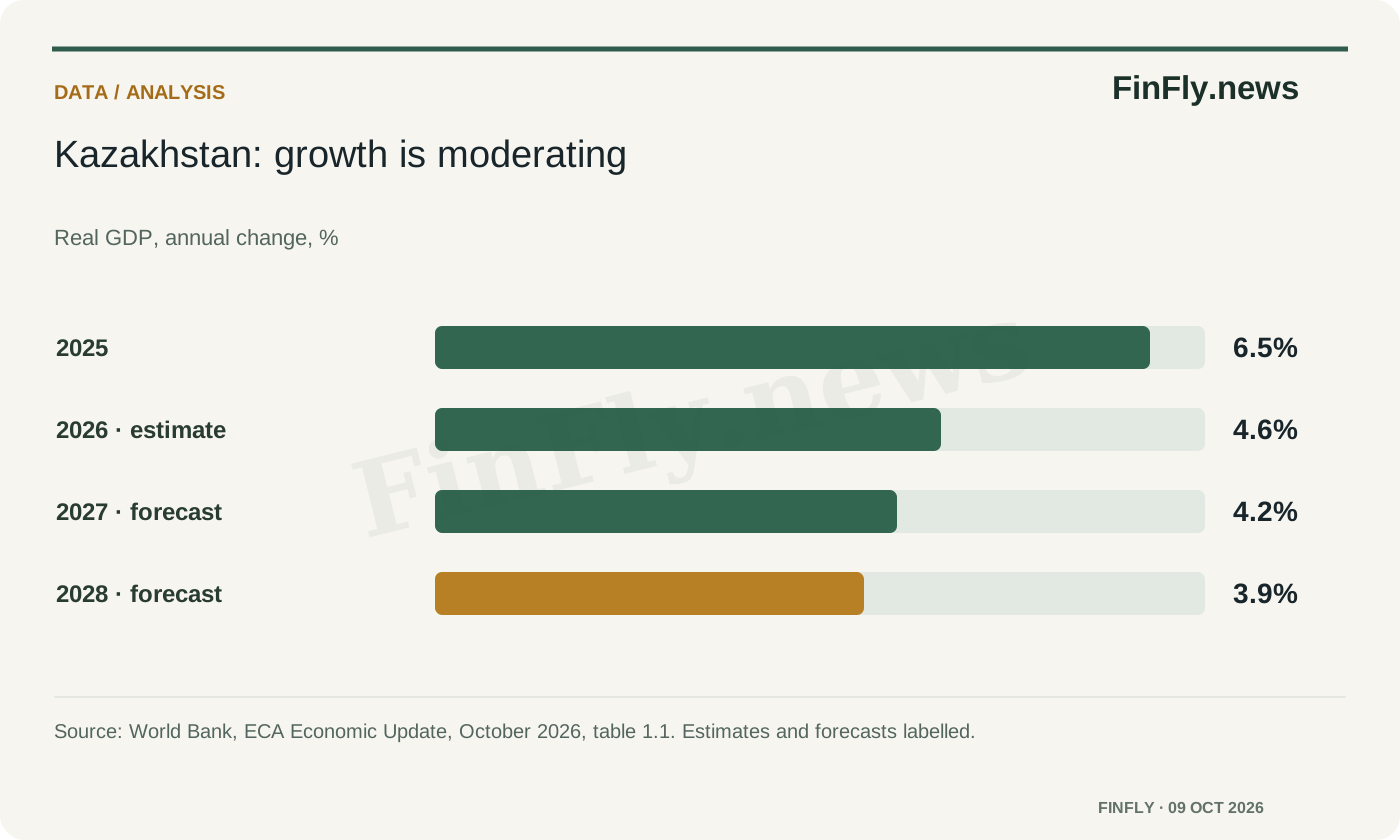
Oil prices can rise while an exporting economy slows. In the World Bank’s October regional update, Kazakhstan provides a clear example: GDP growth is estimated at 4.6% in 2026 after 6.5% in 2025, while crude output fell 8.4% year on year in January–August. Higher prices support oil income without removing production constraints.
For Azerbaijan, this is not a ready-made forecast. It is a useful distinction between three measures: how much oil is produced, how much its sale earns, and how real value added changes. Even in a favourable price environment, these measures can move in different directions. A single headline about expensive oil misses much of the economic picture.
Independent FinFly analysis drawing on World Bank (2026), Making AI Work: Jobs, Firms, and Productivity, ECA Economic Update (October 2026). FinFly’s interpretations are not endorsed by the World Bank. DOI · CC BY 3.0 IGO.
Prices can support revenue, not replace barrels
In simplified terms, sales revenue depends on volume and price. Real GDP, however, is designed to measure changes in output after removing price effects. A more valuable barrel does not become an additional barrel produced. It can improve the cash result without delivering an equivalent increase in real production.
Nor does export revenue translate automatically into budget receipts. Costs, revenue-sharing arrangements and the timing of payments also matter. Oil-price changes therefore cannot be transferred mechanically into GDP growth or future public expenditure. For a contractor, the relevant question is whether extra income becomes a funded, paid order.
The two countries face different constraints
The Bank links Kazakhstan’s performance to disruptions along the Caspian Pipeline Consortium route, maintenance and unplanned shutdowns at oilfields. For Azerbaijan, it describes a structural decline in oil production. These explanations are not interchangeable: a temporary interruption and a longer-term change in productive capacity require different responses.
Restored transport and completed maintenance could recover part of Kazakhstan’s lost output. The report does not guarantee recovery on a particular timetable. Where production is structurally weakening, investment trajectories and other sectors’ capacity matter more. A higher global oil price solves neither a transport problem nor a geological one automatically.
Non-oil growth needs more than a label
The update points to resilience in Kazakhstan’s manufacturing, construction, trade and investment. This helps explain why shrinking oil output need not mean a shrinking economy. Yet non-oil activities can themselves depend on public spending and income generated by commodities. Being classified outside extraction does not establish independence from the oil cycle.
Assessing that independence requires looking at customers and financing. A business selling abroad outside the commodity cycle and a contractor serving an oil investment project face different risks, even if neither is classified as an oil producer. This is a question for revenue analysis, not a conclusion about every company in either country.
Which indicators belong together
Businesses can learn more from a combination of physical output, export-route availability, cash revenue and real non-oil activity. The series need not move at the same time. Their differences help show whether favourable prices are generating new orders or merely compensating for lower volumes.
The Bank forecasts Kazakhstan’s growth slowing further to 4.2% in 2027 and 3.9% in 2028. That remains positive growth, not a prediction of an inevitable contraction. It nevertheless undercuts the idea that strong oil income is sufficient to preserve earlier rates of expansion.
The central lesson for Azerbaijan is to separate price support from an expansion of the productive base. The former can provide resources and time for investment. The latter requires projects, technology and durable demand. Confusing the two makes it easy to mistake stronger export receipts for a solution to the long-term growth challenge.