Amazon’s cloud growth and negative free cash flow describe different sides of an investment cycle. Profitable operations do not automatically generate enough cash to finance all new infrastructure.
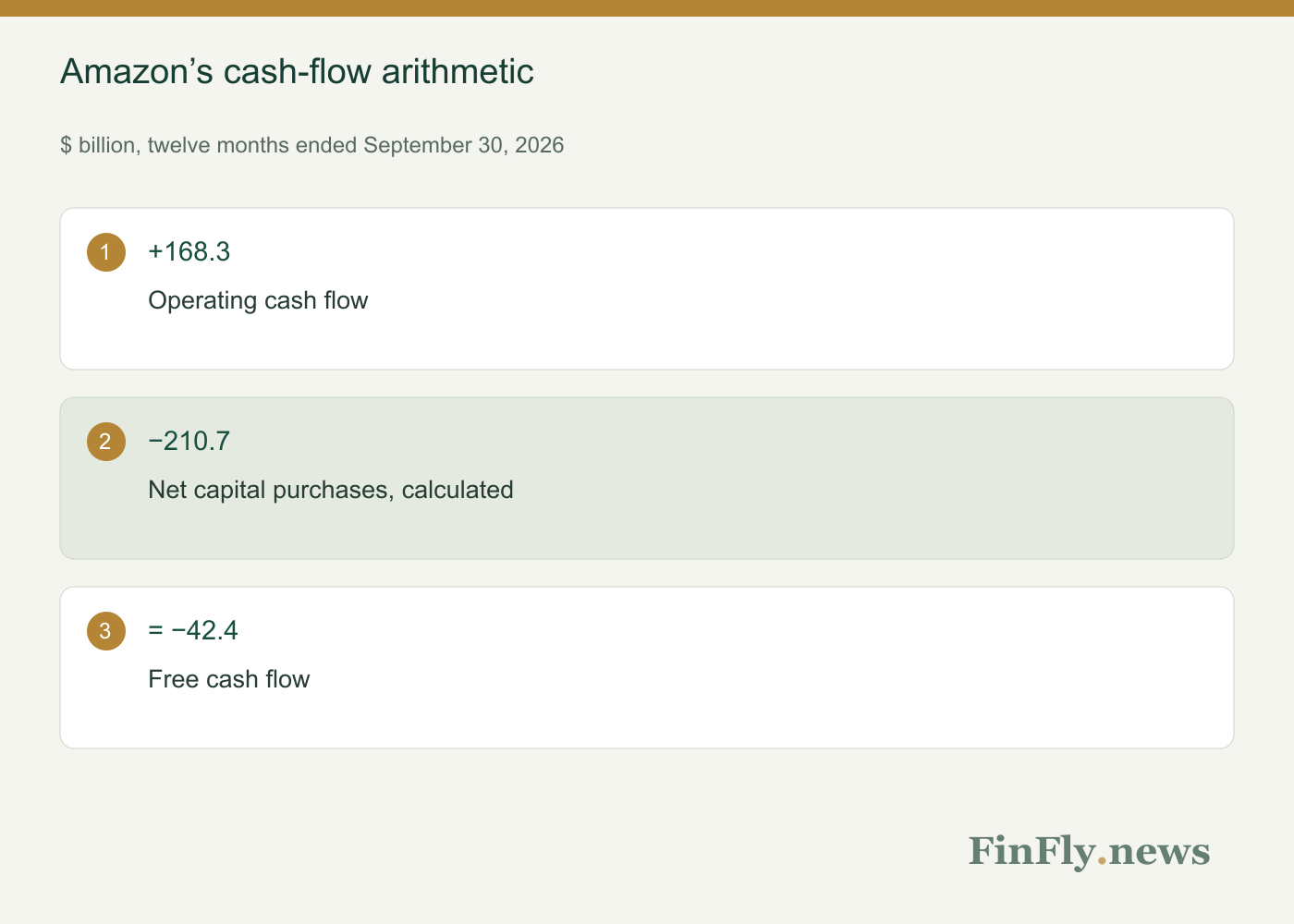
In its third-quarter results, Amazon reported AWS revenue of $46 billion, up 39.3% year on year. For the twelve months ended September 30, group operating cash flow was $168.3 billion and free cash flow was negative $42.4 billion. The company primarily links increased capital purchases to AI.
Do not mix a quarter with twelve months
AWS revenue covers one segment and one quarter. The cash-flow measures cover the group and a trailing twelve-month period. Dividing one by the other would not produce a valid cloud-segment margin.
Analysis needs a consistent reporting perimeter and period first. Otherwise, accurately transcribed figures can generate a misleading metric: annual group investment compared with one quarter of sales from only part of the company.
What the cash-flow gap shows
The rounded figures imply approximately $210.7 billion of net cash capital purchases deducted in this free-cash-flow measure: $168.3 billion minus negative $42.4 billion. This is a group measure, not an established amount spent exclusively on AWS or AI.
The implied amount is roughly 1.25 times operating cash flow. That ratio illustrates the scale of the current investment gap, but does not by itself establish the return those investments will eventually earn.
| Measure | $ billion | Basis |
|---|---|---|
| Operating cash flow | 168.3 | Amazon reporting |
| Net capital purchases | ≈210.7 | FinFly calculation from rounded figures |
| Free cash flow | −42.4 | Amazon reporting |
Consistent group perimeter and period. Net purchases reflect disposal proceeds and incentives under Amazon’s definition.
Negative free cash flow is not an accounting loss
Capital expenditure is paid when assets are acquired or built, while their cost can be recognized through depreciation over subsequent periods. A profitable business can therefore have negative free cash flow at the same time.
That does not establish that every investment outflow is justified. Economic assessment requires utilization, commissioning schedules, contract durability and returns after operating costs. Idle capacity does not become productive merely because it has been paid for.
The next test is returns on installed capacity
Infrastructure has a timing gap: expenditure comes before the full income generated by the equipment. Subsequent quarters should show whether installed capacity turns into paid demand quickly enough to support further expansion.
The lesson for regional data-center projects is similar. Investment volume cannot replace a business model. Committed utilization, electricity costs, debt service and equipment replacement all matter. Amazon’s results illustrate the scale of the challenge, not automatic proof that any AI infrastructure project will pay back.