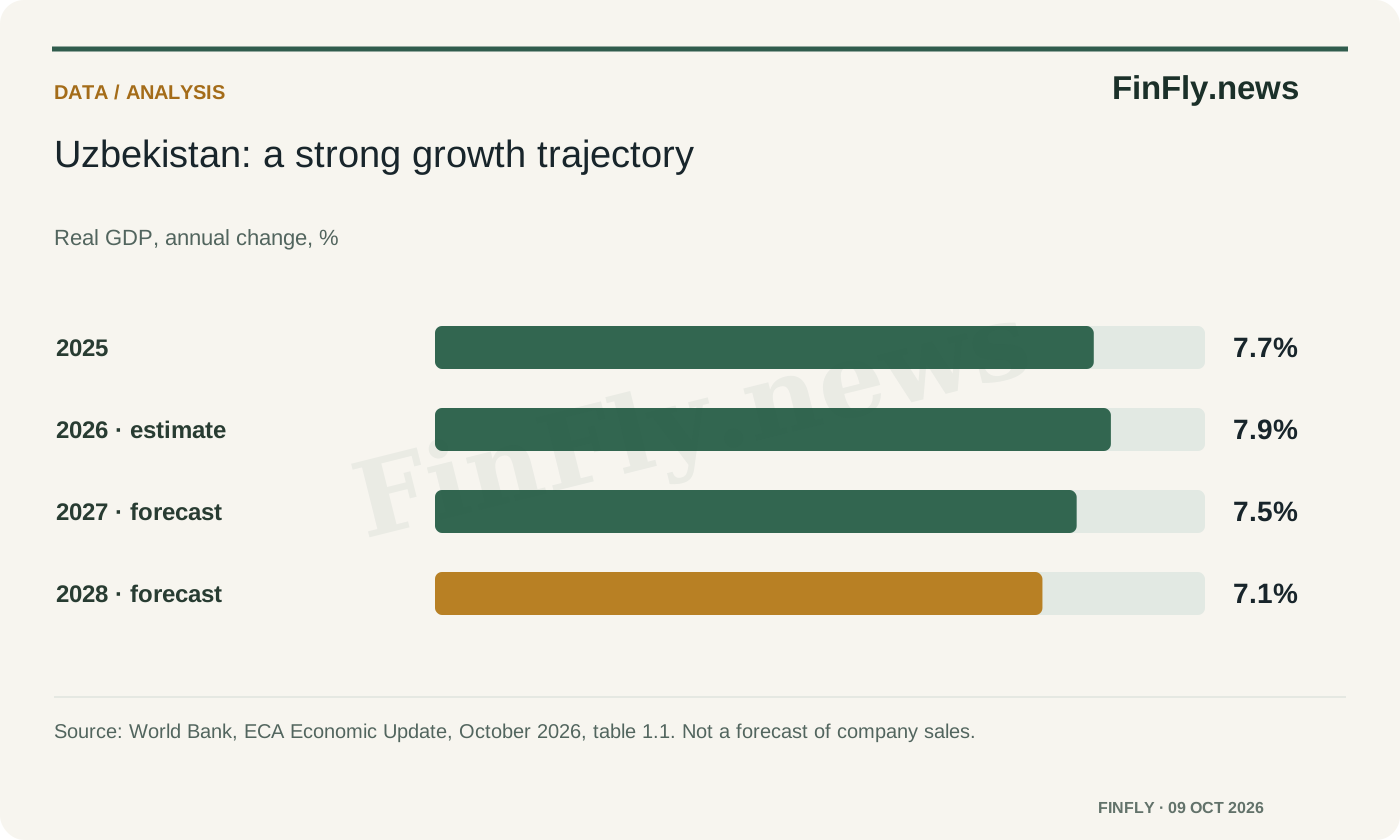
Uzbekistan stands out in the World Bank’s October outlook both for its growth rate and for the upward revision. The 2026 estimate is 7.9%, 1.5 percentage points above the April projection. Resilient domestic demand, rising real wages and employment, transfers, and spending on infrastructure, energy and housing underpin the expansion.
This combination creates demand for both consumer goods and investment supplies. For a company considering the market, however, GDP growth is only a starting point. It does not reveal how much demand concerns its own product, who pays for an order, or how durable the financing behind that demand will be.
Independent FinFly analysis drawing on World Bank (2026), Making AI Work: Jobs, Firms, and Productivity, ECA Economic Update (October 2026). FinFly’s interpretations are not endorsed by the World Bank. DOI · CC BY 3.0 IGO.
Transfers support demand without severing external ties
The report records $9.2 billion in incoming transfers during the first half of 2026, up 13% year on year. Russia accounts for around 70% of inflows in the data discussed by the Bank. Rapid local expansion should therefore not be described as complete separation from the Russian economy.
The source includes an important qualification: bank and money-transfer-system flows are a proxy for migrant remittances and can contain other transactions. Not every dollar can confidently be labelled a migrant worker’s earnings, nor can all incoming money be assumed to translate immediately into consumption.
Foreign financing is not all foreign direct investment
The Bank notes that foreign-financed investment accounts for more than 70% of Uzbekistan’s total investment. That measure combines foreign direct investment and loans. Calling the entire share an inflow of equity capital would conceal the distinction between an investor sharing project risk and a borrower taking on repayment obligations.
With equity financing, the investor’s return depends on project performance. A loan carries payments on agreed terms even if commissioning or revenue is delayed. This difference matters for resilience, but it does not in itself establish excessive national indebtedness. That assessment requires amounts, maturities, currencies and the allocation of liabilities.
Construction now, productivity later
An infrastructure project supports activity during construction through purchases and employment. After commissioning, it should deliver a different benefit: more available power, fewer transport constraints or a useful service. The first effect does not guarantee the second. An investment boom therefore needs to be assessed through operating assets as well as money spent.
For Azerbaijani businesses, this is a reason to examine specific demand chains in equipment, maintenance, transport and software. A strong forecast is not evidence of an accessible contract or an open procurement process. A commercial opportunity begins with a verified customer, market-access conditions and the ability to supply what is required.
What would demonstrate durable growth?
The Bank projects growth of 7.5% in 2027 and 7.1% in 2028: a strong but gradually moderating trajectory. It assumes the current impulse does not disappear immediately, without promising continuous acceleration. The outlook remains sensitive to foreign financing, household demand and project execution.
Commissioned infrastructure, expanding production and exports, and the quality of employment will help test that trajectory. If new capacity removes constraints on private firms, an investment wave can support later expansion without an equally rapid increase in spending. If its effect remains confined to construction, maintaining momentum is harder.
Uzbekistan’s strength is that several sources of demand are working together. Its vulnerability is that some depend on external flows. The central question is not simply how much money enters the economy, but whether it creates an ability to earn after the current investment phase is complete.