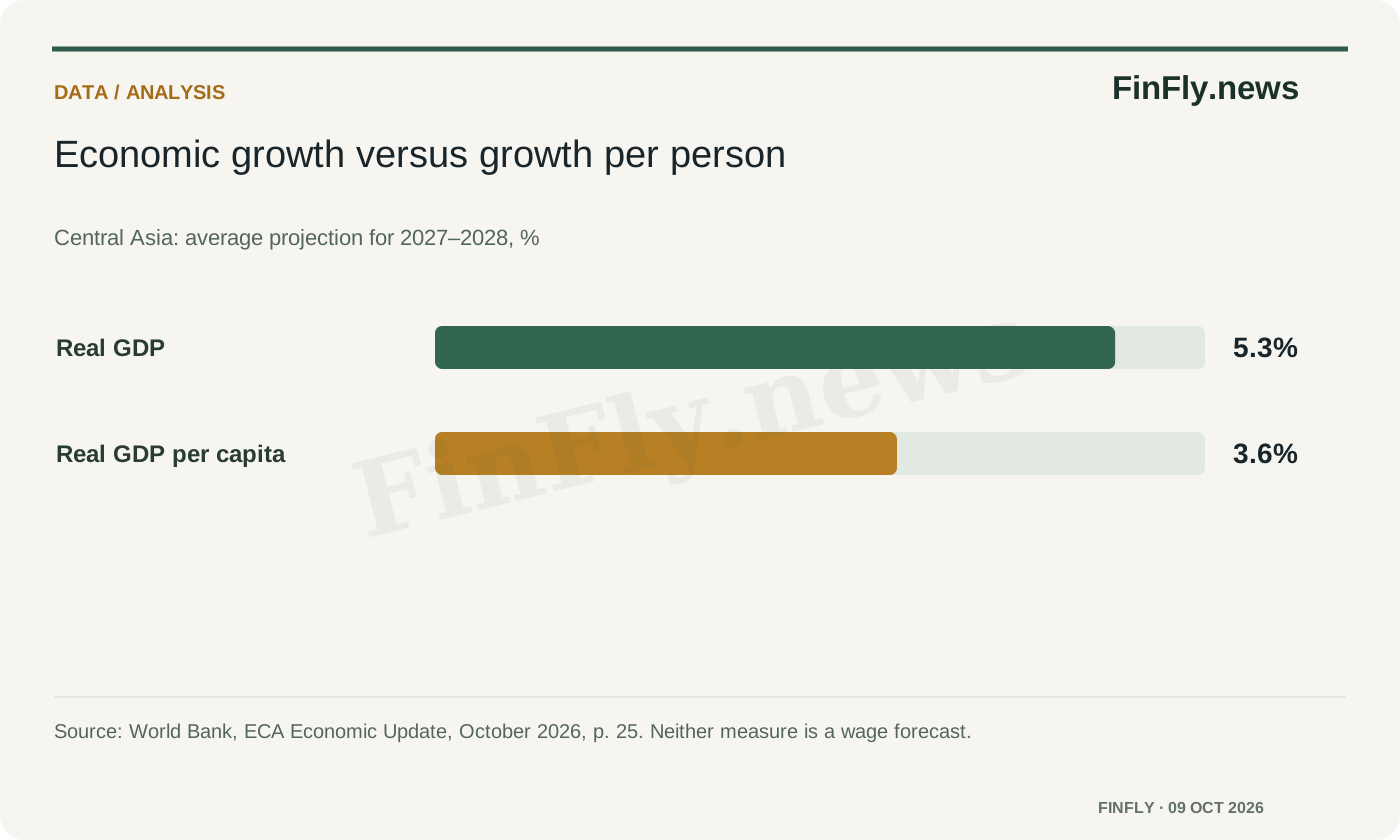
Central Asia remains the fastest-growing subregion in the World Bank’s Europe and Central Asia outlook. A second measure changes how that claim should be read: for 2027–2028, the Bank projects average real GDP growth of 5.3%, but real GDP per capita growth of 3.6%. On a per-person basis, the authors expect a pace broadly comparable with the rest of the region excluding Russia.
The difference does not mean part of the expansion disappears. Total output is divided by a changing population. An economy can expand quickly while needing additional jobs, housing and services simply to support more residents. That is different from raising the income available to each person.
Independent FinFly analysis drawing on World Bank (2026), Making AI Work: Jobs, Firms, and Productivity, ECA Economic Update (October 2026). FinFly’s interpretations are not endorsed by the World Bank. DOI · CC BY 3.0 IGO.
How the denominator changes
GDP per capita divides output by the number of residents. If both grow, the per-person result rises more slowly than the aggregate. The exact calculation uses the ratio of growth factors rather than simply subtracting percentages. The difference between 5.3% and 3.6% should therefore not automatically be presented as an official population-growth forecast.
The report is also discussing average regional rates over two future years, not an identical result for every country. The Kyrgyz Republic, Uzbekistan, Kazakhstan and Tajikistan have different trajectories. A regional projection cannot be applied without checking to an individual economy, city or household.
Output per person is not a wage
Even GDP per capita does not measure the typical worker’s income. Value added is distributed between labour compensation, business income and other components. Employment, distribution and sector composition all matter. Growth in output per resident can therefore coincide with very different outcomes for different groups.
Nominal money and purchasing power must also be distinguished. The Bank’s GDP figures are real growth rates: price effects are already accounted for. Subtracting consumer inflation from them again would be an error. For wages, by contrast, nominal changes and changes in real purchasing power need to be assessed separately.
Why businesses need both measures
The overall economy’s size matters for potential sales volumes and infrastructure demand. The per-person measure helps avoid confusing a growing customer count with an equally rapid increase in average economic resources. A low-cost mass-market service and an expensive product can benefit differently from the same demographic trend.
Neither GDP series replaces research into a specific market. Appliance sales depend on income and credit access; education services depend on age structure and families’ ability to pay; infrastructure suppliers need confirmed projects. More residents create needs, but not automatically funded demand.
Investment must expand productive capabilities
The Bank links Central Asia’s continued growth to resilient consumption and public investment in transport and energy. Such projects can remove constraints on private production. Their value depends on whether completed assets deliver operating services, employment and productivity rather than leaving the main effect within the construction phase.
For Azerbaijani firms considering neighbouring markets, this means separating two opportunities: serving a larger economy and selling more expensive goods to its population. The first can expand without an equally strong improvement in the second. The Bank’s projection provides context, not a substitute for verifying demand in the chosen segment.
A single average percentage cannot settle the argument that the economy is growing while people do not feel the benefit. The relevant questions are how much output exists per person, who receives the income and what it can buy. Central Asia retains a strong trajectory, but the quality of that expansion will be demonstrated in productivity, jobs and households’ real opportunities.