
Renewable electricity curtailment in Uzbekistan could reach about 3.5 billion kWh in 2028. The EDB scenario highlights the need to develop transmission and system flexibility alongside new generating plants.
The estimate appears in EDB’s Energy Without Borders report. Its main text associates the 2028 figure with roughly 13.6% of potential renewable output at about 11.4 GW of capacity. This is a scenario estimate, not an account of energy already lost or financial damage already incurred.
Curtailment is not necessarily an annual energy shortage
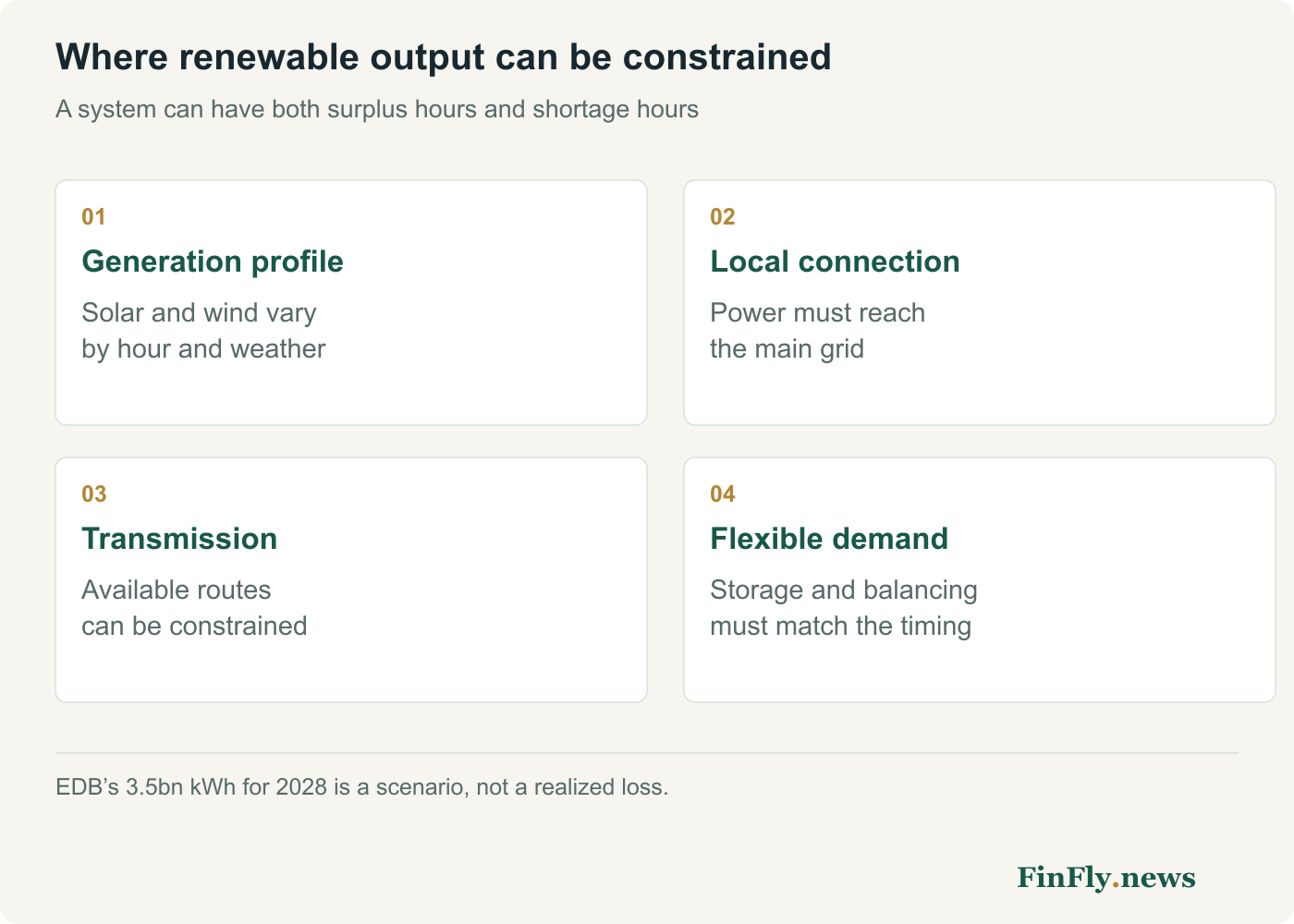
Solar and wind output depend on weather and time of day. During particular hours, production may exceed accessible demand or the ability to transmit power from a specific location. Dispatchers can then restrict output even when additional energy is needed elsewhere in the daily or seasonal cycle.
An annual supply-demand balance cannot capture the entire problem. Hourly data are needed to identify surpluses, constrained lines and resources capable of changing output or consumption. Generating capacity within a country does not automatically mean electricity is available to a customer when required.
Potential energy cannot simply be priced as financial damage
Multiplying 3.5 billion kWh by an arbitrary retail tariff would produce a misleading loss estimate. Supply prices, risk allocation and curtailment compensation depend on contracts. Some output may also have limited market value during particular surplus hours.
EDB treats preserved output as one component of a system-wide economic benefit. That is not a payment due to a particular producer and does not establish government arrears to investors. Financial analysis requires the terms of each individual project.
| Question | Required evidence |
|---|---|
| When output is restricted | Hourly generation and demand |
| Why restrictions occur | Network location, transfer limits and reserves |
| Who bears the cost | Purchase agreement and compensation rules |
| How to reduce restrictions | Costs of grid upgrades, storage and flexibility |
FinFly framework. Potential curtailed electricity and financial loss are different measures.
Regional trade cannot remove every constraint
An additional market can absorb some surplus when transmission is available and the receiving system needs electricity at the same time. A cross-border line cannot solve a local constraint that prevents power from reaching the main grid in the first place.
Storage, flexible demand and dispatchable generation address different needs. Their value depends on the duration of the surplus, the cost of shifting energy and the reliability of alternatives. No single technology solves every constraint at every connection point.
A planning lesson for new regional projects
Investors need to examine more than wind or solar resources. Connection quality, future grid loading and curtailment rules also determine delivery. A project can have sound technology and competitive generation costs while depending on infrastructure progressing to a different timetable.
For Azerbaijan and future energy-corridor partners, the scenario illustrates the value of coordinated planning for generation, transmission and demand. Aligning those elements early reduces the risk that commissioned capacity will remain unavailable for commercial delivery.