
A city can collect more tax while becoming financially less resilient. Mandatory spending only needs to grow faster while available cash declines. The relationship between revenue, flexibility and payment obligations determines the budget risk.
Fitch’s October review of eight Ukrainian cities describes that combination: increasing tax receipts, faster expenditure growth and weaker liquidity. A proposed change in the distribution of personal income tax in 2027 adds a separate planning uncertainty.
64% versus 60%: the denominator matters
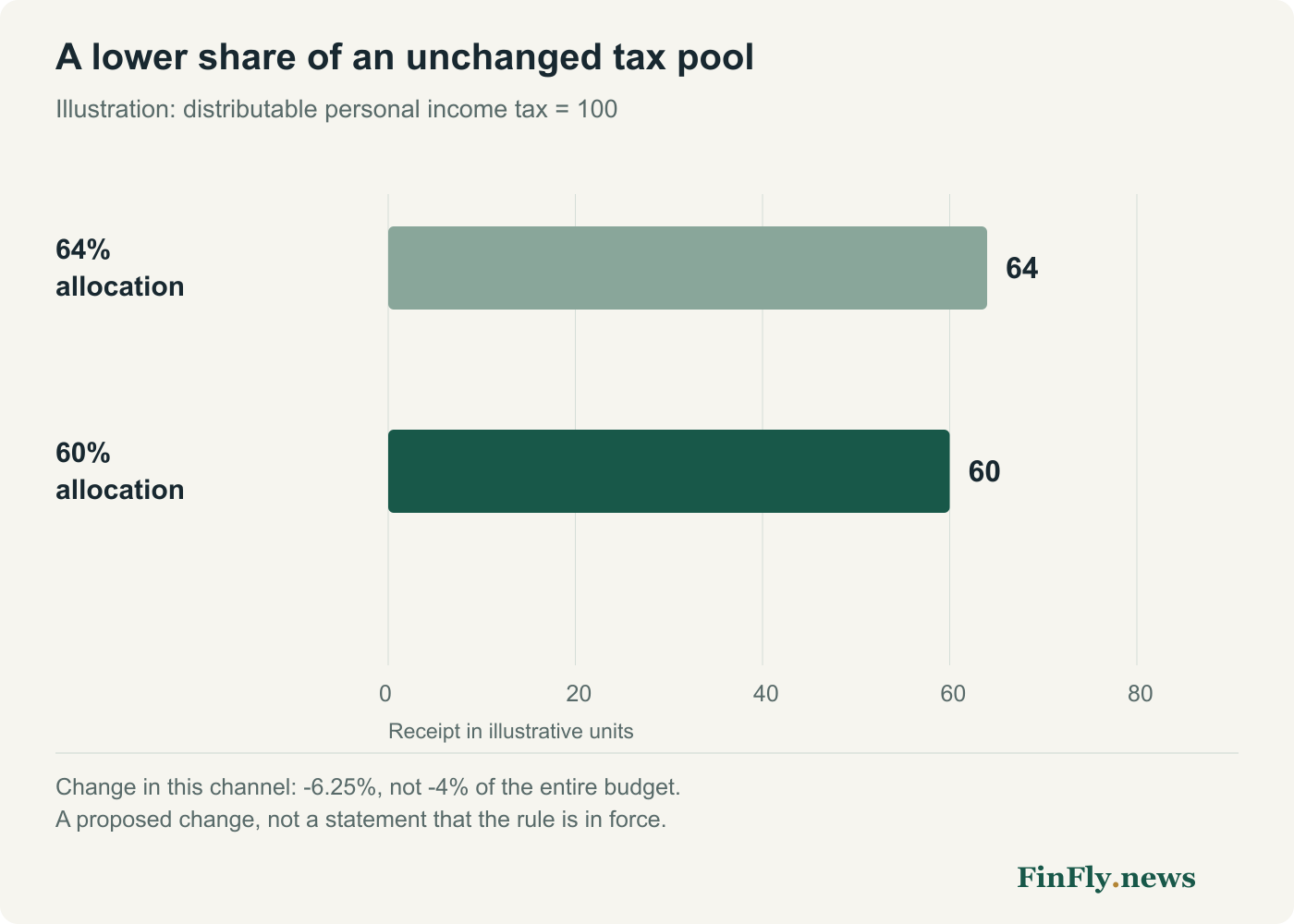
Fitch treats a reduction in the relevant personal-income-tax share from 64% to 60% as a planned measure. We analyze a scenario here, not declare that the rule has taken effect. Its applicability, final parameters and compensation need to be checked against the adopted budget.
With an unchanged distributable tax pool, receipts through this channel decline by four units for every 100 units of tax. Relative to the previous 64 units, that is a 6.25% decrease. Neither 4% nor 6.25% can automatically be described as the reduction in the entire municipal budget.
How much growth would offset the lower share?
To retain the previous 64 units at a 60% share, the distributable amount must increase by about 6.67%: 64 / 60 - 1. This is an arithmetic threshold with other factors unchanged, not a forecast of tax collections.
If the pool grows by 10%, the corresponding receipt becomes 66 units rather than 64. That is a nominal increase of 3.125%, but it does not establish greater spending power: municipal costs may be rising faster.
| Scenario | Tax pool | Share | Receipt |
|---|---|---|---|
| Original allocation | 100 | 64% | 64 |
| No growth in the pool | 100 | 60% | 60 |
| Offsetting the share change | 106.67 | 60% | About 64 |
| Tax pool grows by 10% | 110 | 60% | 66 |
FinFly calculation for one revenue channel. Excludes transfers, reliefs and other changes; not a city forecast.
Earmarked funding is not the same as flexible revenue
Even if some foregone receipts are replaced by targeted funding, financial flexibility may change. Money assigned to one service cannot automatically be redirected to another urgent need. Comparing aggregate totals alone can conceal that distinction.
A practical assessment should separate own-source revenue, earmarked receipts, mandatory spending and available balances. Timing matters too: a promised transfer arriving after a payment deadline does not close today’s cash gap. This is a general financing principle, not a claim that a particular transfer is delayed.
Borrowing fills a gap but creates future obligations
Debt can fund reconstruction or smooth a temporary liquidity shortage. If the gap instead reflects a persistent excess of current expenditure over revenue, new borrowing postpones the problem and adds debt service. Distinguishing temporary cash pressure from a structural deficit is essential before lending.
For a municipal project, a monthly payment plan, repayment source and sensitivity to rates and exchange movements are more informative than one tax-growth figure. Suppliers and lenders should assess not only the size of the budget, but the resources available for a particular obligation on its due date.