Financial results have weakened over the past year across the eight Ukrainian cities rated by Fitch. Higher tax receipts have not offset rising spending amid the war, inflation and support for municipal companies.
In its October 16 review, Fitch says all eight recorded deficits before financing in 2025, with no improvement observed in the first half of 2026. The finding applies to the rated sample, not automatically to every Ukrainian municipality.
Receipts are growing more slowly than obligations
Salary increases, infrastructure restoration and transfers to municipal companies are adding pressure. Tax revenue is rising, but expenditure is increasing faster. Nominal revenue growth therefore does not establish that the budget position is improving.
A deficit before financing identifies a gap between revenue and expenditure. By itself it does not mean debt is overdue: balances, borrowing or other available funding may cover it. Sustainability depends on the availability and terms of those resources.
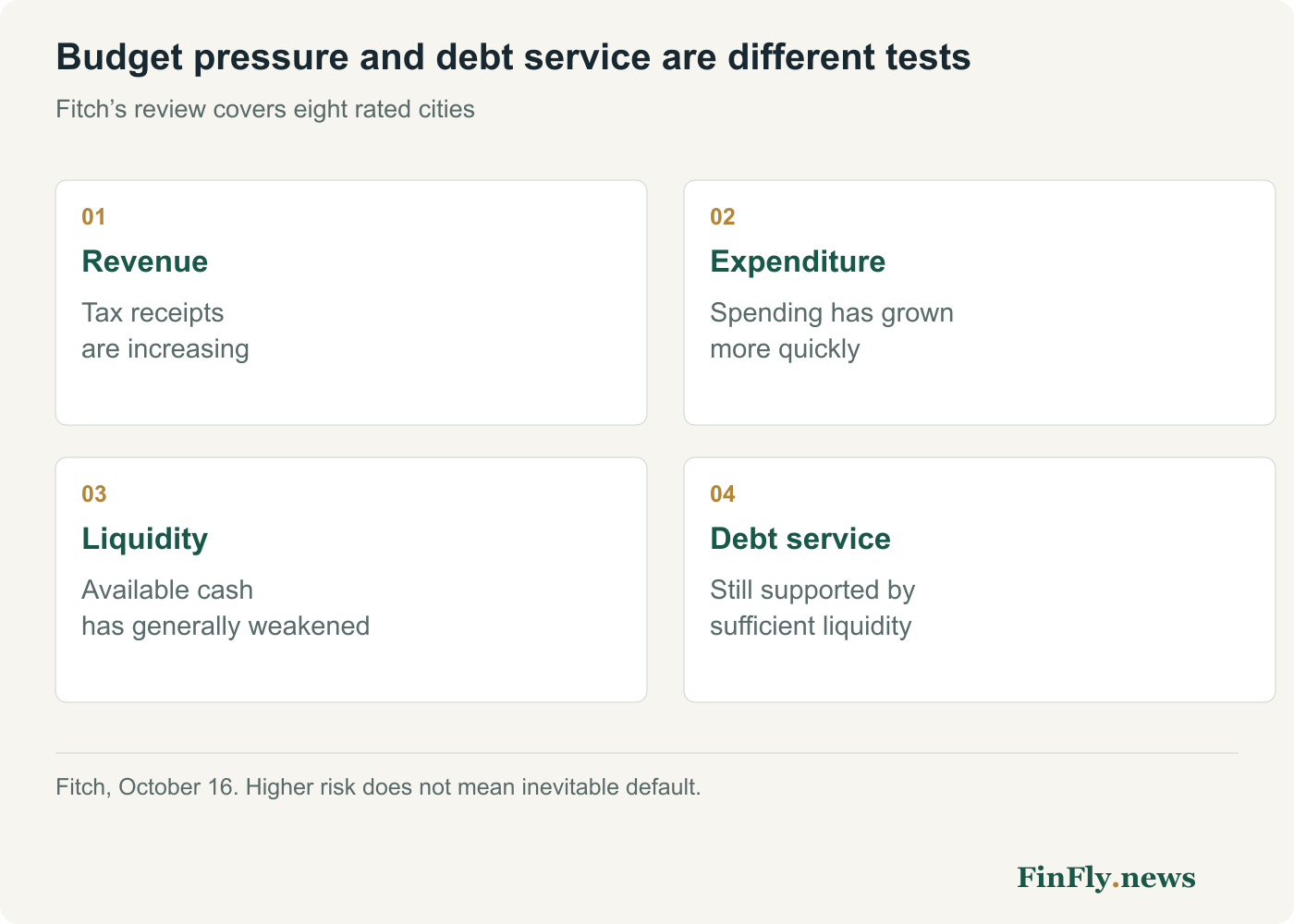
Liquidity remains sufficient, but the cushion has weakened
Fitch assesses liquidity as sufficient for timely debt service. It has nevertheless deteriorated in every city in the sample except Lviv. The agency expects mixed budget performance in 2026-2027, with weaker prospects for cities near the frontline.
Additional borrowing can support investment and immediate liquidity. Floating-rate obligations make payments more sensitive to funding costs, while foreign-currency debt introduces exchange-rate exposure. Borrowing bridges a funding gap but also creates future repayment requirements.
| Measure | Assessment |
|---|---|
| Coverage | Eight Fitch-rated cities |
| 2025 | All had deficits before financing |
| First half of 2026 | No improvement observed |
| Debt service | Liquidity remains sufficient |
| Key risks | Refinancing and a weakening liquidity cushion |
Fitch’s October 16 review, not a uniform forecast for every city in Ukraine.
A rating expresses vulnerability, not a default date
Fitch affirmed all eight cities at CCC in September. In its assessment, systemic constraints, refinancing requirements and liquidity risks leave default a real possibility.
At the same time, the agency does not expect the cities to become unable to service debt over the next 12 months. These assessments are compatible: substantial risk is not a statement that non-payment is inevitable on a particular date.
Contractors need to identify the specific payment source
Businesses undertaking municipal work should distinguish city obligations from those of a separate utility, identify project funding and examine payment schedules. A sector assessment cannot replace review of a contract and the customer’s payment record.
The central signal is reduced financial flexibility. As a larger share of receipts is needed to maintain services and restore infrastructure, budgets become more sensitive to delayed transfers, higher financing costs and additional repair requirements.