
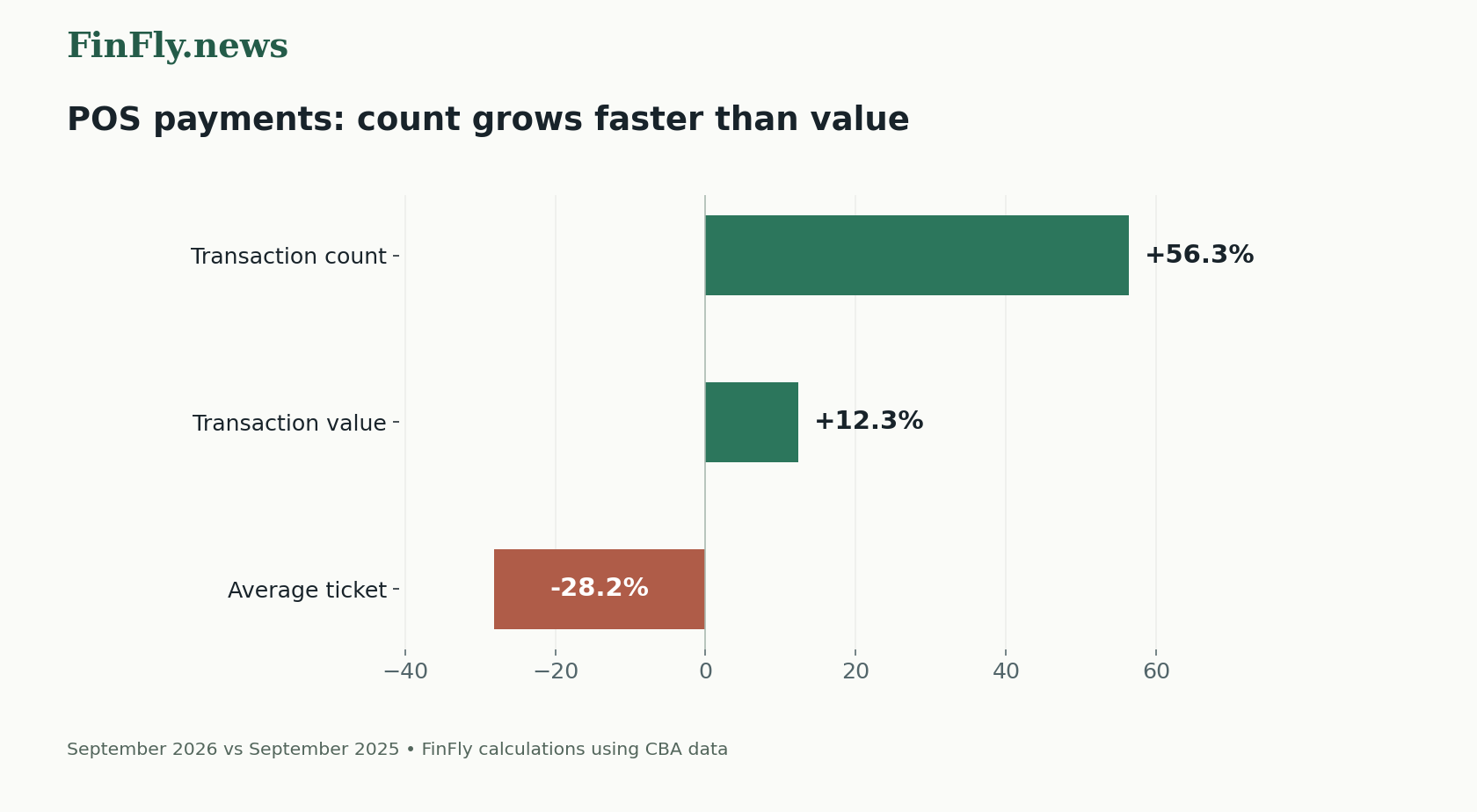
Domestic cashless POS transactions in Azerbaijan rose 56.3% in number over a year, while their value increased only 12.3%. The average transaction became substantially smaller. Banks are processing a wider stream of payments; retailers need to distinguish a shift towards cards from an increase in sales.
FinFly calculated the comparison for September 2026 and September 2025 using the CBA table on payment-card transactions. It covers domestic cashless POS transactions made with the cards in the dataset, rather than all household spending.
More transactions, smaller tickets
| Indicator | September 2025 | September 2026 |
|---|---|---|
| POS payments, million | 67.21 | 105.04 |
| POS value, AZN billion | 1.086 | 1.220 |
| Average transaction, AZN | 16.16 | 11.61 |
Dividing transaction value by transaction count produces an average ticket that fell 28.2%. This is consistent with cards being used for more small, everyday purchases. Additional payments for coffee, transport or individual items could lower the average even as total turnover expands. The table does not identify product categories, so it cannot establish their respective contributions.
Payment activity and consumer demand
A customer switching from cash to a card increases recorded cashless turnover without making an additional purchase. Splitting a large purchase into several smaller ones changes the transaction count. Higher prices can also increase nominal payment value while the quantity of goods remains unchanged. These mechanisms have different economic implications.
The 56.3% increase in payment count is therefore not a measure of consumption growth. Assessing demand requires comparable retail sales at constant prices and a breakdown of spending. POS statistics describe how payments take place, but do not independently measure purchasing power.
Different implications for retailers and banks
A retailer first needs to establish whether total revenue, including cash sales, has increased. Gross margin and the full cost of accepting payments come next: acquiring fees, terminal servicing, refunds and settlement times. More card payments can simplify accounting, but the financial outcome depends on the merchant agreement.
Banks and payment providers face a different operational question. More frequent, lower-value payments place greater demands on processing reliability and speed. With percentage-based fees, revenue primarily follows turnover. Where fixed charges apply, transaction count matters more. The same market trend can consequently affect participants differently.
The next comparison to make
September points to deeper use of payment infrastructure. Several comparable months are needed to judge whether the pattern persists. Businesses should track payment count, value and average ticket together. When count substantially outpaces value, the spread of card use does not translate into equally rapid growth in a seller's revenue.