
EDB cites a KEGOC case in which WACS increased transfer capability by 250 MW. It illustrates how better system control can reduce some grid constraints, alongside investment in physical infrastructure.
The result appears in the roadmap chapter of EDB’s report. It does not establish that 250 MW of generating capacity was built or that the additional transfer capability is continuously available under every operating condition. Transmission depends on the system configuration.
Better control can improve use of the network
A grid must accommodate not only normal flows but also equipment failures. If an operator cannot observe a changing condition quickly enough or respond reliably, allowable flows may need to be set more conservatively.
Monitoring provides information about the system. Automated control adds the ability to intervene in time. A higher operating limit must still be supported by testing, valid models and functioning protection. Installing sensors alone does not prove that an increase is safe.
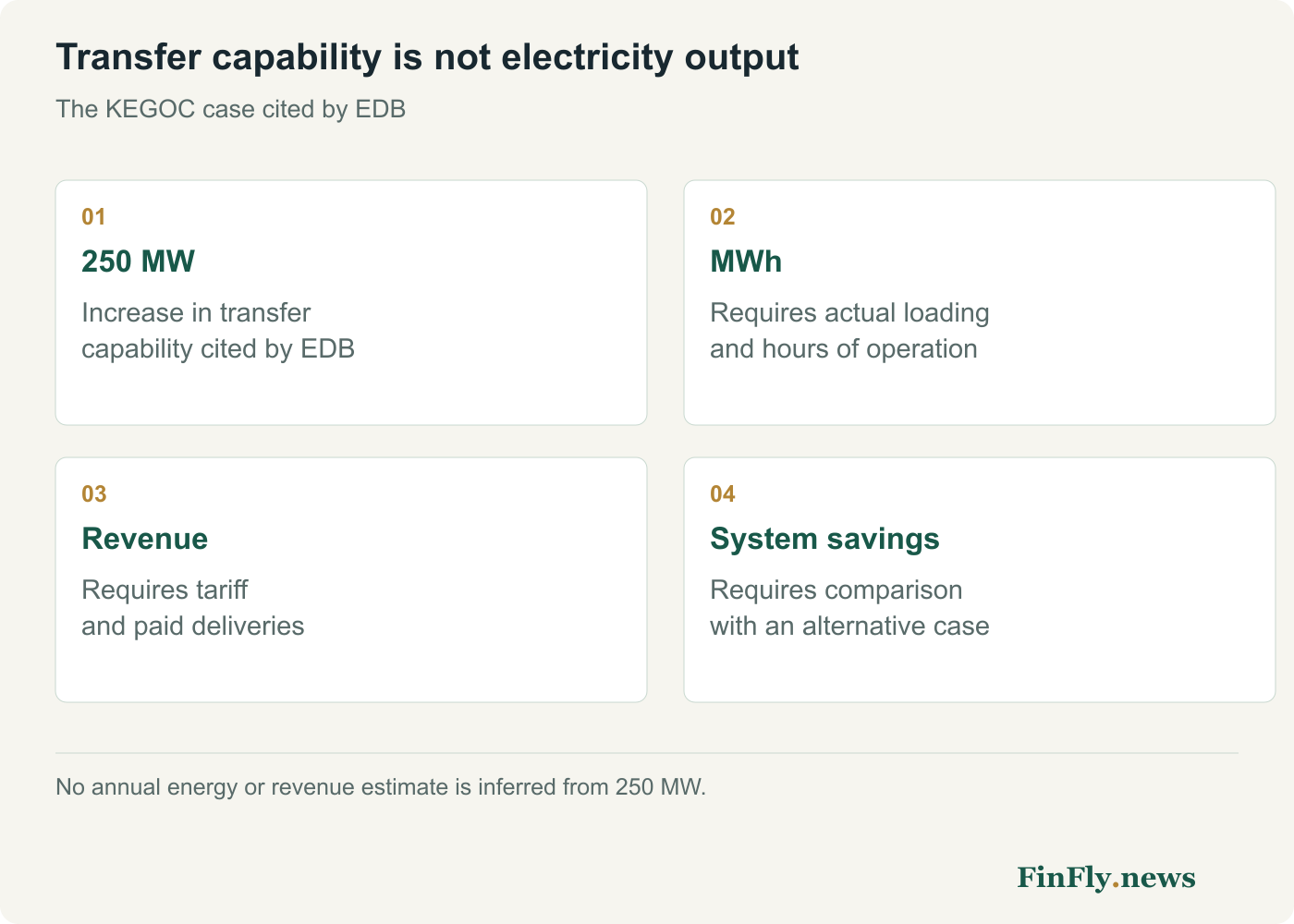
Megawatts are not megawatt-hours
The 250 MW figure measures power-transfer capability. Converting it into energy requires knowing how many hours additional transfer was actually used. Multiplying it by every hour of the year without that evidence would create an unsupported output estimate.
Energy is also distinct from revenue. Earnings require tariffs, paid volumes and access terms. A system-savings estimate requires the cost of displaced generation, reduced curtailment and other evidenced effects. Each step needs additional information.
| Measure | Unit | Required evidence |
|---|---|---|
| Transfer capability | MW | Permissible system conditions |
| Energy transferred | MWh | Actual loading over time |
| Revenue or savings | Money | Prices, volumes and counterfactual |
FinFly framework. EDB’s 250 MW figure belongs to the first level.
Automation cannot replace every physical investment
Digital control can improve use of existing assets. It cannot remove thermal limits, equipment deterioration or redundancy requirements. A constraint determined by a physical limit cannot simply be resolved with a software update.
The practical investment choice is to compare reinforcement, automation and combinations of the two using a consistent reliability model. Maintenance, communications, cybersecurity and operation when the control system itself fails matter alongside initial capital costs.
The implication for cross-border projects
Safe regional transfers require coordinated information and actions between operators. Improving one section may not increase end-to-end capacity when the next section remains constrained. A local result cannot automatically be applied to an entire corridor.
For Azerbaijan, the case provides a useful question for future grid investment: how much improvement comes from control and coordination, and how much requires new lines? KEGOC’s experience demonstrates potential, not a ready-made savings estimate for a different power system.