
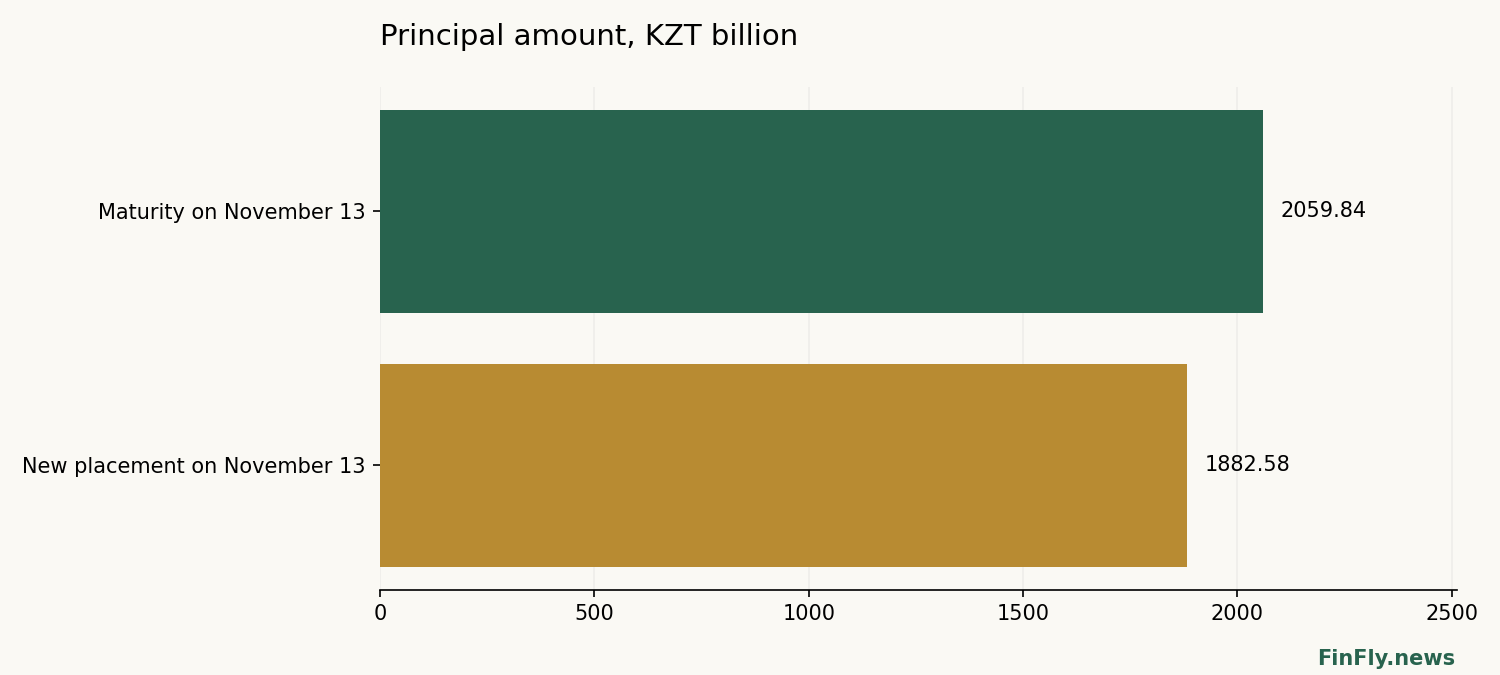
Kazakhstan's central bank accepted KZT 1.883 trillion for seven days at an annualised 15.75% in its November 13 deposit auction. Treating that whole amount as a fresh liquidity drain would miss the reverse flow shown in the regulator's operations table.
| Indicator | Value |
|---|---|
| Maturity on November 13 | 2059.84 |
| New placement on November 13 | 1882.578 |
Money enters and returns on the same day
A KZT 2.060 trillion placement made on November 6 matured on November 13. The difference between the two principal amounts is about KZT 177.3 billion: the maturing amount exceeds the new placement.
This FinFly calculation covers only that pair of operations and excludes interest. It is not the net movement across the entire money market. Other central-bank instruments, fiscal payments and foreign-exchange transactions can also affect bank balances that day.
Why maturity matters
A deposit auction temporarily places bank funds with the central bank. A large order shows demand for that instrument on a particular day; it does not establish that banks have stopped lending to businesses. Such a conclusion requires evidence on credit, borrower demand and lending terms.
There is also a maturity distinction. A seven-day placement and a multi-year loan have different liquidity and risk characteristics. A bank can manage short-term cash while retaining long-term assets.
Assessing monetary conditions requires comparing new placements with maturities and examining outstanding balances across instruments. Adding daily auction volumes without subtracting repayments repeatedly counts money that can be rolled into new placements.