
A major accident happens on a particular day, but its financial consequences can develop for years. An insurer identifies claims, estimates future settlements and pays agreed demands at the same time. A falling reserve balance therefore does not necessarily mean the event became cheaper, while a rising balance does not imply another catastrophe.
Lloyd’s first-half 2026 results report reserve strengthening for the Baltimore bridge loss and updated Ukraine estimates. Overall, however, prior-year reserve releases improved the combined ratio by 3.5 percentage points. Favourable development across a portfolio can coexist with deterioration in individual large claims.
One event can create several financial exposures
According to the NTSB investigation, the containership Dali struck a pier of the Francis Scott Key Bridge on 26 March 2024 after losing electrical power, propulsion and steering. For reserve analysis, the central distinction is between the physical event and the later determination of insured obligations.
Property damage, liability to third parties and contractual losses among transport participants require separate examination. Adding every publicly mentioned damage estimate does not produce a valid bill for insurers. Coverage boundaries, liability allocation, limits, deductibles and recoveries from other parties all matter.
A smaller remaining reserve can accompany a larger loss
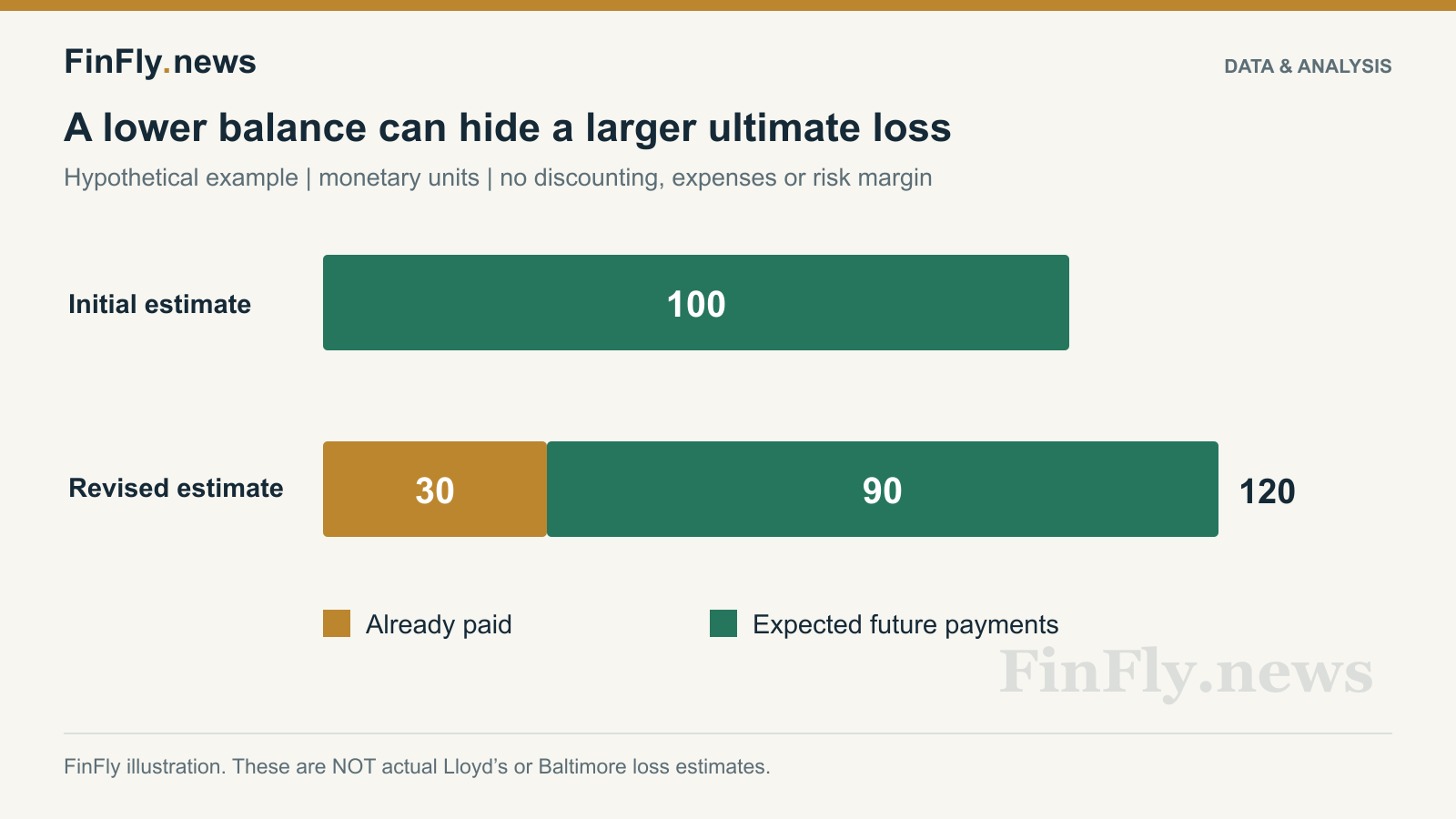
Take a hypothetical insurer initially expecting payments of 100 monetary units. It later pays 30 and revises its estimate of the ultimate loss to 120. Expected remaining payments are now 90: less than the original 100, even though the event has become 20 more expensive. This simplified FinFly model excludes discounting, expenses, reinsurance and risk margins. It does not represent actual Lloyd’s or Baltimore reserves.
In ICP 14, the International Association of Insurance Supervisors addresses technical provisions through a current estimate of obligations and a margin for uncertainty. This is an international supervisory framework, not one accounting rule for every jurisdiction. Transparency about changes in data and assumptions is central.
| Measure | How to interpret it |
|---|---|
| Paid claims | Money already transferred to meet claims |
| Remaining obligations | Expected future payments under the applicable valuation method |
| Estimate revisions | Changed expectations that can affect current-period results |
| Reinsurance recoveries | A separate cash flow with its own timing and counterparty considerations |
Payout rankings cannot tell the whole story
High payments may reflect fast settlement, a large portfolio or the conclusion of old cases. Low payments may indicate a quiet period, but they can also accompany lengthy negotiations. Without the age of claims and movements in reserves, those circumstances are difficult to distinguish.
A company choosing an insurance partner for a complex infrastructure project can usefully examine large-loss development: how estimates changed, what has been paid and what remains disputed. An unchanged initial estimate is not inherently a sign of quality. A justified revision reflecting new evidence makes accounts more useful even when it reduces current profit.
Assessing Azerbaijani insurers requires their own financial disclosures. The international case does not establish a local reserve deficiency. It demonstrates why a one-year comparison of premiums and cash payouts cannot describe the full financial position.