
The State Statistics Committee has published foreign trade data for January–July 2026: imports amounted to $9,880.7 million — down 27.4% in nominal terms and down 43.0% in real terms compared with the same period of 2025. Non-oil and gas imports stood at $9,491.6 million, down 26.4% nominally and 42.6% in real terms. Within this aggregate, trends diverge so widely that the average figure ceases to be a guide for any specific market.
Cars and computers: two different markets
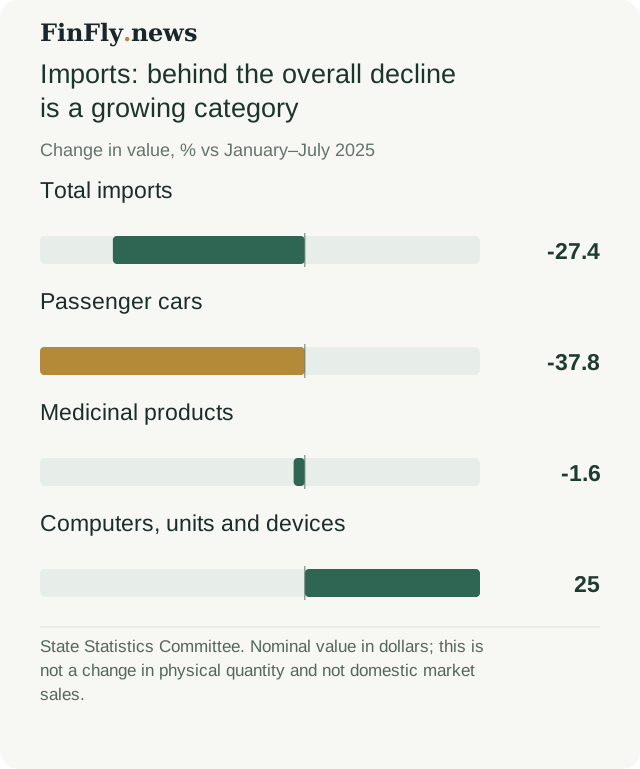
The value of passenger car imports was $660.0 million for 36,169 units, a decline of 37.8% nominally and 37.7% in real terms. The nominal and real indices here almost coincide, meaning the movement in value is not explained by price changes alone: the contraction also affected the physical volume of supplies. This indicates a reduction in car imports, but it does not measure domestic sales: those may be influenced by inventories and other sources of supply.
Computers, units and devices present the opposite picture: $108.8 million, up 25.0% nominally and up 10.3% according to the published real index. Nominal value increased faster than the published real indicator. This difference cannot automatically be taken as a price increase for an identical device: the composition of supplies within the commodity group may change. This is the only growing category in the sample, and it is growing against the backdrop of an overall 27.4% decline in imports.
Medicines: value and the real index diverge
Imports of medicinal products amounted to $274.4 million, down 1.6% nominally but down 28.2% in real terms. Nominal value barely changed, while the real index fell noticeably. An assessment based only on dollar value would give a far calmer picture than an assessment based on the real index. Explaining the gap requires data on prices and the composition of medicine supplies; from two aggregates alone it is impossible to determine which medicines became less accessible. It is important not to read the minus 28.2% as tonnage: in the table this is a real index, not mass in tonnes, and the two must not be equated.
Imports of unwrought or semi-wrought gold, or gold in powder form, amounted to $21.2 million for 136.5 kg — down 99.4% nominally and down 99.6% in real terms. This is a sharp decline in this category, but its share in the overall decline in imports is not calculated here. Attributing a significant part of the slump to it would be incorrect: the direction of influence is visible, the scale is not.
What this means for business
The import aggregate is not a proxy for demand for an individual product. A company planning purchases or marketing based on the minus 27.4% risks applying the average to a segment that behaves differently. A conditional implication: for a computing equipment supplier, the overall decline does not describe its market, whereas in the automotive and pharmaceutical segments the real contraction in volumes may be more significant than nominal dynamics suggest. This is FinFly's reasoning based on published statistics, not the result of a survey or a forecast.
Separately, it is worth keeping in mind that the data prove neither import substitution nor impoverishment. They record multidirectional movements in value and physical volumes. A trade surplus of $10,256.0 million is accompanied by import compression and in itself does not indicate a universal export boom: exports rose 39.1% nominally and 11.2% in real terms, non-oil and gas exports rose 2.8 times nominally and 2.0 times in real terms, but import compression remains an independent factor.
What to check
In future releases, it will be possible to check whether these multidirectional changes in commodity categories persist. Their convergence would change the picture, but in itself would not prove that the previous gap was random. And to assess domestic demand, import data must be distinguished from sales and inventories: a good may be brought in today, sold later, or already be in a warehouse. The main result of the current comparison is that an overall decline in imports coexists with growth in individual supplies and does not provide a universal forecast for every importer.