
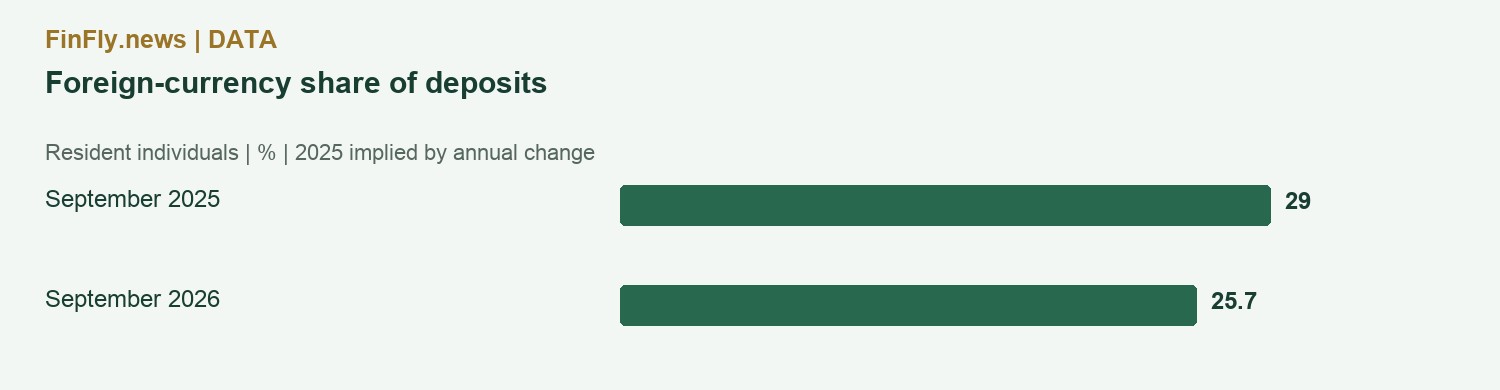
The foreign-currency share of resident individuals’ deposits declined 3.3 percentage points over a year, increasing the relative weight of manat savings in this group’s deposit base.
Changes in deposit currency composition
The CBA September data put dollarisation of resident individuals’ deposits at 25.7%. A year earlier the figure was 29%, implied by the announced decline of 3.3 percentage points.
The complementary manat share is therefore 74.3%, compared with 71% a year earlier. This describes the deposit mix of a defined customer group. It cannot automatically be extended to cash savings, corporate accounts or all household financial assets.
Deposit shares and absolute balances
Faster growth in manat deposits can reduce the foreign-currency share even when foreign-currency balances remain stable. Assessing flows therefore requires absolute balances for both currency groups.
The release does not provide those balances. It confirms a shift in composition towards manat but cannot separate conversion of existing deposits, fresh inflows and other movements. The published figures establish a change in deposit composition, without identifying foreign-currency outflows.
| Deposit mix | September 2025 | September 2026 |
|---|---|---|
| Foreign-currency share | 29.0% | 25.7% |
| Manat share, calculated | 71.0% | 74.3% |
| Change in FX share | -3.3 percentage points |
Savings and future currency obligations
For a household earning and spending mainly in manat, a manat deposit makes it easier to compare interest income with local expenses. Where overseas education or a major foreign purchase is planned, the currency of that future payment becomes another consideration.
Returns, maturity and withdrawal terms need to be assessed together. The market share captures savers’ combined decisions, not the right allocation for every individual. The September figures confirm an increased share of manat deposits within this customer group.
Deposit growth accompanies lower dollarisation
At the 29 October press conference, Taleh Kazimov said individuals’ demand deposits rose by AZN 2.1 billion over the first nine months, while term deposits increased by AZN 1.4 billion. The combined increase across the two categories was AZN 3.5 billion.
The governor linked this trend to rising incomes and confidence in manat savings. He cited increases in both depositor numbers and balances, as well as the contribution of deposits below AZN 30,000. This is the regulator’s assessment: aggregate data do not establish how each household divided the proceeds of currency sales between consumption and saving.