The regulator lowered its inflation forecast for 2026 and raised its 2027 projection. The baseline assumes unchanged government-regulated prices and tariffs.
Revisions to the 2026 and 2027 forecasts
The CBA October forecast puts year-end inflation at 5.9% in both 2026 and 2027. The July figures were 6.1% and 5.8%, respectively, implied by the announced revisions of minus 0.2 and plus 0.1 percentage point.
The revisions point in different directions. The assessment for the coming December improved while the more distant outlook worsened. The figures do not specify a monthly inflation trajectory. Each forecast refers to annual consumer-price growth at the end of the respective year.
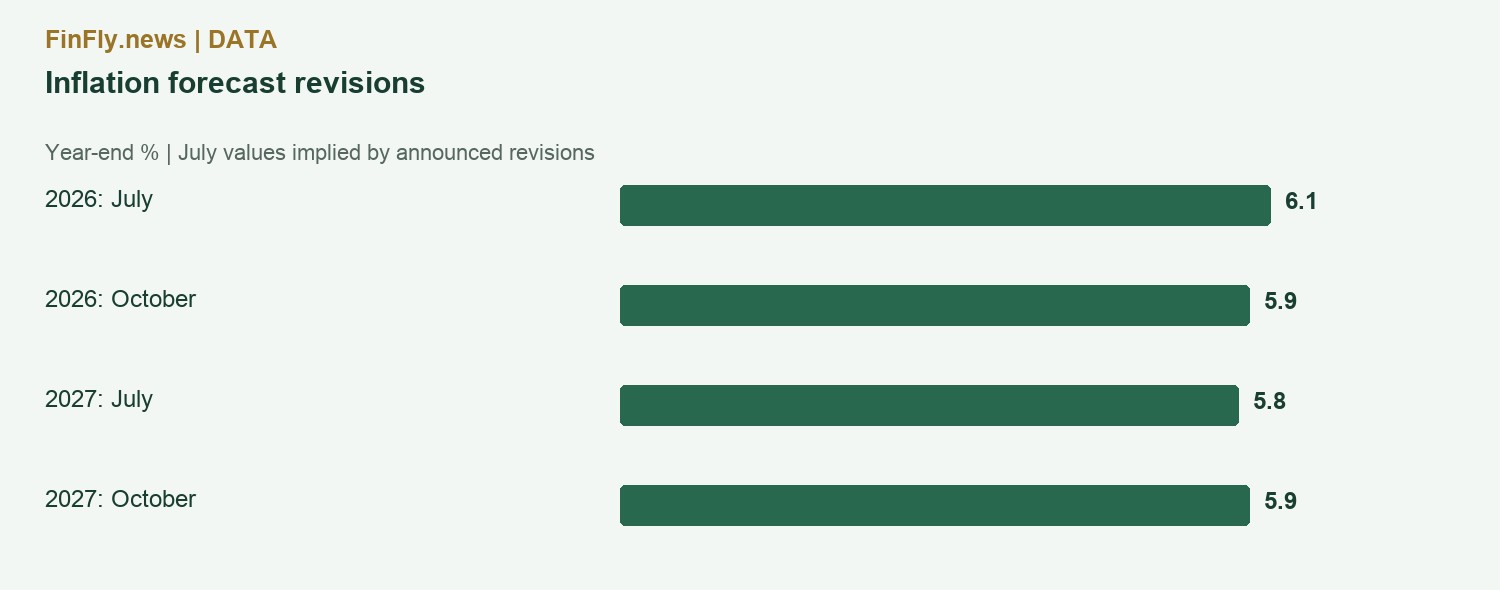
Forecast close to the upper target boundary
The CBA targets 4% inflation with a two-percentage-point tolerance on either side. A 5.9% outcome fits within the range, but only narrowly. Meeting the target in this way would not mean returning to its midpoint.
September’s 5.5% reading is below the December forecast. For households, this outlook implies continued growth in the overall price level. Even falling inflation usually means a slower rise in prices, rather than a reversal.
| Measure | 2026 | 2027 |
|---|---|---|
| July forecast | 6.1% | 5.8% |
| October forecast | 5.9% | 5.9% |
| Revision, percentage points | -0.2 | +0.1 |
Tariff assumptions and external risks
The baseline assumes unchanged government-regulated prices and tariffs. That is a modelling assumption, not a government announcement freezing tariffs. A change in those starting conditions would require the outlook to be reassessed.
The CBA identifies external risks from energy, food and transmission through trading partners. For an importer, a stable dollar exchange rate alone does not protect costs: suppliers can raise foreign-currency prices. Some room in the expense budget therefore remains valuable even when inflation stays inside the target range.
Why the two forecasts moved in opposite directions
At the 29 October press conference, Taleh Kazimov attributed the lower 2026 forecast to slower-than-expected growth in agricultural producer prices. He linked the higher 2027 projection to expected inflation in Azerbaijan’s trading partners.
The revisions therefore reflect different factors over the two horizons. More moderate agricultural prices improve the near-term outlook, while external prices continue to exert pressure on next year. Importers need to consider supplier pricing even when the exchange rate remains stable.