
Household and corporate deposits are expanding at similar rates, but they serve different purposes. Businesses keep most funds readily available, while individuals favor term deposits. For banks, these are distinct sources of funding.
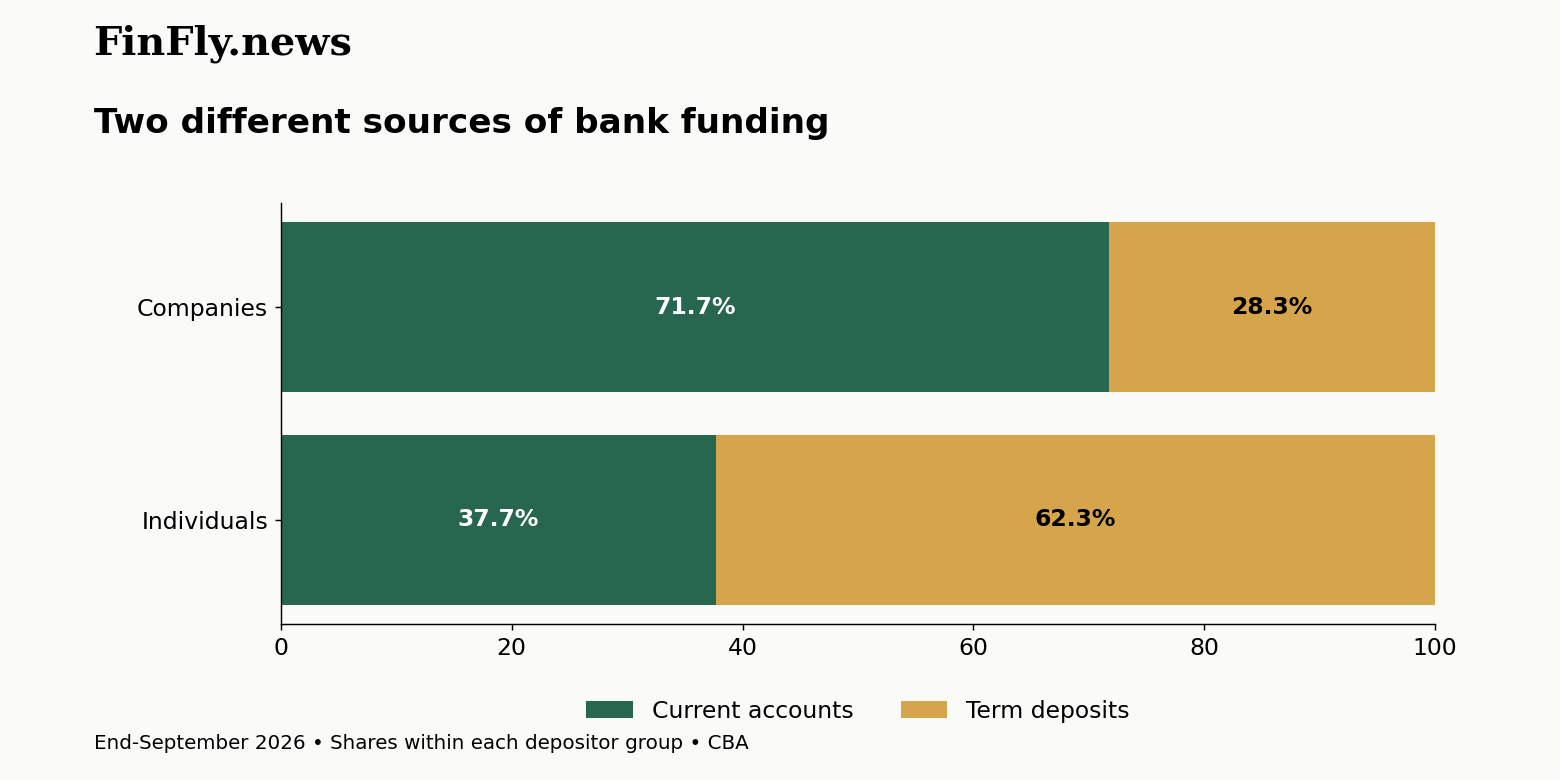
The CBA's November monetary policy review puts current accounts at 71.7% of corporate deposits at end-September, compared with 37.7% for individuals. Term deposits accounted for 28.3% and 62.3%, respectively.
Two different uses for cash
A company needs money for suppliers, payroll and taxes. Locking up its entire balance would restrict working capital. A large corporate account therefore does not automatically provide a bank with stable funding for a multiyear project.
A household may instead want to separate savings from everyday spending and earn interest. A term deposit provides an agreed framework, although early withdrawal rights and any loss of interest depend on the contract.
| End-September 2026 | Companies | Individuals |
|---|---|---|
| Deposits, AZN billion | 23.5 | 18.8 |
| Growth since year-start | 11.9% | 12.3% |
| Current accounts | 71.7% | 37.7% |
| Term deposits | 28.3% | 62.3% |
Why maturity matters
For a lender, the time funds remain available is critical. A current-account balance may leave tomorrow to settle a large invoice. Term funding provides a clearer horizon but carries an interest cost. Comparing aggregate balances alone misses that distinction.
A mismatch between asset and liability maturities requires liquidity buffers. A bank making long-term loans cannot plan depositor repayments simply on the assumption that its deposit book will keep growing. Large-client concentration, maturity dates and the persistence of daily balances all matter.
What businesses can infer
Rising cash balances do not, on their own, establish that companies have postponed investment. They may include supplier payments due shortly, seasonal receipts or funds earmarked for approved projects. Evidence of an investment pause requires cash-flow and capital-spending data.
For banks, lending capacity depends on funding maturity and cost as well as the amount raised. For companies, separating the operating reserve from genuinely available cash is a treasury decision. The composition of accounts explains why similar deposit growth does not make companies and households interchangeable sources of bank funding.