The largest profit does not necessarily identify the most efficient insurer. A useful assessment separates absolute earnings from returns on capital and examines the operations producing the result.
The table is a historical first-half 2026 snapshot based on FED.az’s compilation of disclosed results. It is not presented as a nine-month ranking or a current full-year result. Aqrar Sığorta’s result is absent from the compilation, so the missing observation must not be replaced with zero.
One period and one earnings measure
The table uses net profit or loss in manats. Premiums, investment income and pre-tax profit are not substitutes for that measure. Life and non-life insurers remain in one list to compare the absolute scale of earnings.
Business sizes differ substantially. A smaller insurer’s lower profit can represent a stronger return on invested capital than a larger profit at a market leader.
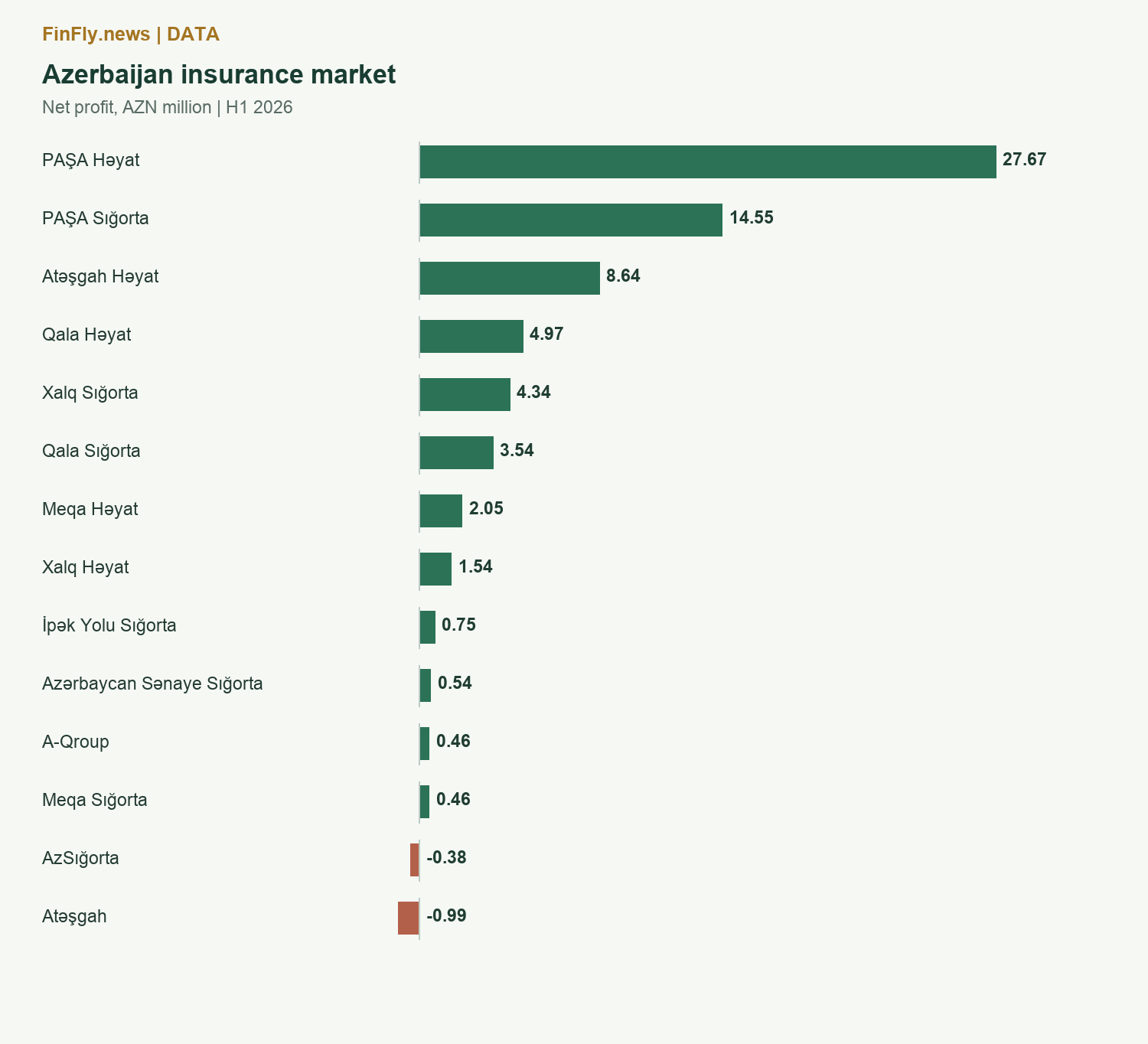
| Insurer | Net profit, AZN |
|---|---|
| PAŞA Həyat | 27 670 842 |
| PAŞA Sığorta | 14 545 934 |
| Atəşgah Həyat | 8 644 831 |
| Qala Həyat | 4 972 287 |
| Xalq Sığorta | 4 336 321 |
| Qala Sığorta | 3 538 497 |
| Meqa Həyat | 2 046 839 |
| Xalq Həyat | 1 539 604 |
| İpək Yolu Sığorta | 749 664 |
| Azərbaycan Sənaye Sığorta | 537 360 |
| A-Qroup | 458 703 |
| Meqa Sığorta | 458 505 |
| AzSığorta | -375 586 |
| Atəşgah | -994 123 |
Why this is not an efficiency ranking
Calculating return on equity requires average equity for the period, not simply its closing balance. A comparison with assets needs the same discipline. Dividing first-half profit by an arbitrarily selected balance-sheet value can materially distort the result.
Comparable treatment of reserves and investment operations also matters. A one-off revaluation or reserve release can boost profit without generating an equivalent inflow from new customers.
Losses require an explanation
A negative first-half result does not by itself establish insolvency. Its size relative to capital, whether it reflects a discrete event and whether it persists in later periods all matter.
A sequence of financial reports is more useful for assessing sustainable earnings. It shows whether profit recurs and whether capital remains adequate. This list provides a starting point for that analysis, rather than replacing an examination of individual accounts and company circumstances.