Azerbaijan’s insurance-sector assets reached AZN 2.258 billion at the end of June 2026, up AZN 123 million from end-2025. Cash and bank funds totalled AZN 839 million and government securities AZN 702 million, according to the asset breakdown in the Central Bank’s report.
Together, those categories represent approximately 68% of the balance sheet. Insurers’ financial performance therefore depends on banking conditions and government securities as well as policy sales.
Cash and bank funds are not just deposits
The broad asset breakdown records AZN 839 million in cash and bank funds. Separately, the investment-portfolio chart identifies AZN 624 million in deposits. These are different categories: treating all cash and bank funds as deposits would be incorrect.
The overall investment portfolio is approximately AZN 1.6 billion, up 9.7% from the beginning of the year. The regulator links higher deposits partly to reduced new issuance of government securities by the Finance Ministry.
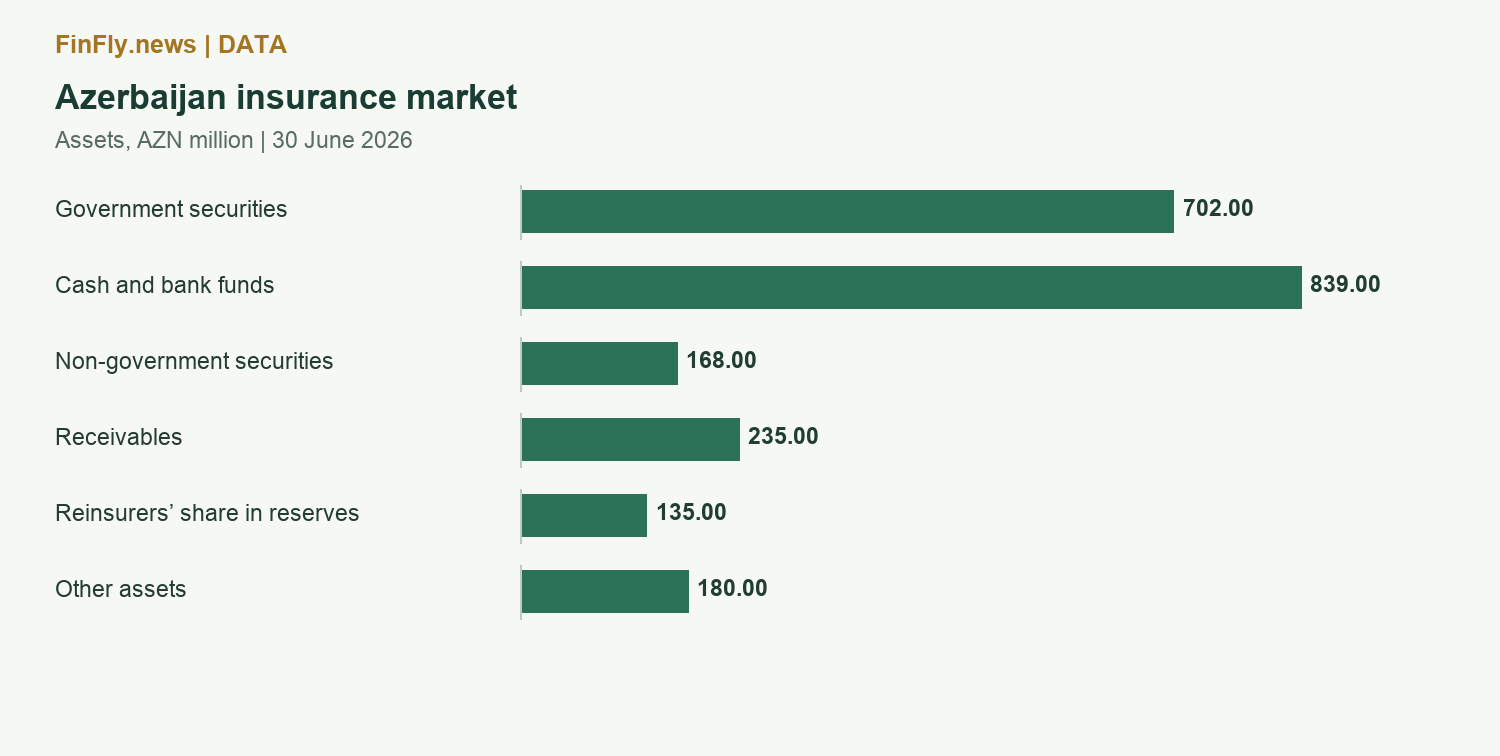
| Assets at 30 June 2026 | AZN m |
|---|---|
| Government securities | 702 |
| Cash and bank funds | 839 |
| Non-government securities | 168 |
| Receivables | 235 |
| Reinsurers’ share in reserves | 135 |
| Other assets | 180 |
Each category carries a different exposure
Government securities provide income and help manage investment maturities, but market values can change with interest rates. Bank placements create exposure to counterparties and the terms on which money can be recovered.
Receivables amount to AZN 235 million. They represent claims on other parties, rather than freely available cash. Reinsurers’ share in reserves should not be treated as immediately accessible liquidity either. Rounded table entries may differ from the total by AZN 1 million.
Matching maturities matters most
Insurance contracts create future payments, and investments need to provide funding when those payments fall due. A higher return on a long-dated asset is not necessarily preferable if obligations mature earlier.
Investments represent 76% of life insurers’ assets and 64% of non-life assets, highlighting different business models. Asset size alone is insufficient to judge financial resilience: quality, timing and the relationship with liabilities matter just as much.