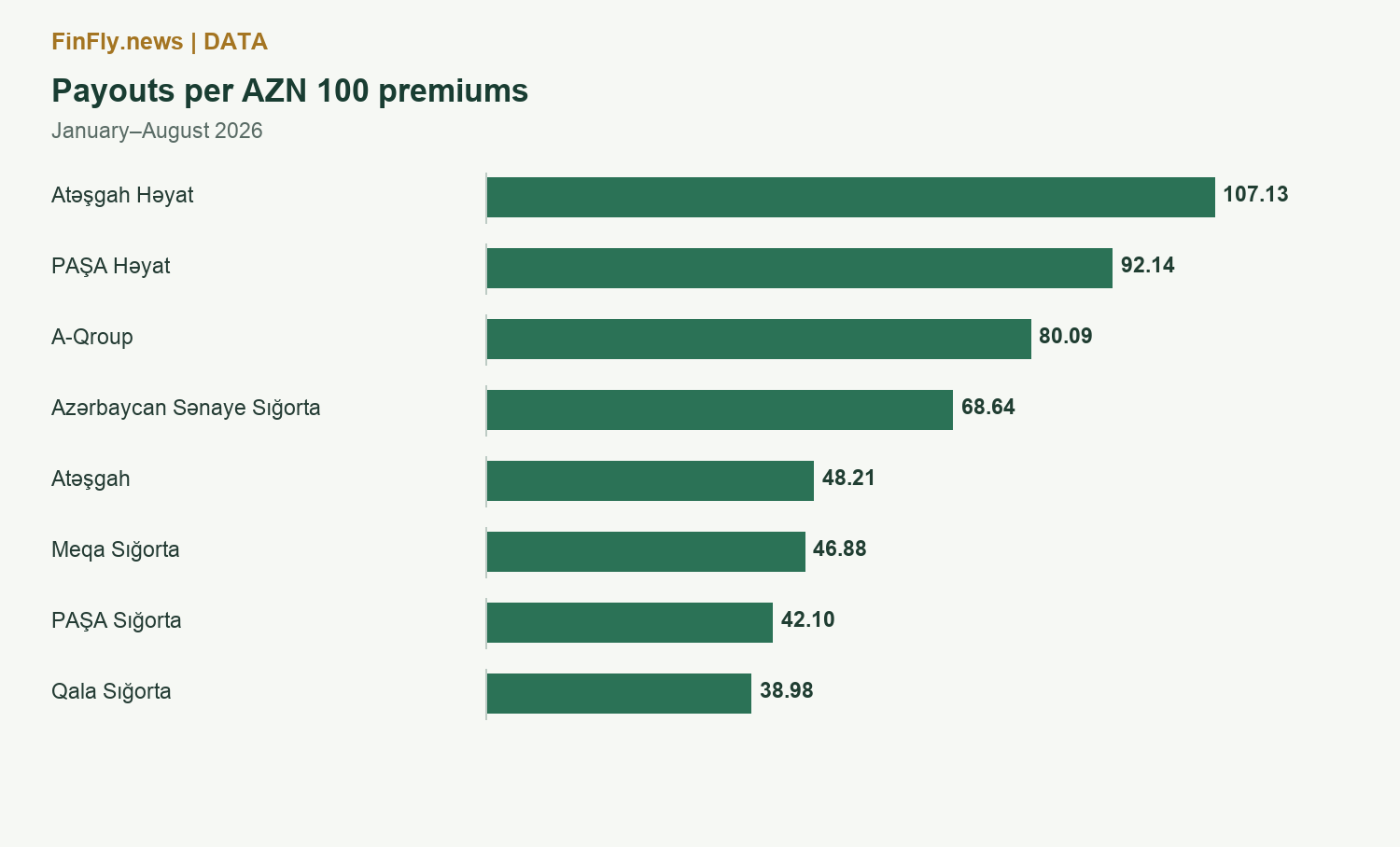
Atəşgah Həyat paid AZN 107.13 for every AZN 100 of premiums collected in January–August 2026. PAŞA Həyat’s figure was AZN 92.14 and A-Qroup’s AZN 80.09. The ratios are calculated from the Central Bank’s company premium and payout figures.
The formula divides payouts during the period by premiums during the same period and multiplies the result by 100. Its economic meaning is less straightforward: money paid today can relate to contracts whose premiums arrived several years earlier.
Above 100 does not automatically mean a loss
Payouts can exceed new premiums in savings-based life insurance when many contracts mature together. Those payments are funded by previously accumulated assets and reserves as well as current receipts.
AZN 107 paid per AZN 100 collected therefore does not automatically imply an AZN 7 loss. Determining the financial result requires earned premiums, reserve movements, investment income and expenses.
Life insurance
| Insurer | Payouts per AZN 100 premiums |
|---|---|
| Atəşgah Həyat | 107.13 |
| PAŞA Həyat | 92.14 |
| Xalq Həyat | 38.88 |
| Meqa Həyat | 21.36 |
| Qala Həyat | 18.15 |
Non-life insurance
| Insurer | Payouts per AZN 100 premiums |
|---|---|
| A-Qroup | 80.09 |
| Azərbaycan Sənaye Sığorta | 68.64 |
| Atəşgah | 48.21 |
| Meqa Sığorta | 46.88 |
| PAŞA Sığorta | 42.10 |
| Qala Sığorta | 38.98 |
| Xalq Sığorta | 35.44 |
| AzSığorta | 23.96 |
| Aqrar Sığorta | 8.79 |
| İpək Yolu Sığorta | 4.20 |
Low readings need explanation too
İpək Yolu Sığorta’s ratio was approximately AZN 4.20 and Aqrar Sığorta’s AZN 8.79. A low current payout flow does not prove either strong profitability or an unwillingness to honour obligations.
Seasonality, large insured events, settlement duration and portfolio age can all influence the reading. Insurers collecting identical premiums can face very different calendars of future payments.
Keep comparisons close to the product
The tables separate life companies from non-life companies. Even within non-life, medical, property and liability insurance differ substantially. A deeper comparison would require product-level data.
The measure is most useful as an indicator of cash-payment intensity. A substantial change is a reason to examine the portfolio, not a ready-made verdict on service quality or financial strength. Anyone selecting a policy should supplement this ranking with coverage terms and customer-service evidence.