
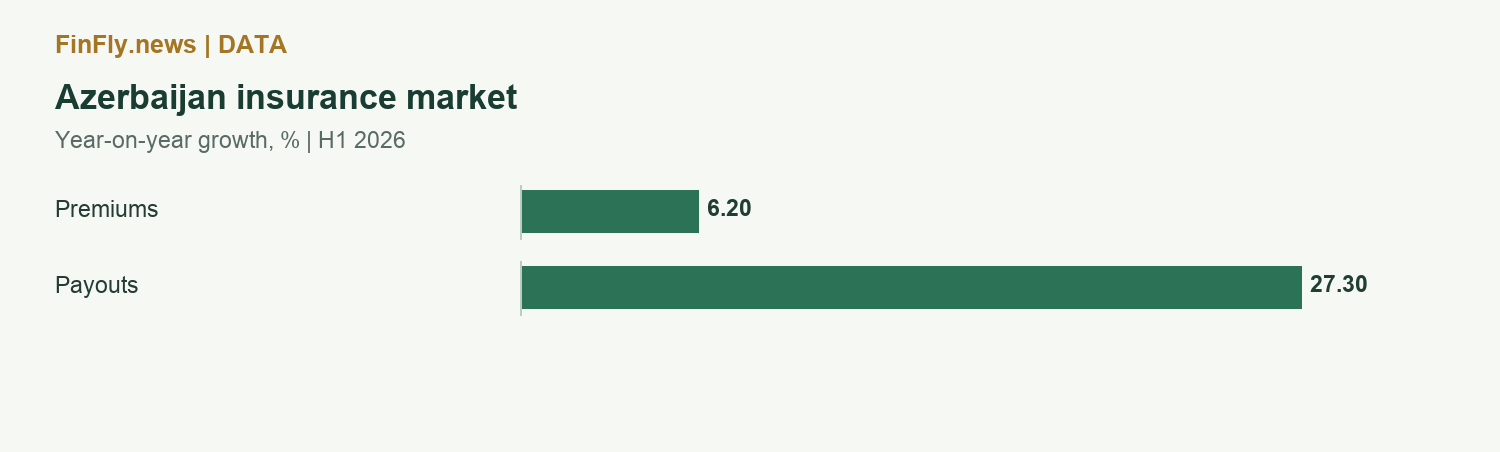
Azerbaijan’s insurers are collecting more premiums, but money paid to customers is rising considerably faster. Premiums reached AZN 867 million in January–June 2026, up 6.2% year on year. Payouts climbed 27.3% to AZN 550 million, according to the Central Bank’s first-half financial stability report.
The growth gap is 21.1 percentage points. Expanding sales alone is therefore not enough: insurers must also arrange funding for obligations falling due. Rising payouts, however, do not automatically mean that the underlying risk portfolio has deteriorated.
Life insurance accounts for most of the increase
Life insurers paid AZN 402 million, almost three quarters of the total, with payouts growing 32.5%. Non-life payouts reached AZN 148 million, up 14.5%. In life insurance, customers also receive money when savings contracts mature. Those payments cannot all be interpreted as losses arising from insured events.
The report excludes insurers with revoked licences from its payout measure. Its figures should not be mechanically combined with statistical tables that include settlements by former insurers.
| Measure | H1 2026, AZN m | YoY growth |
|---|---|---|
| Premiums | 867 | 6.2% |
| Payouts | 550 | 27.3% |
| Life payouts | 402 | 32.5% |
| Non-life payouts | 148 | 14.5% |
Cash flow matters as much as sales
First-half payouts were equivalent to approximately 63.4% of premiums. This compares two cash-flow measures; it is not an actuarial loss ratio. It does not adjust for earned premiums, movements in reserves or operating expenses. The same percentage can mean different things for insurers with different contract durations.
A practical question is whether investment maturities match payments owed to customers. If funds are locked up for longer, even a profitable insurer may need to sell assets to meet obligations. Premium growth should therefore be read alongside reserves and liquidity.
Profit remains positive, but funding deserves attention
The Central Bank puts first-half sector net profit at AZN 90 million. Faster payouts have therefore coexisted with a positive financial result. The more demanding scenario is a combination of large maturities on older contracts, more expensive insured events and slower new business. That combination, rather than a single growth rate, reveals the pressure on an insurer’s business model.